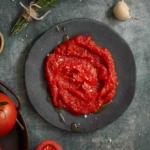

Homemade Tomato Paste
Making tomato paste at home is surprisingly easy and a great way to use up lots of fresh tomatoes. All you need are tomatoes, salt, olive oil, a food mill, and a flair for classic Italian goodness.
Equipment
- 1-pint canning jar
- Silicone baking sheet or parchment
Ingredients
- 10 pounds very ripe plum or regular tomatoes, cored, halved, or quartered if large.
- 1 to 2 tablespoons Diamond kosher salt, depending on personal preference (see chart above)
- extra-virgin olive oil
Instructions
- Scoop out the seeds from the 10 pounds very ripe plum or regular tomatoes with your fingers.
- Dump the tomatoes in a wide 8-quart stainless steel or enamel pot and bring to a roiling boil, stirring occasionally, until the tomatoes release their juices, soften, about 30 minutes.
- Place a food mill fitted with a fine disk over a large bowl and mill the tomatoes to remove the skins and any MIA seeds.
- Pour the tomato purée back into the same pot and bring it back to a boil over high heat. Lower the heat to medium-ish, and simmer, stirring frequently, until the purée has reduced to about 1 quart (946 ml), 45 to 90 minutes depending on the type and water content of your tomatoes.
- Stir in the 1 to 2 tablespoons Diamond kosher salt, a teaspoon at a time, and taste. Don't exceed 2 tablespoons. (That's a lot!)
- Preheat the oven to 200ºF (93ºC). If you have convection, now's the time to use it. Position a rack in the center.
- Line an 18-by-13-inch rimmed baking sheet with a silicone baking sheet or parchment. Spread the thickened tomato purée in an even layer with a spoon or spatula. It should cover the entire baking sheet.
☞ TESTER TIP: If you have a coated or nonstick pan, you can slick the pan with some extra-virgin olive oil rather than using the baking sheet.
- Slide the baking sheet into the oven and roast for 30 minutes.
- Remove the sheet and stir the purée with the spatula. Respread the purée into a rectangle about 1/8 inch thick. Mop up any bits of paste from around the rectangle with a damp paper towel.
☞ TESTER TIP:
Be maniacal about spreading the paste to an even thickness. Thin spots can burn, causing a bitter flavor. - Slide the baking sheet back into the oven and continue roasting until the tomato purée is quite thick, stiff, and a little sticky, about 3 more hours, stirring and respreading the purée every 20 minutes. Taste and, if desired, add more salt.
- Let the paste cool to room temperature.
- Spoon the paste into a clean canning jar, pressing it down to remove air pockets, which can spoil the paste. Level the surface with the back of the spoon. Cover the surface with 1/2 inch olive oil so that the paste is submerged. Screw the lid on the jar and refrigerate. The tomato paste will keep in the fridge for up to a month or frozen for up to a year.
Notes
- Open wide—Using a wide, shallow pot allows the tomato puree to reduce more quickly.
- Keep the paste submerged—Each time you scoop out some tomato paste from the jar, level the surface of the paste and top it with more oil so the remaining tomato paste is completely submerged.
- Freeze the extra—To keep homemade tomato paste longer than a month, either fill an ice cube tray or scoop 1-tablespoon mounds of paste onto a parchment-lined tray and freeze until firm. Then pop the cubes or mounds into a zip-top bag and store them in the deepest part of the freezer.
Variations
Spicy VersionAdd 1 to 2 teaspoons of crushed red pepper flakes when adding the salt. Infused Garlic Version
Add 6 to 8 chopped fresh garlic cloves to the pot along with the tomatoes in step 2.
Nutrition
Serving: 1tablespoon | Calories: 29kcal | Carbohydrates: 6g | Protein: 1g | Fat: 1g | Saturated Fat: 1g | Monounsaturated Fat: 1g | Sodium: 225mg | Fiber: 2g | Sugar: 4g