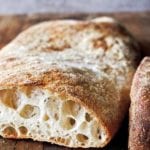

Ciabatta
This ciabatta recipe for traditional Italian bread is made the authentic way with a biga, or starter, and turns out a loaf that's incredible on its own or in a sandwich.
Equipment
- 2 baking stones
Ingredients
- 1 teaspoon active dry yeast
- 5 tablespoons (2 1/2 ounces) warm milk
- 1 cup plus 3 tablespoons (9 1/2 ounces) water, at room temperature (if using a food processor, use cold water)
- 1 tablespoon (1/2 ounce) olive oil, plus more for the bowl
- 2 very full cups (17 1/2 ounces) biga, rested for 12 hours
- 3 3/4 cups (17 1/2 ounces) unbleached all-purpose flour, plus more for the work surface
- 1 tablespoon (1/2 ounce) salt
- cornmeal
Instructions
- Stir the 1 teaspoon active dry yeast into the 5 tablespoons (2 1/2 ounces) warm milk in the bowl of a stand mixer. Let stand until creamy, about 10 minutes.
- Add the 1 cup plus 3 tablespoons (9 1/2 ounces) water, 1 tablespoon (1/2 ounce) olive oil, and 2 very full cups (17 1/2 ounces) biga (be sure to weigh the biga, don't just measure it by volume) and mix with the paddle until blended.
- Mix the 3 3/4 cups (17 1/2 ounces) unbleached all-purpose flour (be sure to weigh the flour, don't just measure it by volume) and 1 tablespoon (1/2 ounce) salt, add to the bowl, and mix for 2 to 3 minutes. Change to the dough hook and knead for 2 minutes at low speed, then 2 minutes at medium speed. The dough will be very sticky.
- Knead briefly on a well-floured surface, adding as little flour as possible, until the dough is still sticky but beginning to show evidence of being velvety, supple, springy, and moist. (If the dough seems almost impossibly sticky to work with, reread the headnote above from author Carol Field.)
- Place the dough in an oiled bowl, cover with plastic wrap, and let rise at room temperature until doubled, about 1 1/4 hours. The dough should be full of air bubbles, supple, elastic, and sticky.
- Turn the dough onto a generously floured surface and cut it into 4 equal portions. Roll each portion into a cylinder, then stretch each cylinder into a rectangle about 10 by 4 inches, pulling with your fingers to get each portion of dough long and wide enough.
- Generously flour 4 pieces of parchment paper placed on peels or upside-down baking sheets. Place each loaf, seam side up, on a piece of parchment. Dimple the loaves vigorously with your fingertips or knuckles so that they won’t rise too much. The dough will look heavily pockmarked, but it is very resilient, so don’t be concerned.
- Cover the loaves loosely with damp towels and let rise until puffy but not doubled in size, 1 1/2 to 2 hours. The loaves will look flat and definitely unpromising, but rest assured that they will rise more in the oven.
- About 30 minutes before baking, preheat the oven to 425°F (220°C) and slide 2 baking stones on the center rack to heat.
☞ TESTER TIP: If, like us, you haven’t yet bought yourself a baking stone, flip some large cast-iron skillets upside down and bake the bread on their bottoms. It ought to do the trick. It has for us.
- Just before baking the bread, sprinkle the stones with cornmeal. Carefully invert each loaf onto a stone. If the dough sticks a bit to the parchment, just gently work it free from the paper. If you need to, you can leave the paper on and remove it 10 minutes into baking.
- Bake the ciabatta for a total of 20 to 25 minutes, spraying the oven 3 times with water in the first 10 minutes. The loaves are done when an instant-read thermometer reads 205°F (96°C) to 210°F (99°C). Transfer the loaves to wire racks to cool.
Notes
Tips for Handling Ciabatta Dough
Before you make this authentic ciabatta recipe, understand that the dough can be tricky to handle correctly. It’s wet. Incredibly wet. It will stick to your hands. It will stick to your work surface. It will stick to everything it comes in contact with. That’s okay. Don’t add extra flour or you’ll get disappointing results. Just rest assured that, as you make the dough again and again, you’ll become practiced in how to handle it. Here, a few tips. Weigh the ingredients. If you pack flour into the measuring cup, it will come out weighing substantially more than what you expect or that the recipe intends. If you must measure it by volume, first pour it into a bowl, stir it to aerate it, and then scoop it into the measuring cup. [Editor’s Note: We understand that the weight-to-volume equivalents in the recipe below are off-kilter compared to what most of us home bakers are accustomed to using. We took these measures directly from the book in which this recipe was printed because they’re the author’s intended cup measures when you use her pour, stir, and scoop method we just outlined.] Have a bowl of water nearby when you’re shaping the dough. Wet dough won’t stick to wet hands, so dip your hands in the water before you scoop up the dough. You can also dip your dough scraper into the water and then use it to cut the dough into 4 portions. Wet your hands before you roll the dough into a cylinder so it won’t stick as much. And then, with those wet hands, pull it into the rectangular shape. Do NOT worry if the loaves look flat and unpromising. Here’s what Field has to say on the topic. “Trust me when I say they will rise on the floured pieces of parchment paper, even though they certainly don’t look as if they will. Let them rise until they’re puffy but not doubled. They still won’t look as if they will be anything you could believe in. If the thought of turning the little loaves over onto the baking stone is too daunting, you can put them still on their parchment paper straight onto the stone without turning them over. You’ll miss the veining of flour that makes the loaves look so attractive, but you might gain confidence this time and then be bold enough to try turning them over the next time.” This recipe should ideally be made in a stand mixer. It can be made in a food processor. And while folks have made it by hand, it’s not recommended. (The natural inclination while kneading it is to add lots of flour to the very sticky dough, and pretty soon you won’t have ciabatta.) So just follow the instructions below. The dough will feel utterly unfamiliar and probably a bit scary. And that’s not the only unusual feature: the shaped loaves are flat and look definitely unpromising. Even when they are puffed after the second rise, you may feel certain you’ve done it all wrong. Don’t give up. The bread rises nicely in the oven. Follow the recipe. It’s written by a baker with untold experience baking bread and seeing home cooks through the inevitable learning curve that comes with handling Italian bread dough, which is much different and wetter to work with than the standard American bread dough. Trust us. When you heed her words, you’ll make it through this recipe with ease and grace—or as close to grace as you can manage when you’ve got flour smudged on your nose and bread dough clinging to your fingers. We also suggest you take a look at the comments beneath the recipe from others who, like you, were curious about trying their hand at this bread so you can learn from their collective experience, tactics, and techniques.Nutrition
Serving: 1slice | Calories: 86kcal | Carbohydrates: 17g | Protein: 2g | Fat: 1g | Saturated Fat: 1g | Monounsaturated Fat: 1g | Cholesterol: 1mg | Sodium: 145mg | Fiber: 1g | Sugar: 1g