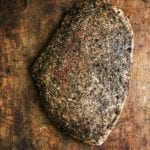

Homemade Guanciale
This homemade guanciale, made with pork jowl, seasoning, and white wine, is easier than you may think. Here's how to make it.
Equipment
- Kitchen scale; kitchen twine or meat hook
Ingredients
- 1 good quality hog jowl, glands removed, trimmed of excess fat and meat (have the butcher do this for you!); about 2.2 pounds (1 kg) after trimming
- About 1 tablespoon plus 1 1/4 teaspoons fine sea salt
- About 1 scant teaspoon pink curing salt,, such as Prague powder #2
- 3 cloves garlic, minced
- 4 tablespoons coarsely ground black pepper
- 1 teaspoon dried crushed rosemary
- 1 teaspoon dried crushed sage
- 1 1/2 cups dry white wine, such as Sauvignon Blanc or Pinot Grigio
Instructions
- Wear clean gloves while handling the pork.* Pat the trimmed jowl completely dry and place it on a cutting board.
- You’ll want to measure the amount of salt you use. It will be approximately 1 tablespoon of both sea and pink salt but the precise amounts for curing depend on the exact weight of the jowl. You want the weight of the sea salt to be 3 percent the weight of the trimmed meat. And you want the weight of the pink salt to be 0.25 percent the weight of the trimmed meat.
- In a bowl, combine the sea salt, pink salt, garlic, pepper, rosemary, and sage and mix well. Sprinkle the cure all over the meat and rub it in well to coat all sides.
- Place the pork in a resealable plastic freezer bag. Scoop up any stray rub and add it to the bag. Squeeze out the air and seal. Place the bag in a baking dish and refrigerate for 1 week. Turn the bag once a day and give the pork a little massage through the plastic each time you turn it.
- After 1 week, remove the sealed bag from the baking dish. Pour the wine into the baking dish. Wearing gloves, remove the pork jowl from the bag and use your (gloved) fingers to brush off as much brine as you can. Immerse the pork in the wine to dislodge more brine; then transfer it to a clean cutting board.
- Use a sharp paring knife to cut a hole in one corner of the jowl about 1 inch from the edge. Thread a length of kitchen twine through the hole and knot it where it meets the pork. Tie the ends together tightly to create a long loop for hanging. Alternatively, if you have a sterilized meat hook, this can be used in place of the twine.
- Weigh the meat and note the weight. If using a meat hook, note the weight of it as well.
- If you have a curing space, hang the guanciale in in it. This is ideally a dark space that’s 41 to 43°F (5 to 6°C). Weigh the guanciale every 7 to 10 days until it’s lost 20 to 30 percent of its weight, which could take anywhere from 2 to 4 weeks.If you don’t have a separate curing space, place the guanciale on a rack set inside a shallow pan in the refrigerator and let it cure, uncovered, until it’s lost 20 to 30 percent of its weight, which could take anywhere from 1 to 2 weeks. Turn the guanciale over every few days to ensure that all sides are exposed to air.
☞ TESTER TIP: You can slow the drying process and allow even more flavor to develop by placing a container of a simple saltwater brine beneath the meat.
- To store the guanciale, cut it into 4- or 8-ounce (113- or 227-g) pieces and vacuum-seal it or wrap it tightly in plastic wrap and seal in a resealable plastic bag. Store in the freezer for up to several months. Once opened, store the guanciale in plastic wrap in the refrigerator for up to 1 week.
Notes
How To Ensure Your Homemade Guanciale Is Safe To Eat
We can’t emphasize enough the need to precisely adhere to the instructions in this recipe. This applies to everything—the weights of the salt in proportion to the pork, the wearing of gloves, and the temperature of the environment in which you keep the pork. Preserving food is an age-old technique yet it also relies on a healthy respect for precision and science in order to do so safely.Nutrition
Serving: 1portion | Calories: 272kcal | Carbohydrates: 3g | Protein: 17g | Fat: 22g | Saturated Fat: 9g | Monounsaturated Fat: 10g | Trans Fat: 0.04g | Cholesterol: 67mg | Sodium: 1084mg | Fiber: 1g | Sugar: 0.4g