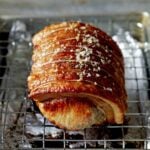

Pork Loin Roast
This pork loin roast calls for boneless pork loin, olive oil, salt, and pepper to be slow roasted. Four ingredients. It's incredibly easy to make. No fuss. And it makes the one of best roast pork I've ever had.
Equipment
- Kitchen string
Ingredients
- One (2-pound) boneless pork loin roast with a fat cap, or covered with pork belly and, if possible, with skin still attached--tied with string
- 1 to 2 teaspoons olive oil
- Coarse sea or kosher salt and freshly ground black pepper
Instructions
- Preheat the oven to 475°F (250°C). Line a rimmed baking sheet or shallow roasting pan with foil.
- Pat the pork with paper towels until completely dry. If your pork loin has skin attached, using a sharp knife, score the skin by making deep, long, parallel cuts, 1/8 to 1/4 inch apart, in the fat, being careful not to cut through to the underlying pork.
- Rub the pork all over with the oil and then sprinkle the top with a generous amount of salt and pepper.
- Place the pork on a wire rack, skin or fat side up, and place the whole shebang on the baking sheet or in the roasting pan. Roast for 25 minutes. (The initial high temperature promotes crisp crackling, which is the skin.)
- Reduce the oven temperature to 350°F (180°C) and roast until cooked through, 40 to 45 minutes longer, rotating the pan once halfway through to ensure even cooking. The meat should be slightly pink in the middle. If you have a meat thermometer, it should read 145°F (63°C). You may need to adjust the cooking time, depending on the weight of the pork roast. Rest assured, the pork will continue to cook slightly after it's removed from the oven.
☞ TESTER TIP: A basic guide when cooking a pork roast is to allow 22 minutes per pound for medium done. If you like your pork more well-done, cook it for 27 minutes per pound.
- Place the pork roast on a warm platter and let it rest in a warm place for 10 to 20 minutes before carving. Don’t cover the roast as any steam coming from the resting pork will soften the skin, which will have crisped into "cracklings." And you don't want to lose that!
☞ TESTER TIP: If you're the sort who prefers extra-crisp cracklings, while the pork roast is cooling, remove the entire portion of skin from the pork loin, cover the pork loin with foil, and place the skin on the baking sheet or the roasting pan and either crank the oven to 425°F (220°C) and give the cracklings a quick blast under your broiler while the pork rests.
- To carve the pork roast, remove the skin, if you haven’t already done so, and cut the crisp pork skin into strips. Carve the pork roast across the grain into slices, arrange them on a platter, and there you go.
Notes
- Create a fat cap—If you can't get pork loin with a thick fat cap attached (and they are difficult to find), have your butcher tie a layer of pork belly onto the roast.
- Internal temperature—The internal temperature of your pork will continue to rise after removing it from the oven, so if you prefer a little pink inside, remove it when the internal temperature is around 140°F.
- Storage—Leftover pork can be stored in a sealed container in the fridge for up to 3 days.
- Reheat—Don't reheat leftovers in the microwave; it'll toughen the meat. Wrap them in foil and pop them into a 300°F (150°C) oven until heated through.
- Dietary—This recipe is suitable for gluten-free and dairy-free diets.
Nutrition
Serving: 1portion | Calories: 308kcal | Protein: 51g | Fat: 10g | Saturated Fat: 3g | Monounsaturated Fat: 4g | Cholesterol: 143mg | Sodium: 111mg