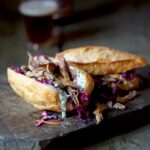

Pulled Pork Sandwiches
As American as apple pie—and, if hashtags can be trusted, far trendier. It’s not hard to understand why. Knee-wobblingly tender and rich pulled pork collide with cool, crisp, tangy coleslaw to terrific effect.
Equipment
- marinade injector
Ingredients
For the marinade
- 3 garlic cloves
- One (1- to 2-inch) piece fresh ginger, peeled
- 1 cup apple cider
- 1/4 cup cider vinegar
- 1 teaspoon Tabasco sauce
- 2 tablespoons Worcestershire sauce
- 3 tablespoons soy sauce
- 1 teaspoon freshly grated nutmeg
- 1 teaspoon ground cinnamon
For the rub
- 2 tablespoons cayenne pepper
- 2 tablespoons sweet paprika
- 2 tablespoons dark brown sugar
- 2 tablespoons fine sea salt
For the pulled pork
- One (5 1/2-lb) bone-in pork shoulder
For the coleslaw
- 1 to 2 tablespoons cumin seeds (optional)
- 2 teaspoons granulated sugar
- 2 teaspoons salt
- 2 tablespoons red or white wine vinegar
- 1/2 head green or red cabbage, finely shredded
- 1 carrot, peeled and julienned
- 2 small red bell peppers, seeded and finely chopped (optional)
For the cilantro mayonnaise
- 1 large egg yolk, at room temperature
- 1 3/4 teaspoons fresh lemon juice
- 1/2 teaspoon salt
- 1/4 teaspoon freshly ground black pepper
- 1 cup mild olive oil or vegetable oil
- 2 to 4 tablespoons chopped fresh cilantro, or more to taste
For serving
- 8 to 12 rolls, partially split lengthwise
Instructions
Make the marinade
- Using a fine grater held over a bowl, grate the garlic and ginger into a pulp. Add the cider, vinegar, Tabasco sauce, Worcestershire sauce, soy sauce, nutmeg, and cinnamon and stir to combine. Transfer the marinade to your marinade injector and inject it into the pork.
Make the rub
- In a small bowl, combine the cayenne, paprika, brown sugar, and salt.
Cook the pulled pork
- Rub the pork evenly on all sides with the spice rub. Don’t worry if some of the marinade spills out of the pork where you injected it. Place the pork in a large resealable plastic bag, seal it, place it in a small roasting pan, and refrigerate overnight.
- If you're using a grill or smoker: Preheat your grill or smoker to 200°F (100°C). Prepare the grill for indirect cooking by turning off one or more burners on a gas grill or piling your charcoal on one side of your grill or in the attached smoke box on a smoker. Place an aluminum pan containing maybe an inch of water on the unlit side of the grill and place the pork on the grill rack above the pan. Close the lid and cook, basting the pork occasionally with the drippings collected in the pan, until the temperature of the meat hovers around 175°F (70°C), about 6 to 12 hours, depending on the exact size of your pork and the temperature of your grill. Wrap the meat in a couple layers of heavy-duty aluminum foil, return it to the grill, and cook until the temperature rises to at least 190°F (80°C) and preferably 200°F (93°C). If needed, raise the temperature of the grill to 285°F (140°C). Remove the pork from the grill and let it rest for 1 hour before carefully unwrapping the foil. If you're using a big green egg: Preheat your EGG to 200°F (100°C). Carefully build the fire, placing large pieces of natural lump charcoal underneath the fire box up to the rim. Make sure the vents are not blocked. Allow the fire to burn for at least 7 hours before grilling. Set up the EGG for indirect cooking. Place the convEGGtor, with the legs facing up, in the EGG. Pour a small amount of water into the roasting and drip pan, then place the roasting and drip pan on the convEGGtor. Use the juices and fat drippings that collect in the roasting and drip pan to baste the pork occasionally as it cooks. Place the cooking grid on the convEGGtor. Insert the meat thermometer into the pork away from the bone, place the pork on the cooking grid, and close the lid of the EGG. After 6 hours, the temperature of the meat should hover around 175°F (70°C). Wrap the meat in a couple layers of heavy-duty aluminum foil, return it to the grid, close the lid of the EGG, and cook until the temperature rises to at least 190°F (80°C) and preferably 200°F (93°C). If needed, raise the temperature of the EGG to 285°F (140°C). Remove the pork from the EGG and let it rest for 1 hour before carefully unwrapping the foil. If you’re using an oven: Preheat your oven to 250°F (121°C). Place a wire rack in a roasting pan. Place your pork, fatty side up, on the rack in the roasting pan. Roast the pork, uncovered, until the exterior of the pork butt is crisp and dry—this is what’s referred to as “bark” in smoking circles. This will take 4 to 8 hours, depending on your oven and the size of your pork butt. [Editor’s Note: For us, this happened when the pork butt reached an internal temperature of approximately 170°F (77°C), but the internal temperature is less important than the undeniable presence of the bark. If you don’t let the bark fully develop, the finished pork will be soggy on the outside, not crisp.] Carefully wrap the pork butt in a couple layers heavy-duty aluminum foil and return the pork butt to the wire rack in the roasting pan. Continue to roast until the pork reaches an internal temperature of at least 190°F (88°C) and preferably 200°F (93°C). Remove the pork from the oven and let it rest for 1 hour before carefully unwrapping the foil.
- Using 2 forks, pull the pork off the bone in shreds.
Make the coleslaw
- If using the cumin seeds, place a small dry skillet over medium heat, toss in the cumin seeds, and toast, shaking the skillet often, until fragrant, about 1 1/2 minutes. Pour the seeds onto a small plate and let cool.
- In a large bowl, combine the granulated sugar, salt, and vinegar and stir until the sugar and salt dissolve. Add the cabbage, carrot, and bell peppers and toss to coat evenly. Add the cumin seeds, if using, and toss to mix.
Make the cilantro mayonnaise
- In a blender, combine the egg yolks, lemon juice, and a pinch each of salt and pepper and process on low speed until well blended. [lc-note]If your blender has a wide base or struggles with small quantities, consider doubling the recipe or using an immersion blender to help the emulsion start.[/lc-note]With the blender still running, gradually add the oil in a very, very slow stream and process until the mixture is thick and smooth. Once an emulsion has formed, you can begin to add the oil a little more quickly.
- Dump the mayonnaise into a small bowl and stir in the cilantro. (This makes quite a lot of mayo, but that's okay because it’s spectacular slathered on so many things—including grilled fish or chicken, corn on the cob, and so, so much more. You can store the leftover mayo in a tightly covered container in the refrigerator for up to 1 week.)
To assemble the pulled pork sandwiches
- Spread the cut sides of each roll with some cilantro mayo. Add a generous spoonful or so of coleslaw to each roll and top generously with pulled pork.
Nutrition
Serving: 1sandwich | Calories: 497kcal | Carbohydrates: 50g | Protein: 8g | Fat: 31g | Saturated Fat: 4g | Monounsaturated Fat: 20g | Cholesterol: 23mg | Sodium: 3075mg | Fiber: 4g | Sugar: 15g