Order Notes on a Banana from your favorite bookstore.
Read reviews and press | Book club guide
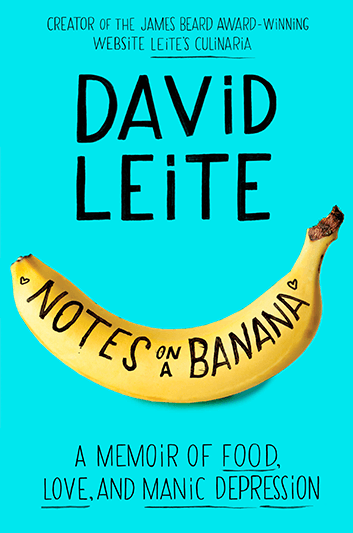
Description of the Book
The stunning and long-awaited memoir from the beloved founder of the James Beard Award-winning website Leite’s Culinaria—a candid, courageous, and at times laugh-out-loud funny story of family, food, mental illness, and sexual identity.
Born into a family of Azorean immigrants, David Leite grew up in the 1960s in a devoutly Catholic, blue-collar, food-crazed Portuguese home in Fall River, Massachusetts. A clever and determined dreamer with a vivid imagination and a flair for the dramatic, “Banana” as his mother endearingly called him, yearned to live in a middle-class house with a swinging kitchen door just like the ones on television, and fell in love with everything French, thanks to his Portuguese and French-Canadian godmother. But David also struggled with the emotional devastation of manic depression. Until he was diagnosed in his mid-thirties, David found relief from his wild mood swings in learning about food, watching Julia Child, and cooking for others.
Notes on a Banana is his heartfelt, unflinchingly honest, yet tender memoir of growing up, accepting himself, and turning his love of food into an award-winning career. Reminiscing about the people and events that shaped him, David looks back at the highs and lows of his life: from his rejection of being gay and his attempt to “turn straight” through Aesthetic Realism, a cult in downtown Manhattan, to becoming a writer, cookbook author, and web publisher, to his twenty-four-year relationship with Alan, known to millions of David’s readers as “The One,” which began with (what else?) food. Throughout the journey, David returns to his stoves and tables, and those of his family, as a way of grounding himself.
A blend of Kay Redfield Jamison’s An Unquiet Mind, the food memoirs by Ruth Reichl, Anthony Bourdain, and Gabrielle Hamilton, and the character-rich storytelling of Augusten Burroughs, David Sedaris, and Jenny Lawson, Notes on a Banana is a feast that dazzles, delights, and, ultimately, heals.
Media Inquiries
Sharyn Rosenblum
Dey Street Books
Sharyn.Rosenblum [at] harpercollins [dot] com






P.S. From supposition I believe the white pill is Lamictal.
Ah, no. That caused too many cardiac side effects.
Would you be able to divulge the names of the pink and white pills mentioned in your book and what medications finally helped you. I don’t know if there would be liability for you, and surely it would not be the right regimen for all with bipolar 2, but doing so might help some with bipolar 2 shorten their struggle to find medication that helps them function better. Doing so may also suggest a reasonable medication trial for psychopharmacologists to try with their patients. I have suffered with bipolar 2 since medical school, and I am now disabled at age 63 due to the disease. I am still unable to find the apparent correct medication or medication combination, having endured many medication side effects, repeatedly stopping my medications due to side effects, and even endured memory sapping shock therapy. I hope you will be able to tell what works for you. If you can’t release the information publicly, I hope you will email it to me.
Thank you and stay well.
Richard, sure, I can. But as you say, there is no right medication protocol for everyone. And I am in no way suggesting you take these; they just help me. (And not always…) The pink pill is Depakote, the white is Neurontin. It was Neurontin that really put me on the right track.
Dear Mr Leite, I just finished your incredible memoir. I couldn’t put it down- not only was your story interesting and engaging, you also write so very beautifully. I believe your book will help, in some way or another, all who read it. Thank you –Allison
allison, thank you so much for your kind message. I’m pleased you enjoyed the book, and I, too, hope it will help others–especially those who can’t put words to what they’re feeling and experiencing.