


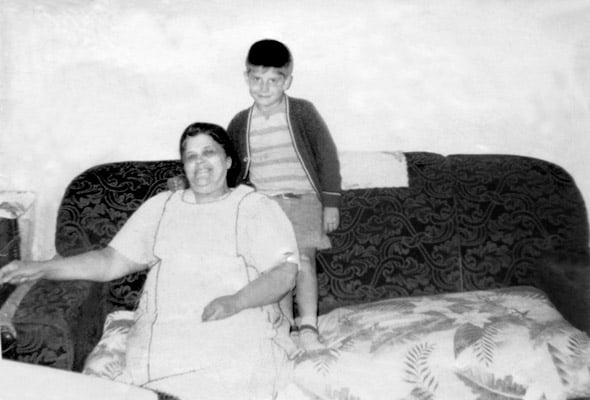
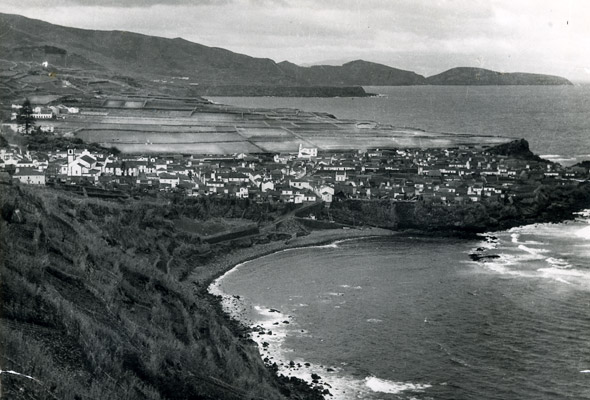
Little did I realize that I lost more than my grandmother, VoVo Costa, when she passed away. Gone, too, were recipes for many of her famous dishes. Sadly, she never wrote them down because, like most Portuguese women of her generation on the island of São Miguel (one of the nine Azorean islands off the coast of Portugal where my family’s from), she was never taught to read or write. And although everyone in the family has their own version of VoVo’s classics, they’re merely that. To this day no one can match her Sopa de Galinha (chicken soup) or her often-copied Recheio com chouriço (spicy sausage stuffing), which were always the highlights of Sunday dinner.
Clearly, something had to be done. So I approached my mother and aunts with a sheepish grin on my face and a video camera in my hand. My goal: to film family favorites being prepared before they too were lost. I wanted a permanent record of the food that filled three tables every Sunday when we laughed and talked (which to other families sounded like fighting), and my mother and aunts buzzed about happily shoveling their specialties onto our plates.
While they were eager to squeeze their way into the viewfinder, capturing their culinary heirlooms proved daunting. For example, there must have been a shortage of measuring cups and spoons in the Azores, because my mother and aunts cook only with pinches of this and handfuls of that. I had to yell “CUT!” more times than I care to recall to fish out a mound of parsley from boiling broth or catch a fistful of garlic midair in order to measure it properly.
Vocabulary proved another sticking point. While the National Live Stock and Meat Board categorizes beef into no fewer than 45 different cuts, it’s all just “meat” to my mother. Any further questioning was met with a shrug of her shoulders and — as if I were asking about sex — the admonition to discuss it with my father. In her intuitive, cookbook-free world, there were no fancy names or elaborate techniques. You simply rolled up your sleeves and began chopping.
But over time the recipes, as well as forgotten bits of family history, revealed themselves. I remembered summer days spent shucking fava beans with VoVo in her kitchen. And even though she sat there in just her slip plonking beans into a big white washtub at her feet, she looked like an empress. I joked with my mother about the ridiculous amount of food she makes every October for family and friends who help my father harvest his grapes for wine. Believe it or not, I even developed an appreciation, but certainly not a taste, for my Aunt Irene’s octopus stew.
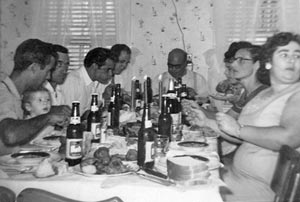
I came to accept that our food defines us, whether we’re sitting at the kitchen table or not. Simply put, we are a family of immigrants — something I denied as a teenager by idolizing Big Macs and the Colonel’s original recipe. Anything to deep-six the Portuguese part of my Portuguese-American heritage.
Well, not any longer. My first visit to the Azores is scheduled for next fall. To prepare, I’m learning Portuguese, much to the hilarity of everyone. But most important, whenever I crave a taste of home, I just pop a cassette into the VCR and follow along with my mother and aunts — to me, the best collection of chefs on TV.











I recently turned a friend on to store-bought linguiça, which, of course, he thought it was longanisa, no one Spanish, one Portuguese. I decided I would search for a recipe for homemade linguiça, so first place I went was here. I ran across this article, which is such a lovely tribute to your yaya and mother and aunts, Sunday dinners and family. It was so touching, that I am going to suggest that my brother and I start this one meal a week tradition ASAP.
Thank you for another wonderful read!
Kelly, you are more than welcome. And thank you for your kind words.
I have been married to a Portuguese man from Terceira, in the Azores for 11 years. I enjoy learning to cook some of his traditional dishes from his childhood in Portugal. He has been here in Canada for 19 years since he was 19 years old and I hope that my cooking some of his traditional foods help him be a little less homesick. We have one daughter, 7 years old, and we are hoping to take a trip to Portugal soon and introduce her to her Portuguese heritage! Thank you for the recipes on here!
Penny, my pleasure. Trekker is a pretty island. My dad was stationed thee during his military duty. I return to the Azores next week, in fact, on a National Geographic Expedition as the food expert. I simply can’t wait!
OMG, David! You never cease to amaze me with your wonderfully written tales! As someone above said, this brought me right back to a wonderful time in my own childhood with Vovós and family! Isn’t it a shame the families today have no clue what they are missing out on with the fast food industry and the hurry-it-up attitude! Thank you so much for sharing this with us! God bless you and your family…they did a fantastic job raising you!
Thank you, Barbara. It is indeed wonderful to have grown up in such a family environment. And it is a shame kids today know so little about their heritage. I’m very happy to be a first-and-a-half-generation Portuguese. It kept me close to my roots.