
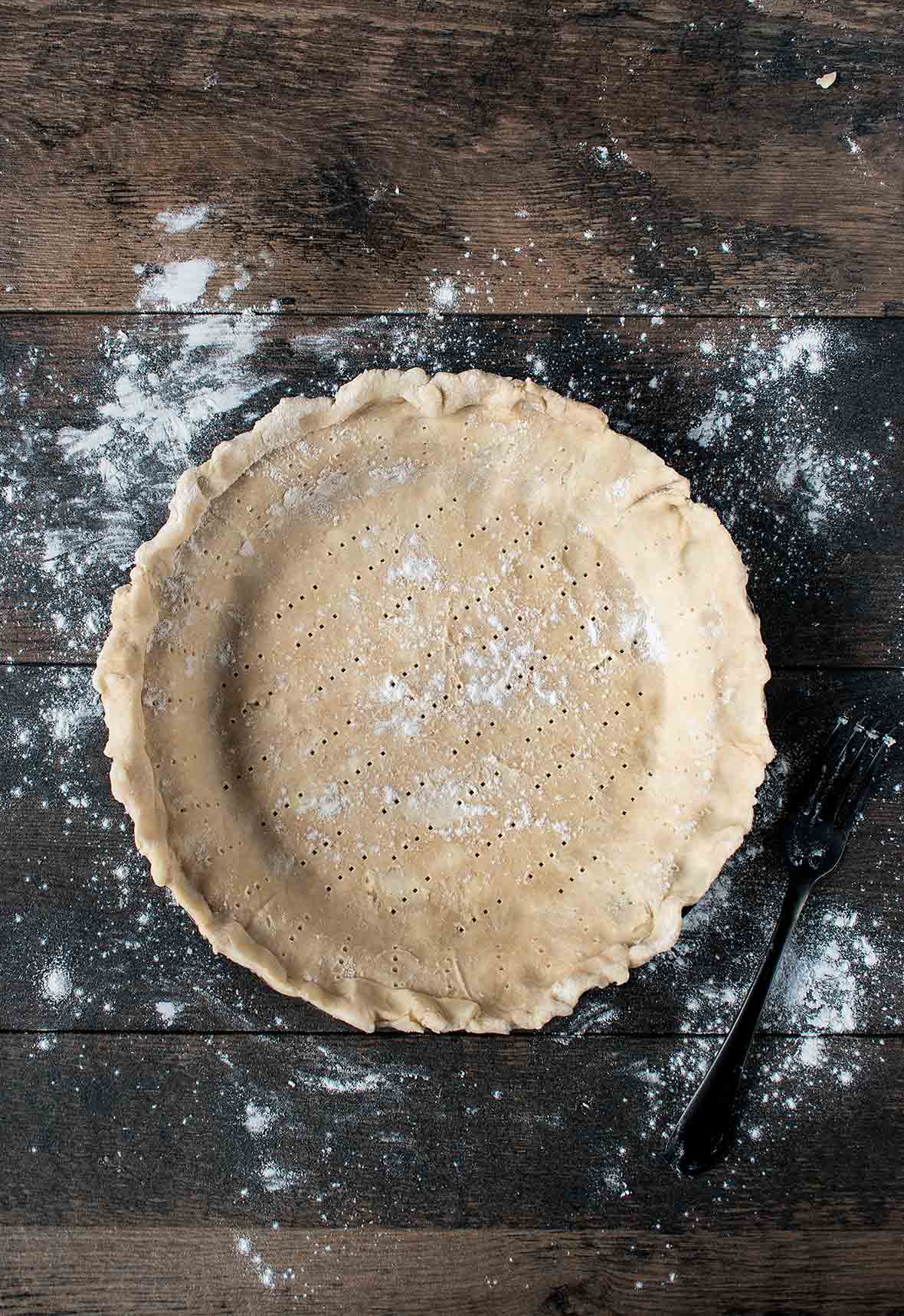

Lard and Butter Pie Crust
This lard and butter pie crust is the flaky, tender, flavorful piecrust you’ve longed for but may not have had the nerve to make.
Ingredients
- 2 1/2 cups all-purpose flour, stashed in the freezer until cold
- 1 teaspoon salt
- 2 tablespoons granulated sugar
- 13 tablespoons (6 1/2 oz) cold unsalted butter, cut into 1/2-inch (12-mm) cubes
- 8 tablespoons (4 oz) cold lard, cut into 1/2-inch (12-mm) cubes
- 4 to 6 tablespoons ice water
Instructions
- In a food processor fitted with metal blade, combine the flour, salt, and sugar.
- Toss in the butter cubes and process with five 1-second pulses.
- Toss the cold lard into the processor and continue pulsing until the butter is no larger than the size of peas and the flour is pale yellow and resembles coarse cornmeal, about four 1-second pulses. Dump the flour mixture into a medium bowl.
- Sprinkle 3 tablespoons of ice water over the flour mixture. Working quickly, use a fork to fluff and mix thoroughly. Squeeze a handful of dough—if it doesn’t stick together, add the remaining water, 1 tablespoon at a time.
- Handling the dough as little as possible, divide it into 2 balls, one slightly larger than the other. Flatten each portion of dough into 6-inch discs. Wrap in plastic wrap and refrigerate for 30 minutes.
- On a lightly floured work surface, roll each portion of dough to slightly larger than your pie plate. Carefully drape the slightly smaller portion of dough in the plate. If desired, prick the bottom crust with the tines of a fork, if desired.
- Fill with your favorite pie filling recipe, top with the remaining portion of dough and crimp the edges. Trim any excess dough that hangs over the edge. Freeze the unbaked pie for up to several weeks or transfer it to the fridge for at least 30 minutes before baking according to your recipe. Originally published January 9, 2002.

Nutrition
Serving: 1 portionCalories: 214 kcalCarbohydrates: 22 gProtein: 3 gFat: 13 gSaturated Fat: 8 gMonounsaturated Fat: 3 gTrans Fat: 1 gCholesterol: 33 mgSodium: 305 mgFiber: 1 gSugar: 2 g
Nutrition information is automatically calculated, so should only be used as an approximation.
Tried this recipe?Mention @leitesculinaria or tag #leitesculinaria!

Recipe © 2002 Cook’s Illustrated. Photo © 2019 Lynne Ann Mitchell. All rights reserved.
Recipe Testers’ Reviews
Did you know only 68% of the recipes we test make it onto the site? This recipe survived our rigorous blind testing process by multiple home cooks. It earned the Leite’s Culinaria stamp of approval—and the testers’ reviews below prove it.

This was one of the best pie crusts I’ve ever tasted. It was also one of the easiest to make. With this recipe in your arsenal, you’ll always get great compliments on your pies.










I was recently gifted some bear tallow by friends who know my love of pie baking. I usually make all-butter crusts and laminate the dough a couple of times (so the end result is sort of a rough puff pastry). Will this recipe hold up to at least one round of folding? I would love to share a pie with my friends using their tallow!
Mika, my, what thoughtful friends you have.
I had to go hunting (no pun intended) on my friend Hank Shaw’s site—Hunter, Angler, Gardener, Cook—for this one.
So, short answer: yes, and yes. Bear fat behaves like lard—soft, mild, and it bakes up beautifully flaky. And this crust is already butter-forward, 13 tablespoons of butter to 8 of lard, so the butter is carrying the structure. Hank bakes bear-fat biscuits, and people are laminating it into croissants, so your rough puff should be fine. Just keep everything wicked cold and work fast, since bear fat is softer than pork lard. Freeze your cubes before you cut them in and give the dough a solid rest between turns.
Report back. And take pictures.