
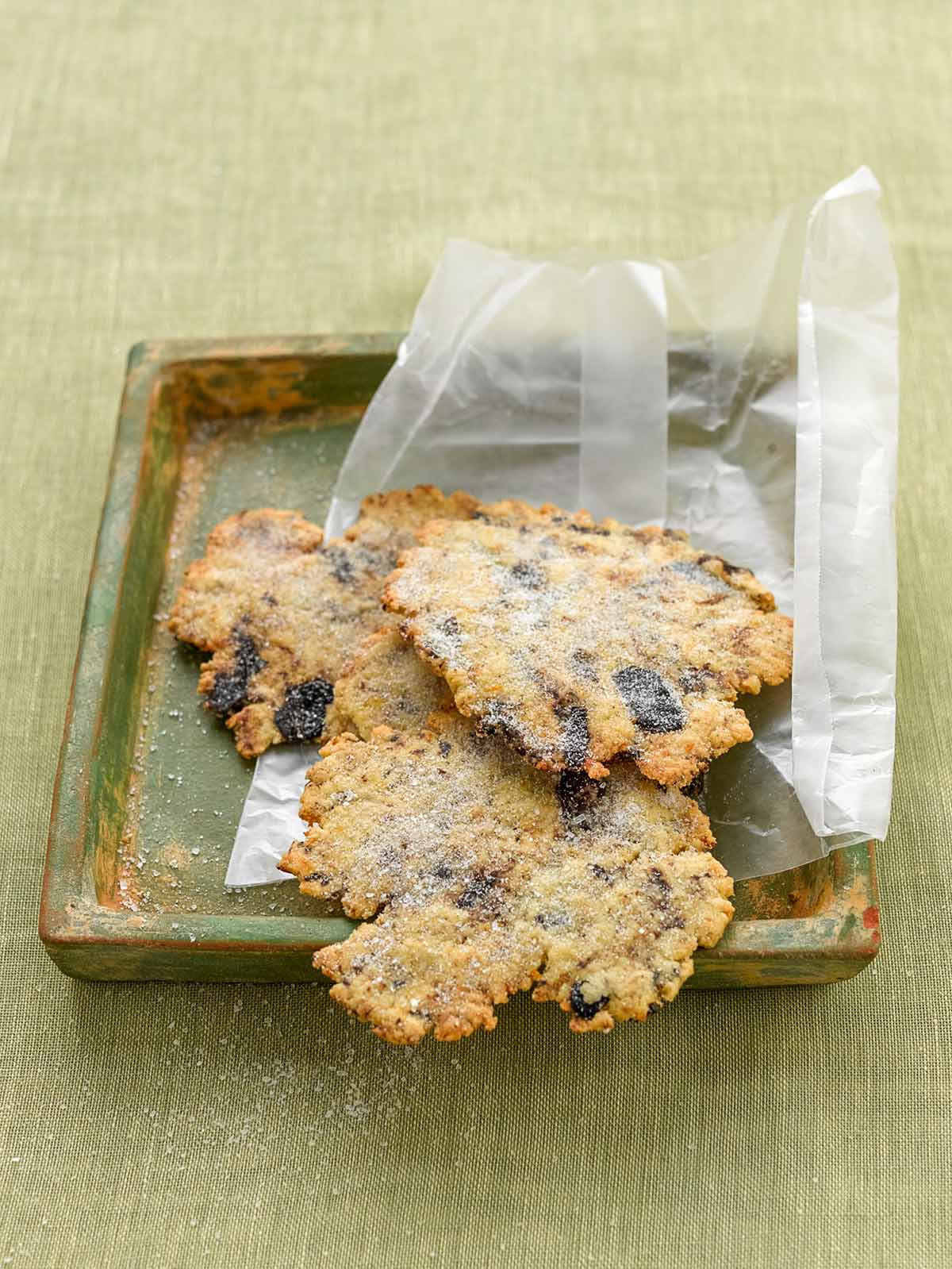
Cookies aren’t exactly a specialty of the Portuguese. Traditionally, they tend to be crumbly and plain, more like dunking biscuits.
One day at a dinner party, though, I had a sweet, thin cookie with a distinctive snap. I immediately made copious notes in my little black book, nibbling one cookie after the next so as to discern their many nuances. The only thing is, I never asked the hostess for the recipe.
Want to Save This?
I spent months trying to come up with a cookie that matched hers, and finally, I think I’ve done her proud. But I ratcheted up the recipe, adding two iconic Portuguese flavors to the mix: olive and lemon.
Serve these cookies alone, as an accompaniment to tea, or, my favorite, as a crunchy little something alongside a scoop of vanilla ice cream or lemon sorbet.
Portuguese Sweet Lemon-Olive Cookie
Ingredients
- 1 1/2 cups all-purpose flour
- 1/2 cup oil-cured black olives, rinsed quickly if particularly salty, pitted, and coarsely chopped
- 1/4 cup granulated sugar, plus more for coating
- 1/4 teaspoon baking powder
- 2 tablespoons grated lemon zest, preferably organic
- 1/8 teaspoon ground cinnamon
- Pinch of kosher salt
- 1/4 cup extra-virgin olive oil
- 1 large egg, beaten
Instructions
- Position a rack in the upper third of the oven and crank up the heat to 375°F (190°C). Cut 3 pieces of parchment paper cut to fit your baking sheet.
- Stir together the flour, olives, sugar, baking powder, lemon zest, cinnamon, and salt in a medium bowl. Whisk together the oil and egg, pour the mixture into the dry ingredients, and mix with your hands until the dough no longer looks dry and holds together when squeezed, 1 to 2 minutes.
- Fill a small bowl with sugar and set nearby. Pinch off 1 rounded tablespoon (about 1 ounce) of dough, roll it into a ball, and coat it well with sugar. Place the parchment paper on your work surface and place the dough ball near one corner of the parchment. Place another piece of parchment on top and, using a rolling pin, roll the ball into a 3 1/2- to 4-inch circle that’s a scant 1/16 inch thick. The edges of the cookie will be ragged; that’s how it should be. Repeat with 4 or 5 more wafers on the same sheet. Lift off the top sheet of parchment and slip the parchment with the cookies onto the baking sheet.
- Bake until the lemon-olive cookies are edged with brown and pebbled on top, 10 to 12 minutes. Slide the parchment onto a wire cooling rack. Repeat with the remaining dough, using a new piece of parchment for each. Once cooled, the cookies will keep in an airtight container for several days, but I doubt they’ll stick around that long.

Nutrition
Nutrition information is automatically calculated, so should only be used as an approximation.










I have made these cookies numerous times now, and love them. When I serve them, people tend to be apprehensive but end wanting more. I had some dough left over and baked them last night before dinner. My housemate did not think he would like them but finished the entire tray of six! I don’t mind pitting the olives, but I hate zesting the lemons. Does anyone have a great tip?
Sharon, so good to hear! As to zesting, do you use a Microplane? So easy.