
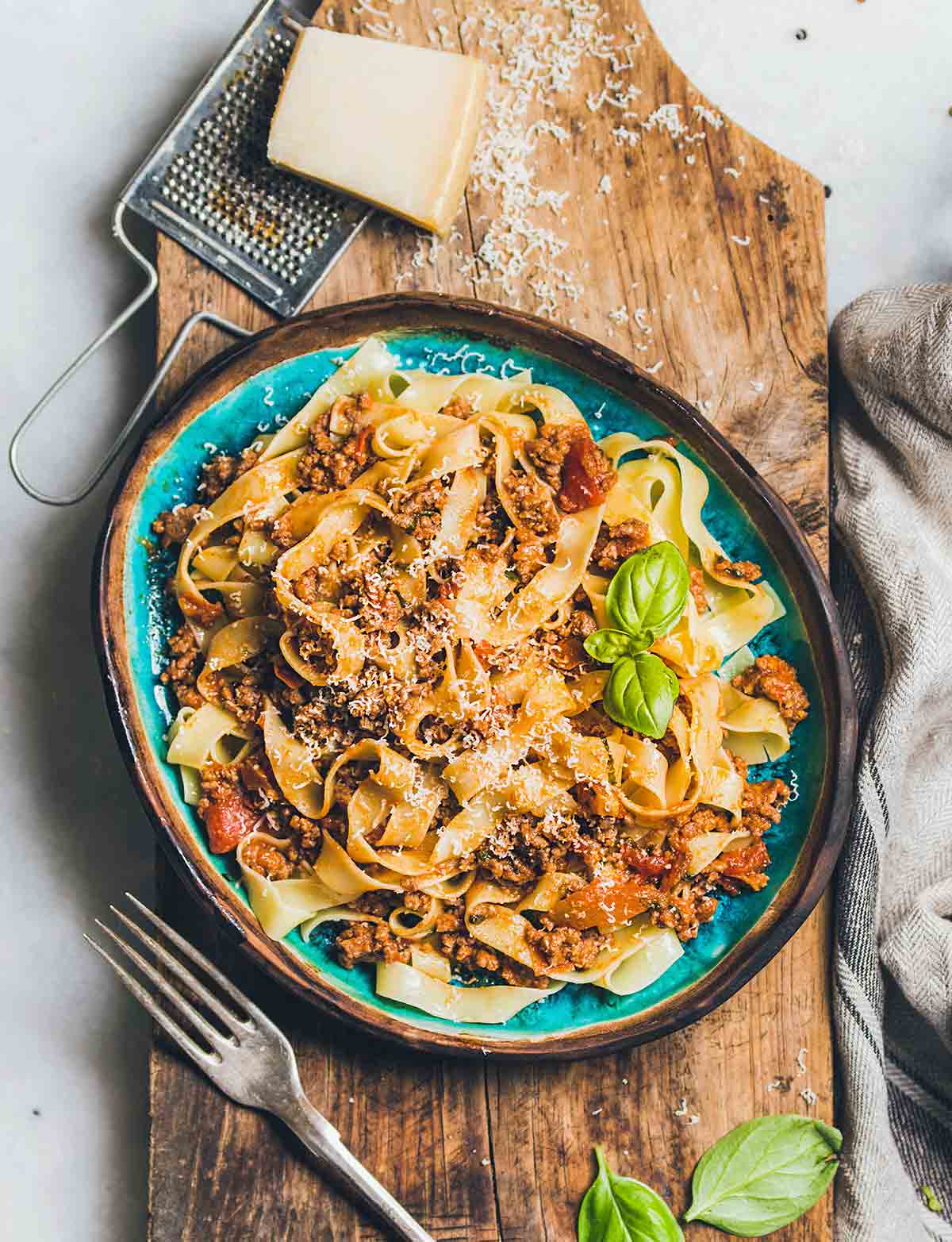
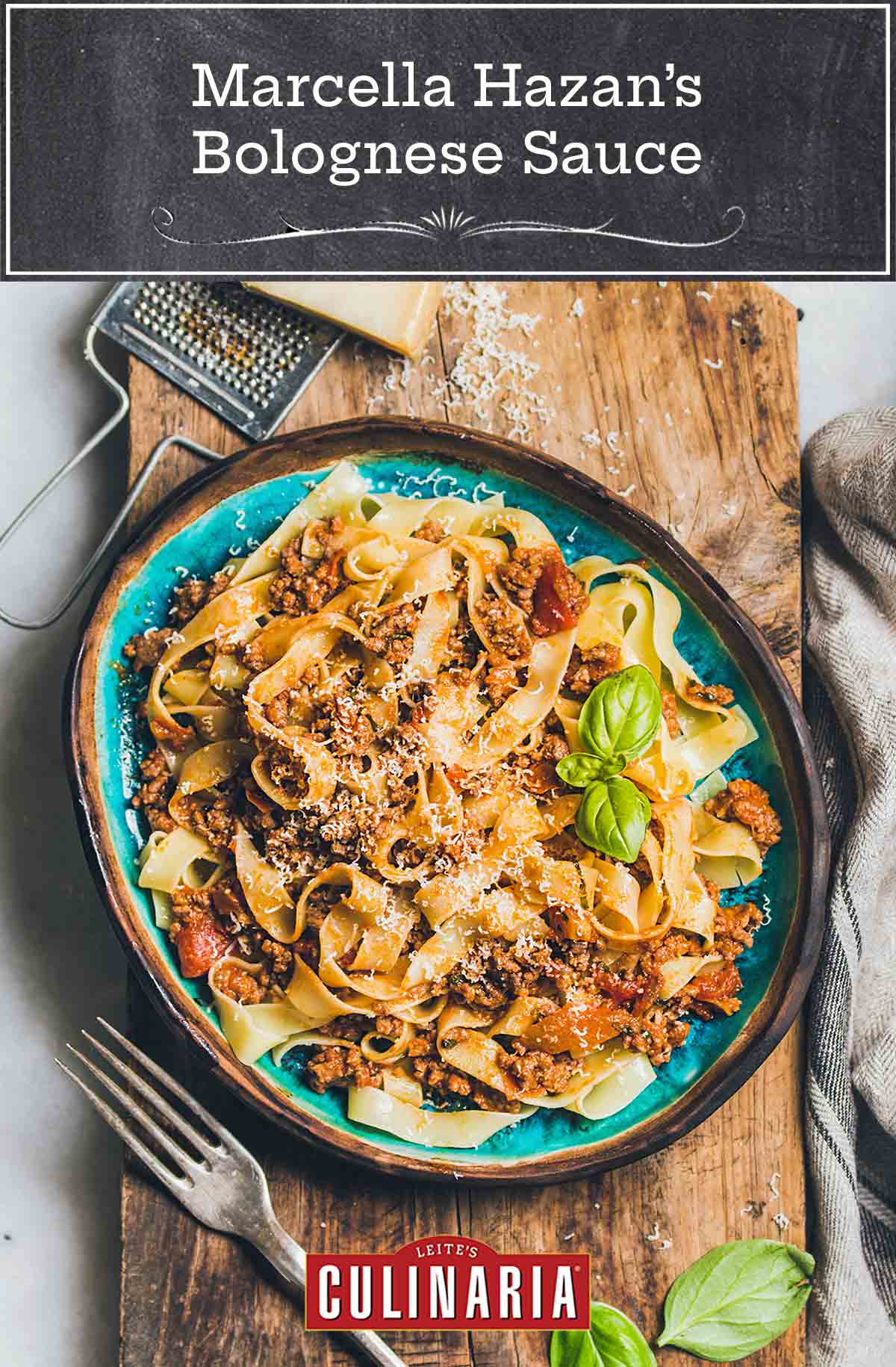
Marcella Hazan, in her inimitable fashion, offers the home cook an authentic Bolognese sauce recipe, the traditional kind an Italian grandmother would approve of, thank you very much.
This is my version of her recipe, found in her cookbook, Essentials of Classic Italian Cooking, with very subtle tweaks. It takes a while to make, although most of the time the Bolognese is spent simmering, unattended, on the back burner except for occasionally making lazy eights with a wooden spoon.
☞ Read the Article: In Defense of Grandmother Cooking
Bolognese Sauce FAQs
In essence, Bolognese sauce is spaghetti sauce. Though it’s no ordinary meat sauce. It’s a long, slowly simmered sauce that’s richer and creamier than your everyday marinara due to the inclusion of milk. It also is less predominated by tomatoes than your typical marinara. It’s named for its city of origin, Bologna.
Believe it or not, traditional Bolognese contains none of the aromatic herbs or spices that many consider necessary in all Italian dishes. You may be tempted to add them, but do your best to resist. The nutmeg is a must – don’t leave that out.
Marcella Hazan’s Bolognese Sauce
Ingredients
- 2 tablespoons vegetable oil
- 8 tablespoons (4 oz) unsalted butter, divided
- 1 cup chopped onion
- 1 1/3 cups chopped celery
- 1 1/3 cups chopped carrot
- 1 pound ground chuck, (I used 1/2 pound chuck and 1/2 pound veal)
- 1/2 pound ground pork
- Kosher salt and freshly ground black pepper
- 2 cups whole milk
- 1/8 teaspoon freshly grated nutmeg, or a pinch of ground nutmeg
- 2 cups dry white wine
- 3 cups canned imported San Marzano tomatoes, (Italian plum tomatoes) with their juice
- As much pasta as you wish (Marcella prefers tagliatelle), cooked and drained
- Freshly grated Parmigiano-Reggiano cheese, at the table
Instructions
- In a heavy 5-quart Dutch oven over medium heat, warm the oil and 6 tablespoons butter until the butter melts and stops foaming. Toss in the onion and cook, stirring frequently, until the onion is softened and translucent, about ⏲ 5 minutes.
- Toss in the celery and carrot and cook, stirring to coat them with the oil and butter, for ⏲ 2 minutes.
- Add the chuck and pork, a very healthy pinch of salt, and a goodly amount of pepper. Crumble the meat with a wooden spoon and cook, stirring occasionally, until the meats have just lost their raw-red color.
- Reduce the heat to low. Pour in the milk and simmer gently, stirring frequently, until the liquid has completely evaporated, ⏲ about 1 hour.
- Stir in the nutmeg. Pour in the wine and gently simmer, stirring frequently, until it's evaporated, about ⏲ 1 1/4 hours more.
- Add the crushed tomatoes and stir well. When the sauce begins to bubble, turn down the heat so that the sauce cooks at the laziest of simmers with just an intermittent bubble breaking the surface.
- Cook, uncovered, for ⏲ 3 hours or more, stirring from time to time. While the sauce is burbling away, there's a chance that it'll start drying out. To keep the sauce from sticking to the bottom of the pot and scorching, add 1/2 cup water if necessary, just know that it's crucial that by the time the sauce has finished simmering, the water should be completely evaporated, and the fat should separate from the sauce.
- Taste a spoonful—or two—of sauce and season with salt and some good grindings of pepper to taste. Add the remaining 2 tablespoons butter to the hot pasta and toss with the sauce. Serve with freshly grated Parmigiano-Reggiano on the side.
Notes
What You Need To Know About Making The Most Classic Italian Bolognese
Following are some techniques and tricks to ensure the most classic Italian Bolognese:- The more marbled the meat, the sweeter the ragu. (The most desirable cut of meat is the neck portion of the chuck. You may have to special order it from your butcher.)
- It’s important to salt the meat as soon as it hits the pan. This draws out the juices and imparts flavor to the Bolognese.
- Use a heavy pot that will retain heat. I use my Le Creuset 5-quart Dutch oven. Avoid using cast-iron, as the acid can interact with the metal and turn the sauce a blech color.
Nutrition
Nutrition information is automatically calculated, so should only be used as an approximation.
Recipe Testers’ Reviews

This is the perfect recipe to make if you’re stuck in the house doing chores and can’t leave. A little prep work and a little stir every now and then gives you a wonderful smell throughout your house and a nice, thick sauce for your pasta. I love that there isn’t a strong tomato taste to this sauce, unlike most commercial jar sauces. This is pure, hearty, stick-to-your-ribs comfort food.
All you need is some warm bread and you have a meal. The next time I make it I’ll probably omit the oil, as I felt there was a little too much oil floating on top when it was ready to serve.










Looks amazing….can I substitute a spicy ground sausage for the chuck?
Maggie, you sure can. I won’t be a Bolognese sauce, but I’m sure it’ll be delicious nonetheless!
I have one question. It says add meat, cook, add milk and then simmer for an hour until all the liquid is gone. Are we expected to simmer away all the fat from the ground meat?
Al, no there will be some fat remaining, but the milk should all gone. The milk acts like a tenderizer. Hope this helps!