
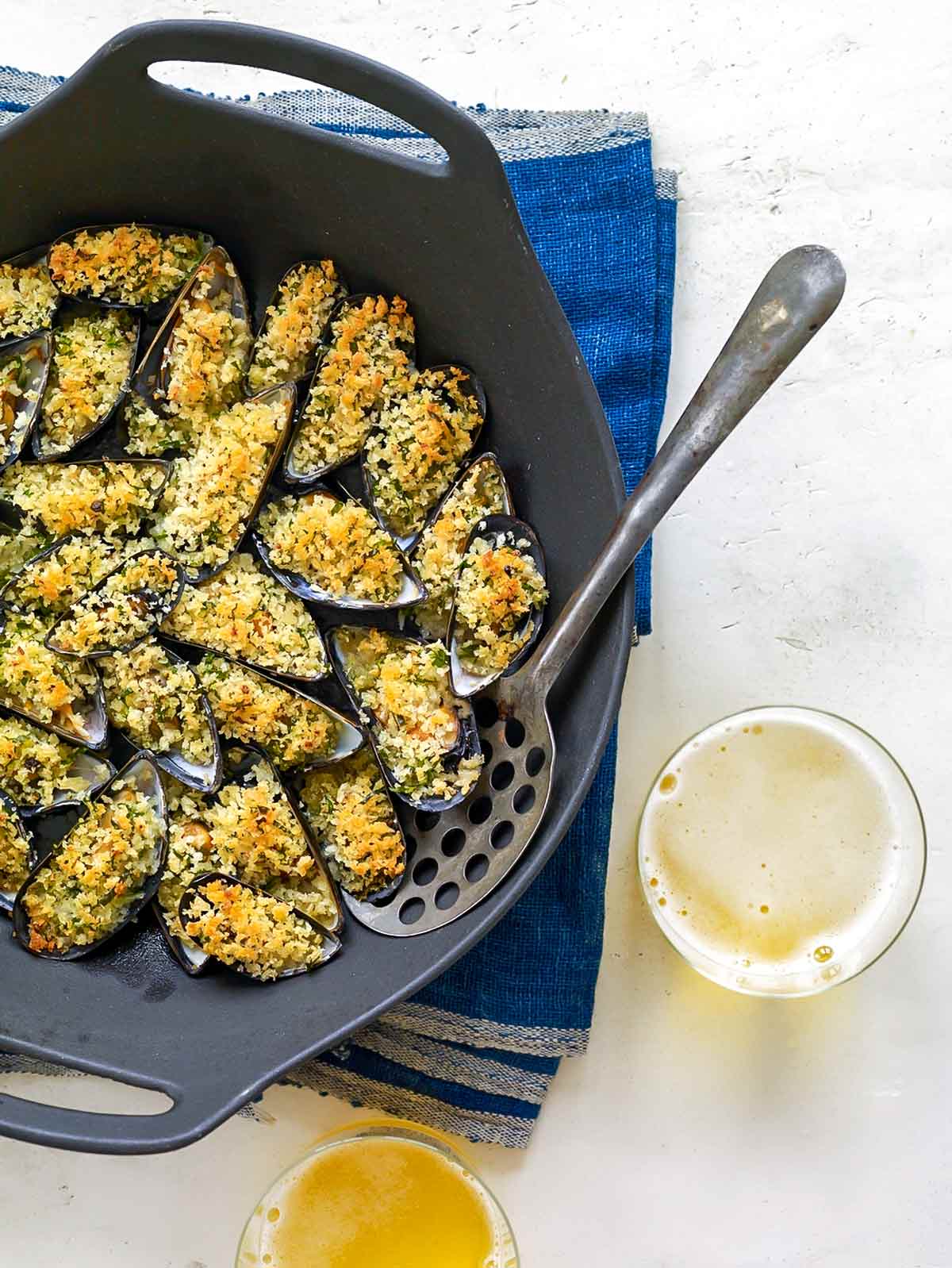
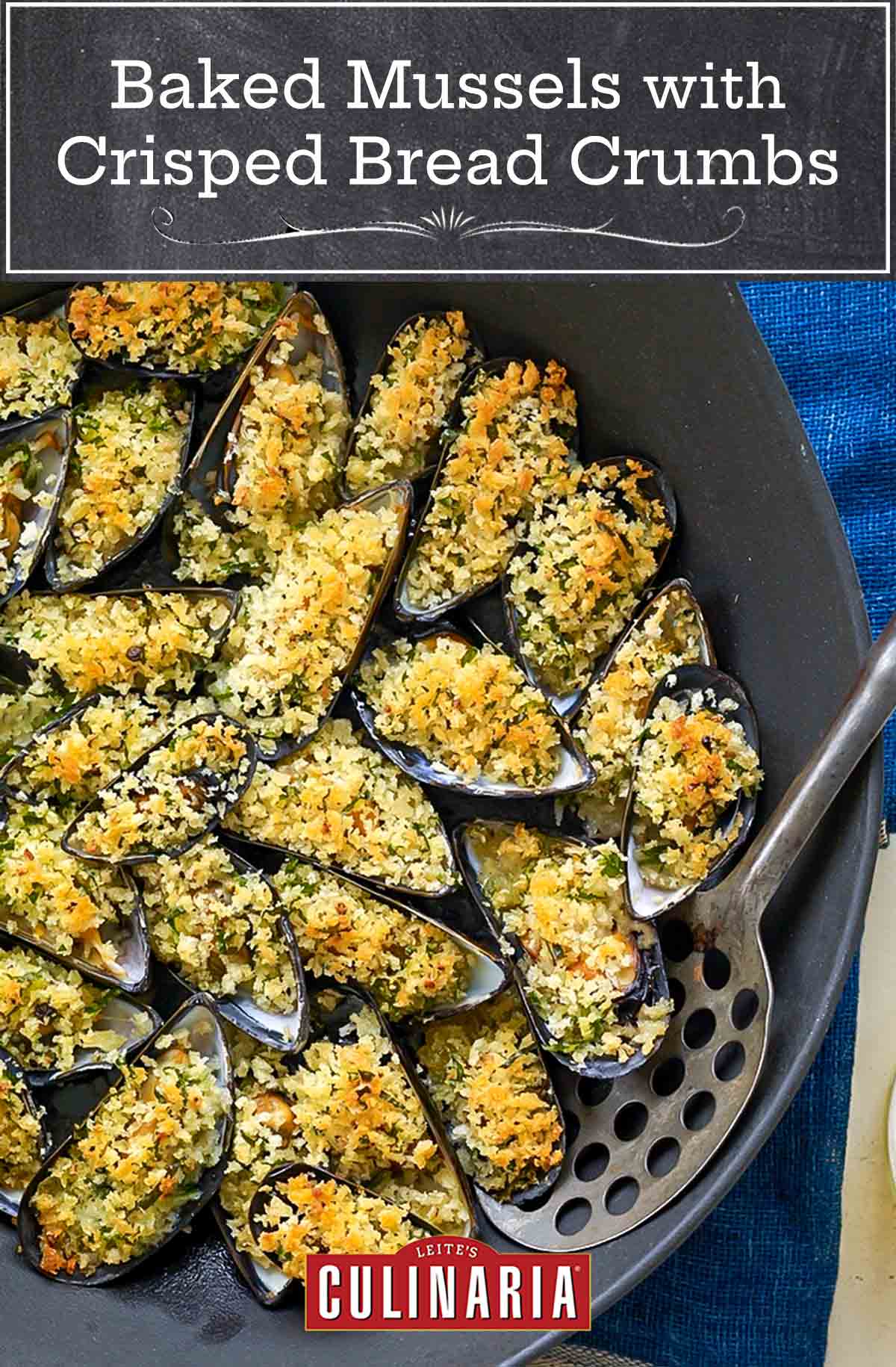
This mussel dish is easy enough to make any time, but worthy of taking center place when serving appetizers. I have to admit that, although we almost always eat seafood on Christmas Eve, I’m not fixated on the traditional Italian seven-seafood idea and serve this instead.—Toni Lydecker
Yout Baked Mussels questions, answered
For all that is good, NEVER eat mussels whose shells are cracked, open, or any that refuse to close their shells when you handle or tap them. They’re likely dying or dead. And be sure that they smell like the ocean, briny and like sea air, not fishy. Try to cook the mussels immediately (unwrap them as soon as you get home). If you have to wait, place them in a bowl and cover them with a damp towel so they can breathe.
If you’re out of store-bought crumbs, you can easily make your own. Skip the ultra-airy, “gummy” supermarket white breads (like Wonder Bread), which tend to clump and turn to pap. Instead, reach for a sturdier artisan loaf, a rustic filone, or pan carré-type bread. Yes, pan carré is a soft Italian sandwich bread, but it’s way denser (think brioche), so its crumb sucks up all that briny mussel goodness while still crisping into a beautiful golden “mollica” (crumb) under the broiler.
The Box Grater (The Italian Way): For a truly rustic, jagged “flake” that soaks up the mussel juices beautifully, rub a piece of day-old artisan bread against the large holes of a box grater. It’s a wicked good workout and produces a much better texture than a machine.
The Food Processor: If you use a processor, tear the bread into small pieces and use short, sharp pulses. Stop the second you have medium crumbs—if you go too long, fresh bread will clump into a ball of dough.
The Skillet Method (Best for Fresh Bread): If all you have is fresh bread, I’ve got you covered. Lightly toast the slices in a dry skillet or a toaster oven on low heat just until they feel dry to the touch but haven’t turned into croutons.
Baked Mussels with Crisped Bread Crumbs
Ingredients
- 1 cup bread crumbs (See FAQ above), day-old white bread
- 2 tablespoons chopped flat-leaf parsley
- 1 to 2 cloves garlic, finely chopped
- 1/4 teaspoon sea salt or kosher salt
- 2 tablespoons extra-virgin olive oil, plus more for drizzling
- Freshly ground black pepper, to taste
- 2 pounds small mussels, (about 4 dozen), scrubbed
Instructions
- Preheat the oven to 450°F (230°C). Adjust the oven rack to the top position.
- In a small bowl, mix the bread crumbs, parsley, and garlic. Season with salt and a few grindings of black pepper. Drizzle with about 2 tablespoons olive oil and mix until the bread crumbs are thoroughly moistened.
- Dump the mussels in a large skillet. Cover the skillet and place it over high heat, shaking often, until the mussels start to open. As the mussels open, move them to a roasting pan or rimmed baking sheet. (Because the mussels will be baked, they need to be heated just long enough to force the shells open.) Snap off the top shells and arrange the mussels so they support each other evenly rather than tilt to one side.
- Drizzle any cooking liquid from the pan over the mussels and into the shells. Spoon the seasoned bread crumbs over the mussels, packing them gently into the shells with the back of the spoon. Drizzle the mussels with a little more olive oil.
- Bake the mussels just until the bread crumbs brown, about 10 minutes. Serve the mussels warm or at room temperature.

Nutrition
Nutrition information is automatically calculated, so should only be used as an approximation.
Recipe Testers’ Reviews
Did you know only 68% of the recipes we test make it onto the site? This recipe survived our rigorous blind testing process by multiple home cooks. It earned the Leite’s Culinaria stamp of approval—and the testers’ reviews below prove it.

This was really delicious! This felt indulgent but was really light and extremely flavorful with the garlic and herbs. The recipe itself is not hard to make but is slightly finicky with opening up and laying flat all the mussels. I recommend getting a helper for this part. This would make a great appetizer, but I served this as a side with grilled filets and roasted asparagus. It made a lovely surf and turf dinner.










Can’t figure out how to transform fresh or day-old white bread into crumbs. To me the “crumb” texture results from baking at a low temperature, then grinding in the food processor. Wonderbread varieties maintain their moisture and clumpiness for weeks. And even day-old bakery bread will stay too soft and clumpy to achieve the texture required for mixing with oil/herbs and spooning over the mussels. Am I missing something here?
Carol, I hear you! You’re definitely not missing anything; fresh bread can be a real diva if it’s too soft. You’re 100% right that Wonder Bread loaves have way too much moisture, and they clump into a gummy mess the second they see a food processor blade.
When I refer to fresh crumbs in this recipe, I’m leaning into the Italian tradition of using a sturdier, artisan-style loaf—think a crusty boule or the pan carré I mentioned in the headnote. Those breads have a tighter, drier crumb that can actually be grated (I often use a box grater for that perfectly jagged texture).
However, you’ve got a sharp eye for detail, and your comment made me realize I should’ve been a bit more “belts and suspenders” with the instructions. I’ve just rewritten the How Do I Make Breadcrumbs? FAQ section. I also explained what bread Italians use for this dish. Last, because so many American supermarket breads are the stay-soft-for-a-year loaves, I’m removing fresh bread from the ingredients list.
Please let me know if this is clear and more helpful.
To die for!!
That’s what I love to hear, MrsD!
Will try tonight and let you know how it turns out! Can’t see anything wrong with the recipe though. Thanks!