

TL;DR (Quick-Answer Box)
- What it is: A traditional rye sourdough starter made from scratch with just two simple ingredients: whole-grain rye flour and water, plus time.
- Why you’ll love it: A vibrant and active sourdough starter that’s a snap to make and a fantastic way to enjoy healthier, homemade bread.
- How to make it: Mix flour and water, then feed it daily for a week, incorporating a portion of the previous day’s starter into the daily feeding. After a few days, it will bubble and develop a sour smell. Use it in your favorite sourdough bread recipe.

Jump To
It’s not hard to make a rye sourdough starter from scratch. Some sourdough starters rely on wild yeasts that live in the air, others on acid-producing bacteria present in buttermilk, yogurt, pineapple juice, and the like, and still others start with commercial yeast or store-bought starters.
☞ Learn More: How to Dry Sourdough Starter
Fact is, none of these additives is necessary. All it really takes to build a delicious and robust rye sour culture, or starter, is some whole-grain rye flour, water, a warm place, and patience.
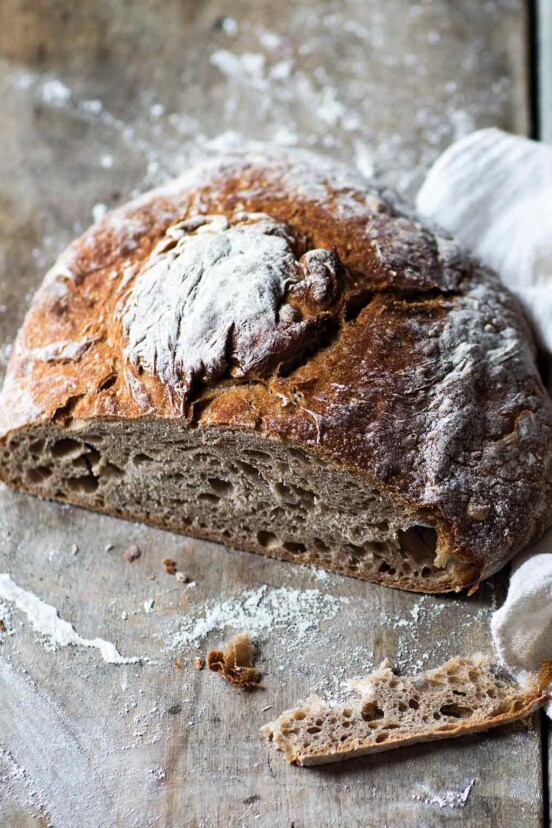
And when your traditional rye sourdough starter is complete, the very first thing you’re going to want to do is use it to make this Galician rye bread.
More Great Sourdough Recipes
Write a Review
If you make this recipe, or any dish on LC, consider leaving a review, a star rating, and your best photo in the comments below. I love hearing from you.–David
Featured Review
Hi, guys. Finally have my rye sourdough starter working really well in and out of the fridge. Baking rye and white loaves every two weeks. My wife says the rye is just like she use to buy in Germany. Happy Days!
Joe

Rye Sourdough Starter
Equipment
Ingredients
Day 1: Make the Rye Sourdough Starter
- 2.5 ounces whole grain rye flour, preferably organic
- 2.5 ounces warm water (105°F or 41°C)
Days 2 to 7: Refresh the Rye Sourdough Starter
- 2.5 ounces whole grain rye flour, preferably organic
- 2.5 ounces warm water (105°F or 41°C)
- 2.5 ounces Sour Starter from the preceding day
Days 8 and Beyond: Maintain the Rye Sourdough Starter
- 2.5 ounces medium or whole-grain rye flour, preferably organic
- 2.5 ounces warm water (105°F or 41°C)
- .25 ounces rye sourdough starter
Instructions
Day 1: Make the rye sourdough starter
- Start with equal amounts of organic rye flour and water by weight. Dump them in a nonreactive (glass, porcelain, stainless-steel, plastic) container, mix by hand into a stiff paste, cover, and let stand at room temperature (68 to 72°F or 20 to 22°C) for 24 hours.
☞ TESTER TIP: Occasionally the yeast normally present in whole grains fail to establish itself in a new culture; if, after 3 or 4 days, the culture darkens, develops a mold, or smells bad, dump the whole batch and start over. After a week, the culture, or sourdough starter, will be ready to use or to be stored refrigerated in an airtight container for a couple days. [Editor's Note: If storing the sourdough starter for more than a couple days, you'll need to maintain it, which we explain how to do just below.]
Days 2 to 7: Refresh the rye sourdough starter
- The next day, discard all but 2 1/2 ounces (70 grams) of the culture and mix the remainder with the refresh ingredients, cover, and let stand. Repeat each day, discarding all but 2 1/2 ounces (70 grams) of the preceding day’s culture.
☞ TESTER TIP: The most important point to remember at the early stages is to feed the sourdough starter daily. Even when it shows no apparent fermentation, the yeast is busy multiplying and consuming nutrients at a very high rate. By the second or third day, it will swell, show bubbles, and give off a clean sour smell. Over the next few days the activity will become more and more vigorous and the smell more intense.
Days 8 and Beyond: Maintain the rye sourdough starter
- In a perfect world—or in a working bakery—sourdough starters are refreshed daily. That said, daily feedings demand both a degree of dedication and abundant flour supplies that are impractical for all but the most committed home bakers. You can get by refreshing your starter every 36 hours or so.
- Mix the rye flour, water, and rye sourdough starter by hand until incorporated. Cover and ferment at room temperature (68 to 72°F or 20 to 22°C) overnight or for 10 to 12 hours. The sponge will be very bubbly, have a clean sour smell, and will have tripled in volume. Store refrigerated in an airtight container and it will last indefinitely.

Nutrition
Nutrition information is automatically calculated, so should only be used as an approximation.
Recipe Testers’ Reviews
Did you know only 68% of the recipes we test make it onto the site? This recipe survived our rigorous blind testing process by multiple home cooks. It earned the Leite’s Culinaria stamp of approval—and the testers’ reviews below prove it.

The rye starter was easy to make and quick. It took about 5 minutes each of the 7 days. Mine smelled great and seemed consistent after the week of feedings. I switched to the refresh amounts after that and it stayed nice and healthy.
During the buildup, you end up tossing about 2/3 of it away. I definitely recommend a scale versus just using volume measurements.










I’ve made all of our bread for several years now but have always shied away from sourdough because of the starter maintenance and waste. Dona Ks suggestion helps with the latter. Each recipe I have calls for a starter using the flour the bread will be made from. Is it possible or desirable to grow a generic starter then use it for rye, red fife, or whatever unique flour you want to use?
Rick, baking is such a precise science, I suggest you try this or a different starter and stick with the bread recipe suggested for starters. Then, as you become more comfortable and experienced with various doughs, you can explore a little. But the relative densities and moistures and such all play into the resulting bread’s texture as well as taste.
How would I maintain the starter over time? Frequency of feeding etc.
Thanks
Patty k, this information has been added to the instructions under “Maintain the rye sourdough starter.” Good luck!
This article is so informative and well written but I’m still confused between “refresh every 36 hours” and “stick it in an airtight container in the fridge to last indefinitely”
So do you still refresh it every 36 hours indefinitely? Or can you ignore it for weeks/months between using it for a recipe?
Thank you!
KM, thanks for asking for clarification, I added a note that hopefully helps to clarify. Greatly appreciate your feedback. You can stick it in the fridge and not do anything with it if you intend to use it to make bread within a couple days. You’ll need to refresh it every 36 to 48 hours or so if you want to keep the starter alive for weeks, months, even decades! I hope this helps!
I know, maybe I’m a tad frugal, but I hate the thought of throwing out about a pound of perfectly good (if a tad young) starter (about what you’ll end up with by the end of the week). How about saving each day’s 2.5 oz, stick it in the fridge, and use it mid-week and end of week for bread? It won’t be a ‘full-up’ starter, but should still provide a little extra flavor for a couple loaves of bread. If that’s too much baking for you, you could lob a couple days worth of starter slag into a zippy bag, toss it in the freezer, then defrost it at a later date for a loaf. Just let it thaw, add a little more flour and water, proof overnight, and it’s good to go the next day. Just saying, no reason to chuck it out.
Dona K., love your no-nonsense approach! Thank you!
I hated to throw out the extra feeding starter too. I saved it all together in the fridge then at the end of the week I made sourdough rye waffles that were incredible. Followed this recipe here (and doubled it). We topped the waffles with thick cut bacon, an overeasy egg, a little creme fraiche and hot sauce. It was a superb breakfast and made tons for the freezer!
Brilliant, Annie! Thank you for sharing this wonderful tip!