
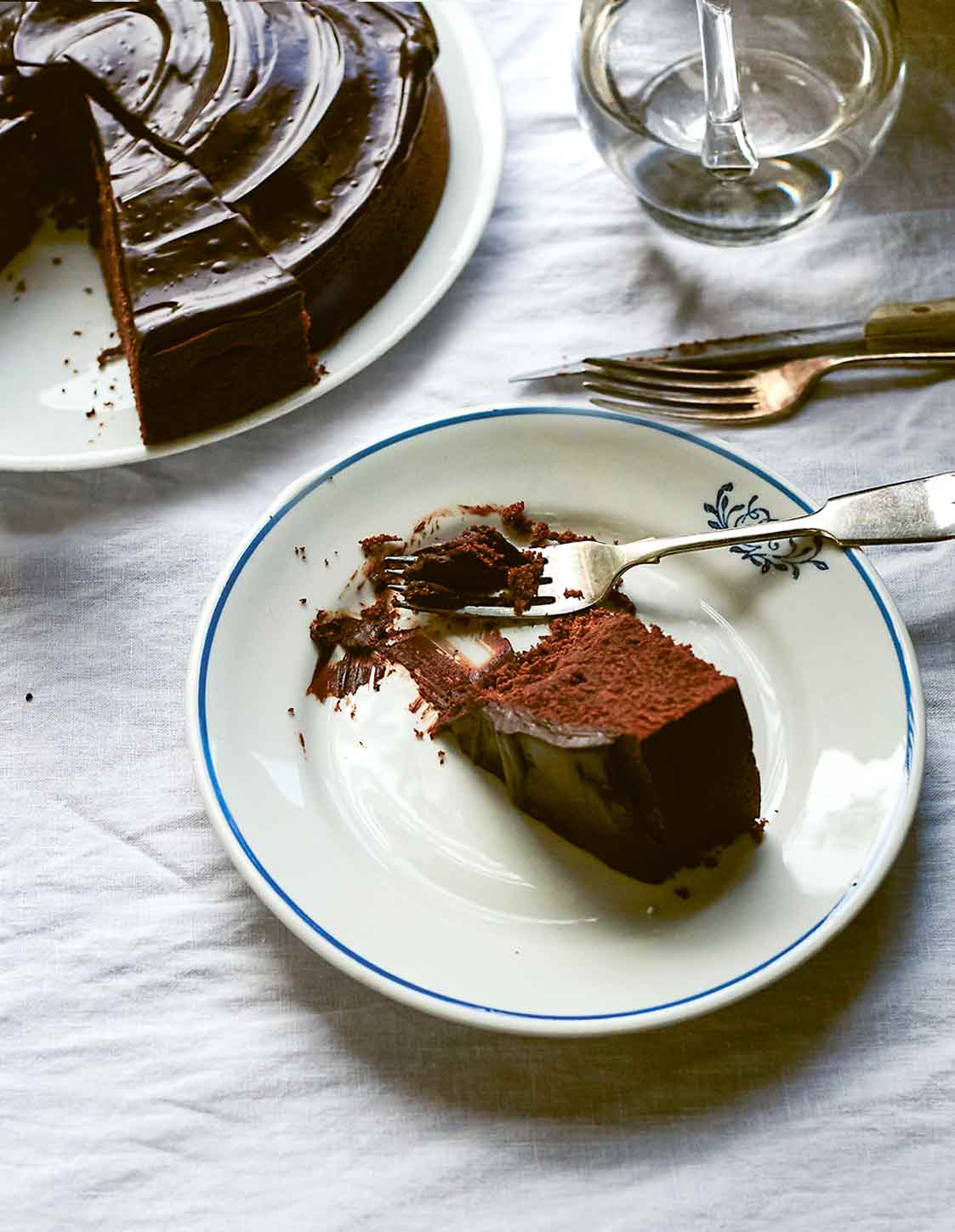
We didn’t need any convincing to make this rich chocolate and red wine cake that’s hidden beneath a creamy dark chocolate glaze. We doubt you will, either.–Angie Zoobkoff
What red wine goes with chocolate?
Chocolate and red wine are a match made in heaven, especially chocolates with a higher percentage of cocoa. Merlot, Cabernet Sauvignon, pinot noir and syrah are all great choices because they can stand up to the richness of chocolate. Velvety, sweet with a big mouthfeel, and layers of rich fruit, a fortified wine is a good partner for chocolate cake’s earthy flavors.
Red Wine Chocolate Cake
Ingredients
For the cake
- 14 tablespoons unsalted butter, at room temperature, plus more for the pan
- 5 1/2 ounces 70% dark chocolate, broken into pieces
- 1 1/2 cups dark brown sugar
- 5 large eggs, at room temperature, lightly beaten
- 3 tablespoons cocoa powder
- 1 3/4 cups all-purpose flour
- 1 teaspoon baking powder
- pinch of fine sea salt
- 1/2 cup full-bodied red wine, (Merlot would be perfect)
- finely grated zest of 1 orange, preferably organic (about 1 teaspoon)
For the glaze
- 4 1/2 ounces 70% dark chocolate, broken into pieces
- 1/2 cup heavy cream
- 2 tablespoons ruby port
- 3 tablespoons confectioners’ sugar
Instructions
Make the cake
- Preheat the oven to 350°F (177°C). Butter a 9-inch (23-cm) springform cake pan and line the bottom with parchment paper.
- In a heatproof bowl set over a pan of gently simmering water (the bottom of the bowl shouldn’t touch the water), melt the 5 1/2 ounces 70% dark chocolate, stirring a little to help it along. Remove the bowl and let it cool a little.
- In a stand mixer fitted with the paddle attachment, beat the 14 tablespoons unsalted butter and 1 1/2 cups dark brown sugar until fluffy and lighter in color. Add the 5 large eggs, one at a time, beating well after each addition.
- In a medium bowl, sift together the 3 tablespoons cocoa powder, 1 3/4 cups all-purpose flour, 1 teaspoon baking powder, and a pinch of fine sea salt, and then fold the mixture into the batter. Stir in the 1/2 cup full-bodied red wine and the finely grated zest of 1 orange and then stir in the melted 4 1/2 ounces 70% dark chocolate.
- Scrape the batter into the prepared pan and bake until a skewer inserted into the middle comes out with just a few moist crumbs attached, 30 to 40 minutes.
- Let the cake cool in the pan for 10 minutes and then turn it out onto a wire rack to cool completely.
Make the glaze
- In a heatproof bowl set over a pan of gently simmering water (the bottom of the bowl shouldn’t touch the water), melt the 4 1/2 ounces 70% dark chocolate, stirring a little to help it along.
- Remove the bowl and pour in the 1/2 cup heavy cream and 2 tablespoons ruby port, stirring until the mixture is smooth, and then whisk in the 3 tablespoons confectioners’ sugar. Let cool a few minutes (though don’t leave it until it has set).
- Pour the glaze over the cake and let the glaze set at least a few minutes before serving.
☞ TESTER TIP: If you have any glaze leftover, stash it in the fridge for a couple of hours, then roll the mixture into tablespoon-sized balls and coat in cocoa powder, nuts, or sprinkles. Voila! Truffles!

Nutrition
Nutrition information is automatically calculated, so should only be used as an approximation.
Recipe Testers’ Reviews
Did you know only 68% of the recipes we test make it onto the site? This recipe survived our rigorous blind testing process by multiple home cooks. It earned the Leite’s Culinaria stamp of approval—and the testers’ reviews below prove it.

Chocolate. Wine. Orange. What a sophisticated combination of flavors! This delicious beauty is the little black dress of cakes and makes a perfect finish for an elegant dinner. This was such an easy recipe and the results were just divine.
I tried the cake shortly after I finished glazing it and it was just wonderful but was even better the next day (I had some for breakfast with an espresso). The flavors were more pronounced and the texture a bit denser. The next time I make this, I would make it in the morning so it would have a chance to sit for a while.
I had some glaze left over which I refrigerated. When I took it out I realized it was just the right consistency for truffles.
You could get 10 or even 12 servings from this cake. Since it’s so intensely chocolatey a small slice is perfect for a dessert serving.
Now, go get some chocolate and open some wine and have fun baking this perfectly delicious cake.

Yes! This chocolate cake recipe is a winner. Granted, coming to this conclusion requires imagination, since I accidentally left out the melted chocolate. I couldn’t believe my error. Even with this key ingredient missing, I still loved the complex flavors created by the wine (a full-bodied merlot from Bordeaux) and orange (1 tablespoon zest from a Cara Cara). Fortunately, the 3 tablespoons of cocoa powder helped temper the wine and orange.
The chocolate glaze is shiny and beautiful just like the photo and we loved the hint of ruby port. I appreciated that there is only a single layer because the cake is intense. I agree that this cake would be lovely in the afternoon with tea, coffee, or after dinner with whipped cream, crème anglaise, or a scoop of vanilla ice cream.

This easy to make cake has a deep flavor, a perfect balance of wine, chocolate, and orange, and a soft texture.
I used a red wine from the Douro region, produced mainly with Touriga Nacional, a Portuguese wine variety with strong red fruit flavors.

This cake has the potential to be cloyingly sweet and chocolatey but the wine and orange zest do a really good job cutting that down just enough. It’s a dense cake but very flavorful. Being so rich, we cut thin slices and got 4 servings out of a quarter of the cake.
I think going by the recipe’s call for 70% cacao chocolate is key. The recipe says you can sort of taste the wine—it warns to not add too much orange zest or you’ll lose the wine. I’m not sure if that’s what happened to me, but we couldn’t really tell there was wine in it.
Nothing overly complicated in putting it together and the glaze topping with its touch of port was perfect. Will be making this one again for sure.










Good morning, I am making this today for Valentine’s tomorrow, yum! I am unclear re the glaze. While the directions call for pouring the glaze over the cake the frosting appears “swirled” onto the top of the cake. Am I looking for a pourable coating that flows and drips down sides or thicker and spreadable?
Den, thanks for checking in before making it. You’ve got a great eye. The photo does show a bit of a texture on top, but that’s actually more about timing than technique. When you first make the glaze, it’s quite pourable—think of a thick syrup. If you pour it right away, it’ll flow beautifully and drip down the sides for that classic “enrobed” look. If you let it sit in the bowl for a few extra minutes (or if your kitchen is a bit chilly), it thickens into a more spreadable consistency. That’s when you can use the back of a spoon or an offset spatula to create those swirls you see in the photo. I hope you and your Valentine have a great dinner!