
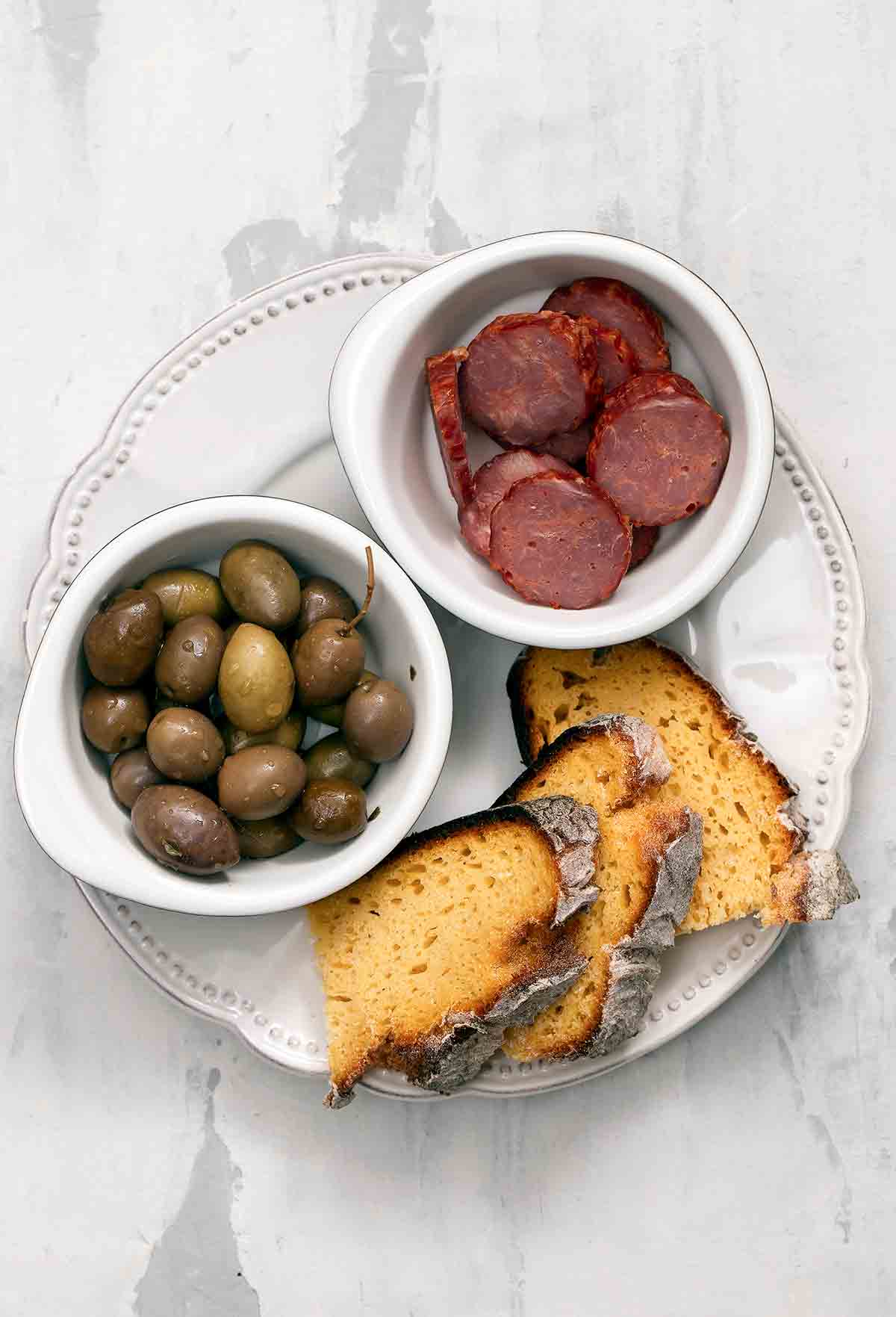
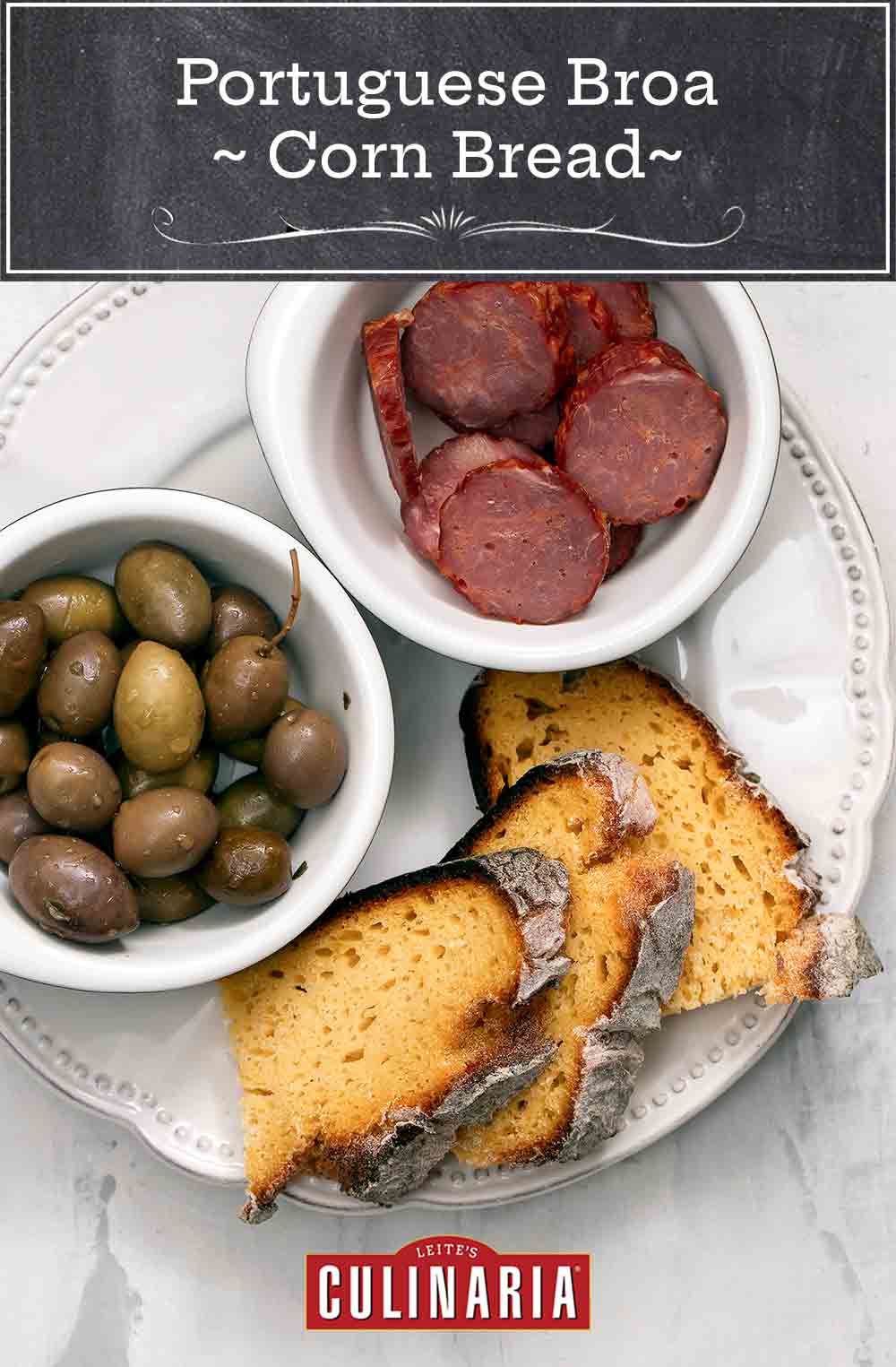
Broa, a bread made with yellow or white cornmeal, is the daily grain food of the poorer regions of Portugal, mountain territory where the semi-wild pigs of the old ibérico breed provide a cash crop. It has a distinctive whitish crust, which cracks to reveal a golden-brown crumb. Corn, a hardy grain, an introduction from the New World which proved a boon to upland farmers, is combined with wheat flour in varying proportions. The higher the proportion of wheat flour, the lighter the loaf. Although this recipe uses a high proportion of wheat to cornmeal — 2:1 by weight — broa is never dainty. It tastes good, though, and is an excellent keeper. Perfect with a spoonful of Queijo da Serra (mountain cheese: ripe and runny in winter and spring, firm and pungent later in the year) or a few slivers of the region’s magnificent salt-cured hams and sausages. [Editor’s Note: Broa is also an integral component of this traditional Portuguese bread and shrimp soup.]–Elisabeth Luard
Broa | Portuguese Corn Bread
Ingredients
For finishing
- Flour, for dusting
- Oil or lard, for greasing
Instructions
- In a warm bowl, combine the flour, cornmeal, and salt.
- In a small bowl, dissolve the fresh yeast in 1 cup of the warm water and sprinkle with a spoonful of the flour mixture. Let rest until bubbly and foamy, 5 to 10 minutes.
- Work the yeasty liquid into the flour, adding as much of the remaining water as you need to make a soft, sticky, rather wet dough. Knead the dough by gently pushing and tugging and turning the dough. If the dough is unmanageable sticky, you may need to sprinkle it with a little more flour, but keep in mind, it will be stickier than most bread doughs. Form it into a ball and dust it with a little more flour. Let the dough rise under a damp cloth in a warm place until more than doubled in size, which will probably take a couple of hours. Don’t rush it. You need well-risen dough with nice big bubbles to get a crisp, light crust.
- Dust your hands and your work surface with flour. Scoop out the dough and punch it down roughly with your fists to distribute the air. Cut the dough in half, work each piece into a ball, and generously dust with flour.
- Slick a baking sheet with oil or lard and place the bread on top. Cover the dough with a cloth and let it rise again in a warm kitchen for 30 minutes.
- Preheat the oven to 400°F (200°C).
- Bake the bread until well-risen and hollow-sounding when you tap the bottom, about 1 hour. Don't undercook the loaves or they'll be heavy. The surface will be white from flour and probably cracked. That's normal.
Notes
Nutrition
Nutrition information is automatically calculated, so should only be used as an approximation.
Recipe Testers’ Reviews

Sometimes I crave airy, squishy bread; other times I crave a hearty and dense bread. Broa is for the hearty and dense bread cravings. This is another of those Portuguese breads that I have to travel outside of my local community to purchase. Making it at home both satisfies the immediacy of this hearty reward, and obsession over baking bread. In just over 4 hours, with only 30 minutes of hands-on time, I was rewarded with 2 hefty boules of broa.
I followed this recipe exactly except for the use of a greased baking sheet. As described, the dough for this bread is sticky and wet. From prior learned lessons, the easiest way for me to handle this type of dough is on my silicone mats, so that’s what I used. I warmed a glass bowl for 1 minute on high in the microwave. I didn’t really understand the necessity of this step but did it anyway. I also wasn’t sure that my fresh yeast cake would work because it was in the fridge for a while and had dry cracks on the surface. I reshaped the yeast cake using only interior smooth pieces and the pieces dissolved well and created bubbles in the warm water. That was my sign that the yeast remained active.
The dough was soft and very sticky and wet. I needed an extra 50 g of AP flour to assist the dough into a ball. I needed another 50 g of AP flour for shaping the bread. Yup, the recipe did say to dust generously. In the end, I might have dusted a bit too generously but this gave the outside crust that rustic crackled top characteristic of broa. I happened to have white corn flour (very fine cornmeal) and so my breads were quite white. Yellow cornmeal would have also looked great although the flavor would not have changed.
My bread was baked in 1 hour as evidenced by its rise, hollow sound when tapping bottom, and my added security of internal temperature which was 206F. I’ve bought this bread before when the center isn’t well baked and it becomes mushy and yeasty, spoiling rapidly. I definitely wanted to avoid this. While my hpllow-sounding yet hearty bread rested, I just couldn’t resist thawing and quick roasting a Portuguese blood sausage that I enjoyed smeared on a slice of my freshly baked broa with extra slices of fresh paprika pepper.
I stored my second broa in the freezer wrapped in parchment paper and aluminum foil. To thaw, I moved it directly from freezer to preheated oven at 375F in same wrapping. It was as fresh as if just initially baked after 25 minutes in the oven. The broa crusts were quite crunchy and I may have overdone the exterior flour a bit. The crumb was exactly like I would expect broa crumb…airy and chewy, hearty and delicious!

This bread is decisively rustic, chewy, and a great accompaniment to any hearty soup or stew. It comes together easily using a stand mixer (which isn’t called for in the recipe) or by hand since it’s a soft, wet dough.
To simplify preparation, I used instant yeast instead of fresh yeast cakes, converting 2/3 ounce of fresh yeast to 2 1/4 teaspoons or 1 packet active dry yeast. I allowed the broa to cool for 30 minutes but couldn’t stand it anymore and cut a slice and slathered with butter. Nice crisp crust. Delicious!
I’d never had or made broa before but I’m a convert and will make this again! Now that I made this recipe, I’m going to try David’s recipe in his “New Portuguese Table” with the boiling water technique.










I made this today. It was delicious and I will definitely make it again! My boyfriend was very skeptical about it because he doesn’t like American style cornbread. But this is so different from that – rustic, chewy, with a great, unique flavor. I have so much, I will likely freeze any leftovers in a day or two. I did add a pan of hot water to the bottom rack of the oven to add steam as that is what I usually do with my breads. Do you think that was a mistake aka would it have been even BETTER if I hadn’t done that? Thanks for the great recipe!
Amy, my, oh my, oh my! That loaf is a looker. I think adding the steam is fine. Steam allows bread to rise higher by keeping its skin supple longer. But this is such a hearty loaf that I don’t think it made that much of a difference. Again, though, that is a beautiful bread.
Just want to clarify the amount of yeast to use as per Deb Lynch…
“Two (2/3-ounce) fresh yeast cakes”: is this equivalent to two x 2 1/4 tsp = 4 1/2 tsp?
Yes, that would be right, Heather. As a general rule of thumb, when converting from fresh yeast to active dry yeast, you want to multiply the weight by 0.4. So a total of 1.3 oz fresh yeast would be equivalent to 0.5 oz of active dry yeast, which is 2 packets or 4 1/2 teaspoons.
Do you think I could use semolina flour instead of the unbleached wheat flour?
Kat, I’ve never done it, but it certainly can work.