
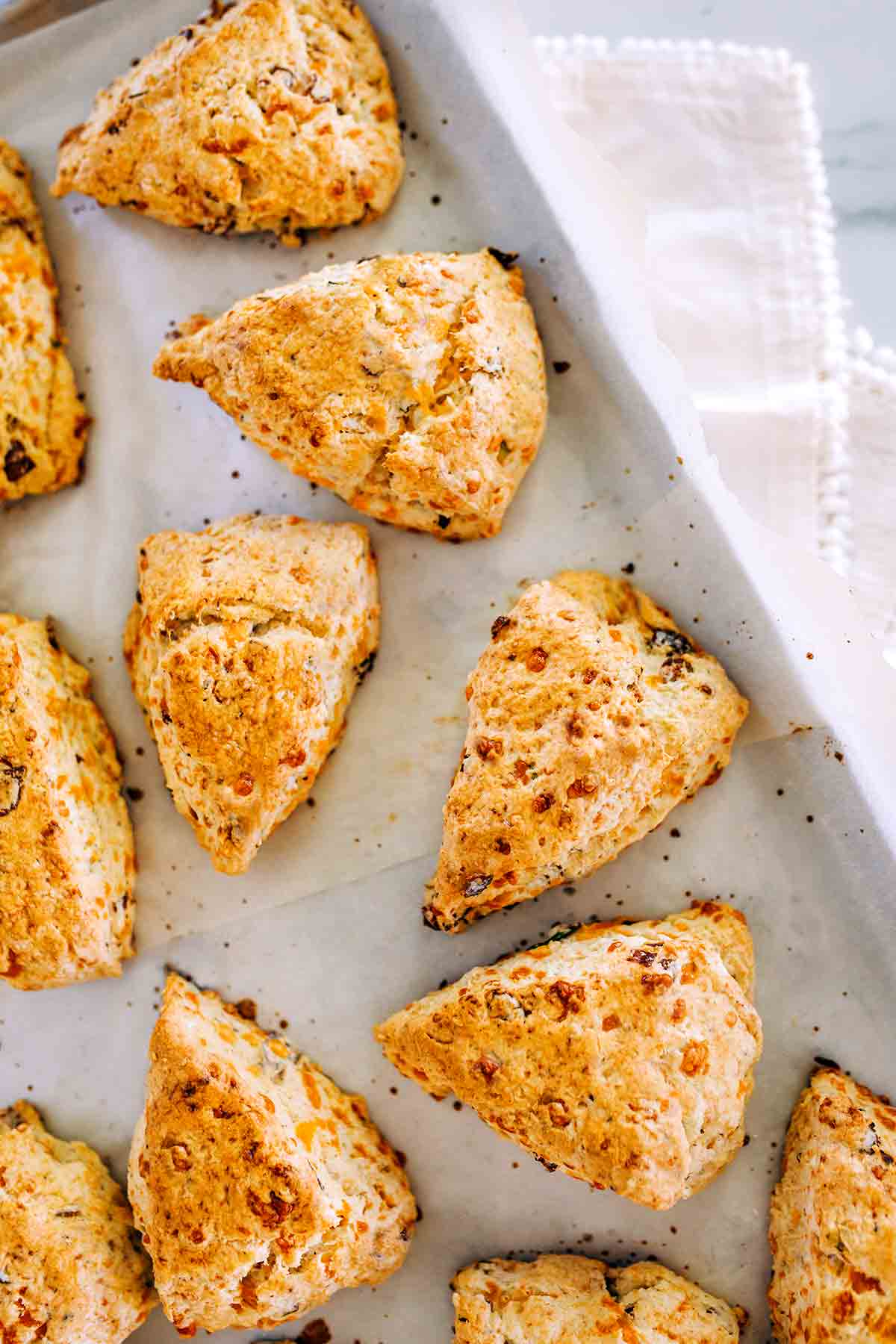

Scones, which originated in England, are similar to biscuits but much richer. They are made from a short pastry, with lots of butter and cream incorporated into the dough. They are very flaky and tender. They are usually cut into large triangles.
Once on a morning walk, I passed an elegant coffee bar in downtown Seattle. There on the counter were the most gorgeous scones, labeled bacon and egg scones. I had never heard of this variation before, but I thought it was a great idea, combining all the ingredients for a complete breakfast into a handheld meal.–Paula Lambert
Featured Review
These are dangerously good! It is tempting to eat two or three 😆. My teenager, though, is not a fan. Not because of the scone itself, but because of the mess I made in the kitchen—her chore is to clean up after meals, and we don’t have a dishwasher. 😂
Melinda
What’s the secret to making scones?
What we really mean is what’s the secret to making tender yet superlatively flaky scones? Here, a few simple things to make certain you achieve scone satisfaction.
Keep your ingredients cold
What causes scones to be flaky is the moisture in the cold butter meeting the hot blast of the oven and evaporating into steam, which lifts and separates the layers of scone. You want to ensure the butter stays as cold as possible until it goes into the oven. Keeping the other ingredients cold helps keep the ambient temperature of the dough nice and frigid.
Don’t overmix the dough
Handling the dough can toughen the resulting scones. So be delicate, please.
Use as little flour as possible
Too much flour can create a dense dough that’ll throw a tantrum when it tries to lift those layers. The dough may be slightly sticky, but that’s fine. Don’t add more flour than the recipe indicates.
More fantabulously tender scone recipes



Write a review
If you make these bacon, egg, and Cheddar scones, or any breakfast dish on LC, consider leaving a review, a star rating, and your best photo in the comments below. I love hearing from you.–David
Featured Review
My family is absolutely hooked on these scones. This recipe started me on a scone spree! I can’t stop making them. The only thing I’ve changed is that after shaping into a disk, I place it in the freezer for about 15 minutes. Then I sliced it pizza-style and brush it with cream instead of egg. Don’t cut them too large or they tend to lose their shape. I’ve experimented with using more bacon, but after 4 slices I find it overpowering. Make these scones… your family will love them.
Barbara Martino

Bacon, Egg, and Cheddar Scones
Ingredients
For the mix-ins
- 3 strips bacon
- 2 large eggs
For the scones
- 2 cups unbleached all-purpose flour
- 4 teaspoons baking powder
- 1 teaspoon table salt
- 5 tablespoons unsalted butter, cold
- 2 large eggs, cold
- 3/4 cup heavy cream, cold
- 2 ounces Cheddar cheese, shredded (1/2 cup), cold
For the egg wash
- 1 large egg
- 2 tablespoons cold water
Instructions
Heat the oven
- Crank the oven to 450°F (230°C). Line a baking sheet with parchment paper or a silicone baking mat. Set aside.
Cook the mix-ins
- Cook the 3 strips bacon in a skillet over medium heat, flipping once, until the fat has rendered and the bacon is cooked but still pliable, 4 to 6 minutes. Drain on paper towel and cut into 1/2-inch-wide (12 mm) strips.
- In the same pan, lightly scramble the 2 large eggs your favorite way. Spoon the eggs onto a plate and break them into 1-inch (2.5 cm) chunks. Let cool completely.
Mix the scone dough
- Dump the 2 cups unbleached all-purpose flour, 4 teaspoons baking powder, and 1 teaspoon table salt into a large bowl and whisk to combine.
- Cut the 5 tablespoons unsalted butter into the flour until it's completely incorporated using 2 knives, a pastry blender, or your best kitchen tools: your hands.
- Beat the 2 large eggs and the 3/4 cup heavy cream in a medium bowl until combined.
- Pour the egg mixture over the flour and gently stir, just to incorporate the eggs. Don't overmix.
- Fold the 2 ounces Cheddar cheese, scrambled eggs, and cooked bacon into the flour mixture. The dough will be sticky and chunky. Stir and knead the dough as little as possible while evenly distributing the cheese, scrambled eggs, and bacon throughout.
- Plop the dough onto a well-floured work surface. Pat the dough into a rectangle about 12 by 4 by 3/4 inch (30 by 10 by 2 cm) high. Cut the dough into three 4-inch (10 cm) squares. Cut the squares on the diagonal to form six triangles.
Brush the scones with egg wash
- Place the scones at least 1 inch (2.5 cm) apart on the baking sheet. Beat the 1 large egg with 2 tablespoons cold water and brush the tops of the scones. If you're not utterly hangry, slide the baking sheet into the fridge for 30 minutes to set the dough so it doesn't spread during baking.
Bake and serve
- Bake the scones for 10 to 12 minutes, or until golden brown. Remove and serve warm.
☞ TESTER TIP: The scones truly are best served straight from the oven and not hours or days later, although you can refrigerate any leftovers and heat them in a 300°F (150°C) warm oven.
Notes

Nutrition
Nutrition information is automatically calculated, so should only be used as an approximation.
Recipe Testers’ Reviews
Did you know only 68% of the recipes we test make it onto the site? This recipe survived our rigorous blind testing process by multiple home cooks. It earned the Leite’s Culinaria stamp of approval—and the testers’ reviews below prove it.

This recipe is one of those that I saw and said “Why didn’t I think of that?” Followed by, “I’m glad someone did!” These scones were amazing. My family has long been fans of bacon, egg and cheese sandwiches but this form of what we loving call a BEC just takes it to another level. Baking the BEC into a buttery, flaky scone is a masterstroke.
The best part for home bakers is that it’s not hard at all. It was a tad challenging mixing the dough enough to evenly distribute the bacon, egg, and cheese but not so much as to toughen the dough but really, just a tad. The dough was very easy to work with, not overly sticky. And the best part was that we were eating them within an hour.
The only other thing to say is, “Where have you been all my life?”

These were really delicious. All the elements of an egg muffin, but better. Flaky and tender with melting cheese and bites of egg punctuated by flecks of crisp bacon. And they were a cinch to put together; hardly more effort than making bacon and scrambled eggs alone. They were definitely best eaten freshly baked, but the leftovers reheated well enough.

These are quick to pull together and result in beautifully golden and crisp scone versions of a classic breakfast. I was a little nervous that the scrambled eggs would just be a weird distraction, but they blend well into the dough and provide little fluffy pockets in the final product.

Reading the recipe, I knew exactly how these would taste—buttery scones, when done right are an absolute treat. All the delish add-ins aside, the biscuit dough itself was perfection. Flaky from all the butter and rich because of the heavy cream. Gorgeous. The eggs, bacon and cheese just put them over the top.
Putting them together is a cinch. It didn’t take much longer than making eggs and bacon, honestly. I think these would be excellent for a brunch but they’re especially good for a on-the-go sort of breakfast. Fresh out of the oven, they’re tender and flaky, and the scrambled eggs stand out particularly well. I had a leftover one this morning, gently reheated and it was still pretty great. Not as awe-inspiring as yesterday but really enjoyable.

I have a special mental file for recipes like this, which I seem to mess up six ways to Sunday and they still come out fine. They’re destruction-proof. These tasted great (bacon! eggs! cheese!) and had a good crumb. They were, however, oddly shaped, but I can live with that. Someone else making these—say, someone who is not spatially and geometrically challenged—will get a prettier result.
So, I made a complete mess of the rectangle/square/triangle project. I had a ruler out and thought I had close to the right dimensions, but then encountered difficulty with the geometry. The not-quite-triangle shapes were entertaining in a Rorschach Test kind of way, though, featuring among other things, a map of Africa and a poodle.
Using the food processor to mix these is not the way I would usually go, and it dirtied extra equipment (boo!), and I’m pretty sure I overworked the dough. Incorporating the eggs into the flour and butter took about 45 seconds, just under a minute. (One of the egg yolks was still intact going in after I thought I had mixed both pretty well with the cream, so it took a little longer than it should have.)
I chose the processor to get the butter and flour totally incorporated because I used butter from the freezer, and it seemed unlikely I would do as good a job blending it completely by hand. I think the freezer-cold butter was a good choice and the jury is out on whether I’d try these by hand next time or use the processor again. But, it did work.
My hands were a sticky mess working with the dough. It was, indeed, very sticky. I did my best to get everything evenly distributed throughout the dough, but the stickiness was an obstacle.

My husband and I had these one morning fresh out of the oven. The tops and bottoms were beautifully golden brown in 12 minutes. They were light and fluffy so we couldn’t stop at just one. I will be making these again but with a few adjustments.
I would double the bacon and the cheese. I believe this will take them from good to delicious. The amount of egg was perfect for us. I will also cook the bacon (pre-sliced) and the egg either the night before or earlier than when I want to bake. These come together very quickly when using a food processor, only 3 pulses for each step, but because the egg and bacon needed to be refrigerated for a bit it added 15 minutes. I wasn’t adding anything even slightly warm to the dough.
The dough was quite wet but folding in the egg, bacon, and cheese was still easy. A few spread so next time I’ll try placing the scones in the fridge for 30 minutes before baking.










I needed something savory for brunch that wasn’t a heavy main dish, and stumbled on this recipe. I make a lot of scones, and wondered why I’d never thought of this. These were a total hit.
I made the recipe mostly per the instructions, but found the egg usage confusing. I ended up editing my copy of the recipe (I definitely saved it!), to show 2 eggs, raw for the batter; 2 eggs lightly scrambled; and 1 egg raw, for the egg wash. 5 eggs total, divided use.
My only other minor tweak was to add some chives, and I tossed all the inclusions in the flour to coat them before adding the milk/egg mixture. They seemed to incorporate more evenly. I reserved a bit of bacon, chopped fine, and some cheese for the top. They came out beautifully.
Delicious. We weren’t sure if we should serve them with butter or ketchup 🙂
Thank you for sharing!
Moxie, I’m so stoked these were a hit! Your chives and extra bacon and cheese on top sound AH-maz-ing. As for butter or ketchup? I think that calls for a second batch. (Or maybe hot sauce?!)
Your comment also sent me back into the recipe for a proper overhaul. While you sussed out the eggs sitch correctly, you shouldn’t have had to be a Sherlock. I’ve divvied them into three ingredient groups and made the scrambling, cooling, and mixing steps way clearer.
Thanks for helping me make this better for the next reader who bakes them. Chow.