Many of the recipes for classic regional breads begin with a starter dough made from small amounts of flour, water, and yeast allowed an initial fermentation. The starter, known as biga in Italy, or bighino when in small amounts, not only gives strength to what in Italy are weak flours, it also produces a secondary fermentation from which come the wonderful aroma, natural flavor, and special porosity of the final loaves and wheels of bread. The important point about a starter dough is that the breads made with it develop a wonderful taste because their risings are long and bring out the flavor of the grain. Another benefit is that the loaves remain fresher and taste sweeter than those made with large amounts of commercial yeast.
In Italy, bakers use dough from the previous day’s baking to start a new dough. I keep some starter on hand at all times; by having it around, I can decide to make pane pugliese or ciabatta in the morning and have it for dinner that night. Because the first biga must come from somewhere, though, you may make it following the instructions below. It’s remarkable. It freezes very well and needs only about 3 hours at room temperature until it is bubbly and active again, or it can be refrigerated for up to 5 days. When using it in recipes, I strongly recommend weighing rather than measuring it, for it expands at room temperature. Use chilled biga when measuring by volume; when measuring by weight, the biga may be chilled or at room temperature.–Carol Field
LC Obliged to Biga Note
Behind each and every memorable bite of proper Italian bread we’ve daintily nibbled, hungrily inhaled, or otherwise somehow consumed, we have a biga to thank. Much obliged.
Italian Biga Recipe
Ingredients
- 1/4 teaspoon active dry yeast
- 1/4 cup (2 ounces/ 60 grams) warm water
- 3/4 cup plus 4 teaspoons (7 ounces/ 200 grams) water, preferably bottled spring water, at room temperature
- 2 1/3 cups (11.6 ounces / 330 grams) unbleached all-purpose flour
Directions
- 1. Stir the yeast into the warm water and let stand until creamy, about 10 minutes.
- 2. Stir in the remaining water and then the flour, 1 cup at a time. If mixing by hand, stir with a wooden spoon for 3 to 4 minutes. If mixing with a stand mixer, beat with the paddle at the lowest speed for 2 minutes. If mixing with a food processor, mix just until a sticky dough forms.
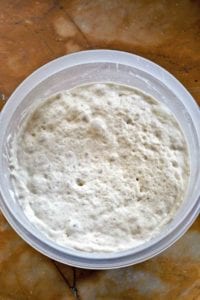
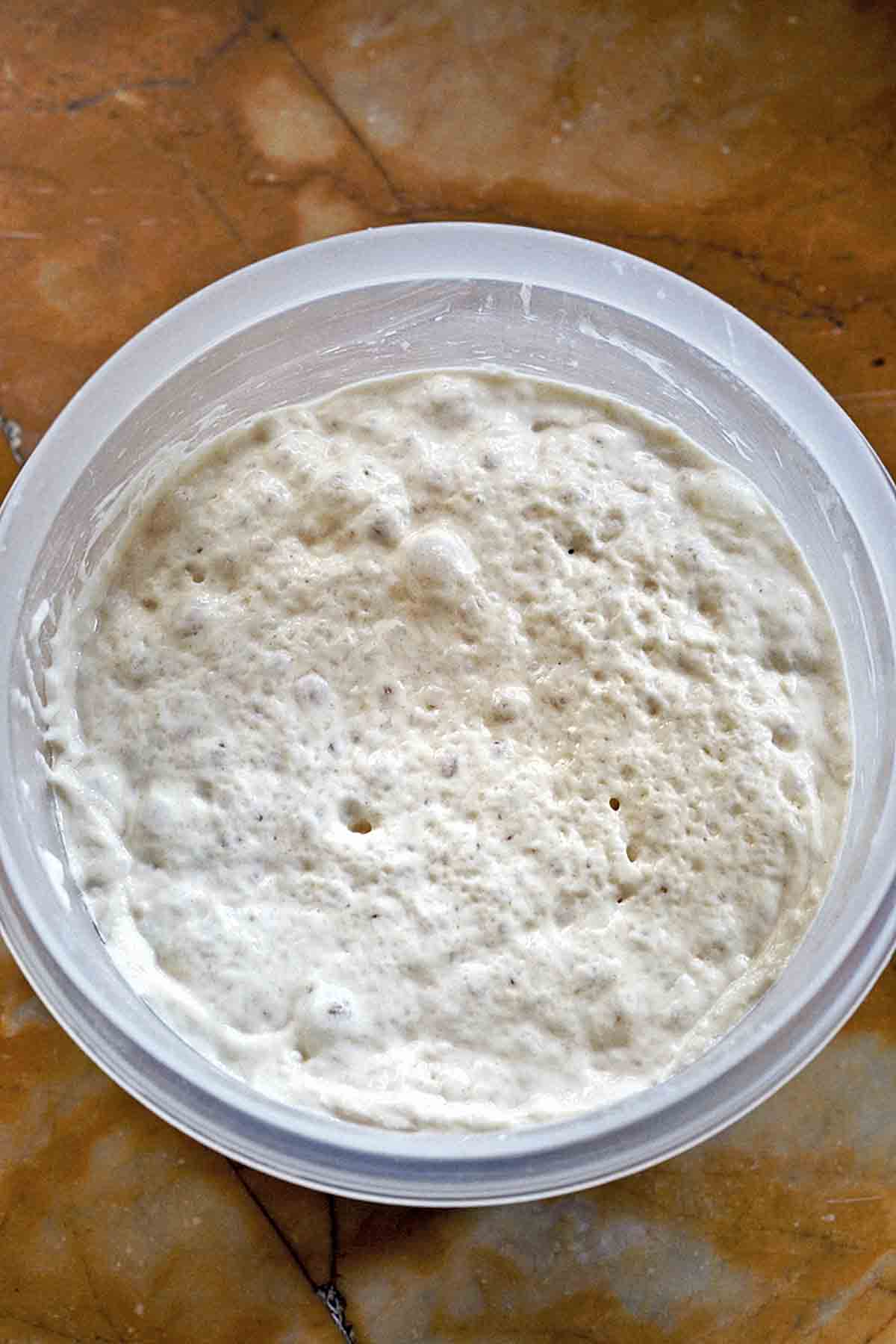
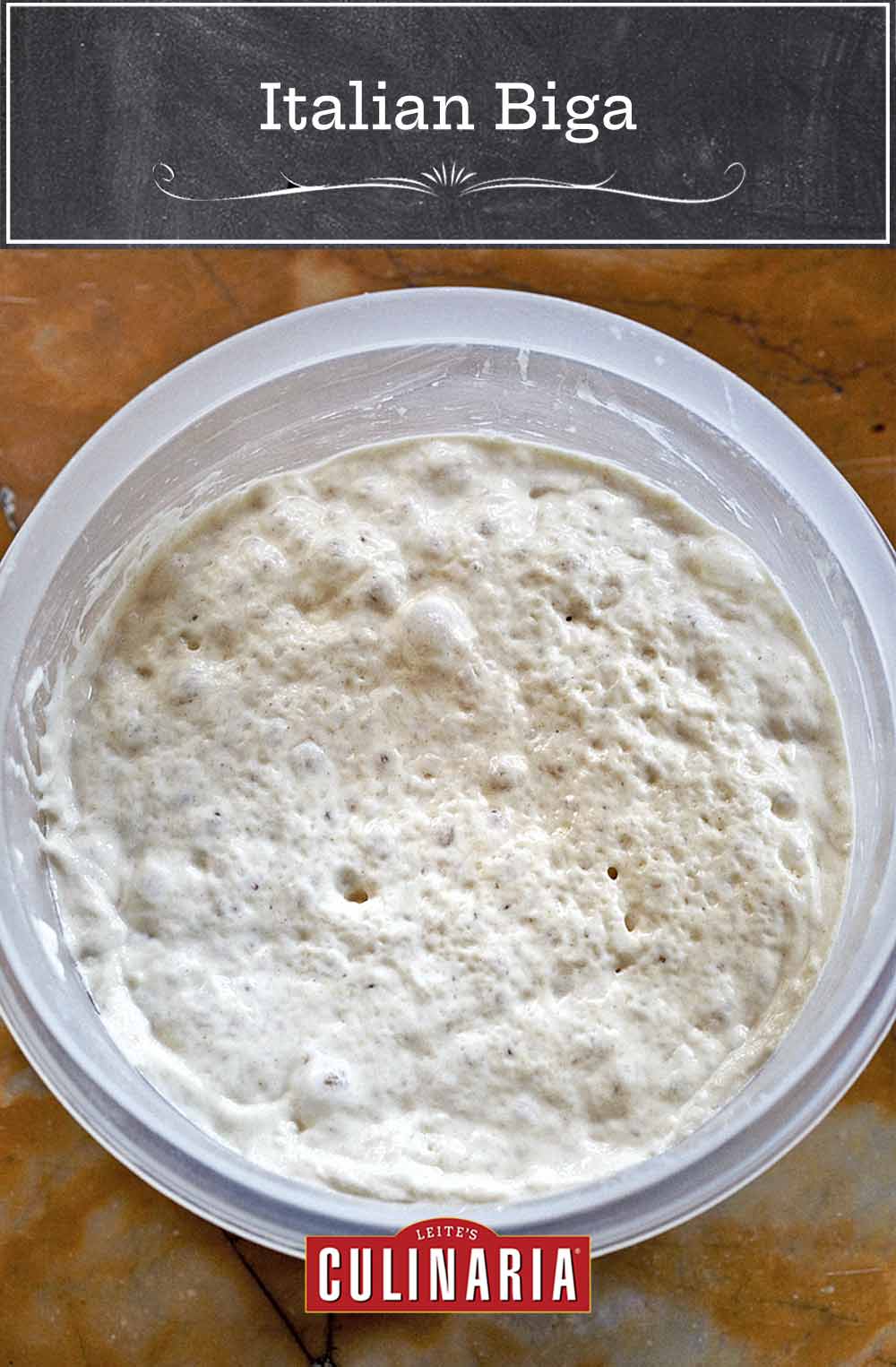
- 3. Transfer the biga to a lightly oiled bowl, cover with plastic wrap, and let rise at a cool room temperature for 6 to 24 hours. When ready, the starter will be triple its original volume and still be wet and sticky. (The bakers I admire most advise 10 to 11 hours for the first rise, but others are very happy with the 24 hours it takes for dough to truly become yesterday’s dough. If you like sour bread, allow your biga to rest for 24 to 48 hours, or you might even stretch it to 72 hours.) Cover and refrigerate or freeze until ready to use. (If refrigerating the biga, use within 5 days. If freezing the biga, let it rest at room temperature for about 3 hours until it is bubbly and active again.) When needed, scoop out the desired amount of biga for your recipe and proceed.
Hungry for more? Chow down on these:
- Amish Friendship Bread from The Kitchn
- Gluten-Free Sourdough Bread Starter from Simply Sugar and Gluten-Free
- No-Knead Whole Wheat Bread from Leite's Culinaria
- Spoon Bread from Leite's Culinaria
Italian Biga Recipe © 2011 Carol Field. Photo © 2011 Ed Anderson. All rights reserved.

Thank you for this! You have just confirmed what I’d discovered (and read) about making bread that tastes like the grain rather than the commercial yeast. Since the first time I made an Italian bread with a biga, and discovered that the no-knead bread was really just a biga, baked, I’ve used the technique almost exclusively with all my breads; sweet doughs as well. It’s so simple and it makes a world of difference in the flavor of the bread. I usually just throw it together the night before and let it do it’s thing until I’m ready to make the bread dough the next afternoon. Nothing could be easier andm as a bonus, I get more mileage out of a jar of yeast because I don’t need to use as much in a recipe. Such an outstanding technique!
Susan, why were you keeping all this to yourself all this while?! But we won’t hold it against you. We’re just glad we’re privy to it now.
You know I was wondering about the whole idea of using my no-knead dough as just a biga and now I will. I almost always have a batch of it in my fridge. Thanks for the idea of using it this way, as well as for other types of bread also. I’m going to try it for my cinny rolls now, too, I think.
Elaine, I’m loving the cinny rolls idea, do let us know how that goes…
This looks great! Do you know of any recipes where I can use the biga, or any cookbooks? I have made biga before but have never found any recipes that use it. I therefore guesstimate how much to use… It would be nice to see an authentic recipe use it.
Thanks!
Hi, Chris. We certainly do. The ciabatta recipe that we featured requires biga, which is why we linked them. Happy baking!
Do you think it would be possible to make the ciabatta recipe with a sourdough starter instead of a biga? I might give it a try and report back…
Hi Jake, I asked Linda, one of our recipe testers and a great baker, what she thought. This is what she had to say “I believe that you could use a sourdough starter for ciabatta instead of a biga. To give it the character and flavor that you would get from a young biga, I suggest feeding the starter a few hours before you will be mixing the dough and letting it sit at room temperature until it becomes active. You can adjust the thickness of the starter with flour or water depending on how sour you want the bread to be – the thicker the starter, the more sour the taste.) I have not personally tried this method, but I did think about it as an alternative when I was testing the recipe for the website.” Please let us know if you give it a try!
Ok, I’ve tried a couple of things now and can report that you can make a very successful focaccia using sourdough. Unfortunately my partner has a low gluten tolerance, so cooking with proper 00 flour is not an option and I think it’s a bit of a lost cause to try and make a ciabatta with any kind of low gluten flour because you need so much stretch in the dough. Spelt flour makes an amazing focaccia though.
Hi Jake, great news on the sourdough. Cindi Kruth, one of our baking testers, swears by her stash of sourdough. Happy baking!
I really want to give this a go but it’s hard to find a cool room temperature nowadays. What happens if it is left out in a warm room? Or can I put this in the refrigerator for the initial 6-24 hours? I don’t want to wait until the fall to eat this! Thanks!
Hi Suzanne, I checked with Cindi (our super duper baker) and this is her advice “When I made this the other day I actually had it at un-airconditioned room temp for about 6 hours then stashed it in the frig overnight. It worked fine. My room temp wasn’t that hot, but definitely there is a difference when this is made in the summer. Doughs ferment differently, not just faster, at higher temperatures, more yeast action less bacterial. If the room is over 80 degrees I’d suggest leaving it only a few hours, then refrigerating overnight. There’s little risk in keeping it at cooler temperatures. Although, frankly, I doubt there’s much problem with even a very warm room temperature (90) for 6 hours for the biga since there’s no added fat or sugar. I proof starters at school in a proof box sometimes (90-95) when I need to get them active quickly since our class isn’t long enough to allow the proper time at room temp. It’s not my preferred method because it doesn’t allow for maximum flavor and texture development, but it doesn’t hurt the yeast. And, as you know, I stash Lex (fyi “Lex” is her beloved sourdough starter) in the refrigerator indefinitely. I don’t think there’s any reason to hesitate just because it’s summer and the kitchen’s warm. Leave it out for the full 24 hours and it may develop a slightly more sourdough flavor, which is not necessarily a negative in any case. I can’t see any harm in a 6 hour rise at summertime room temps.”
Hope this helps, can’t wait to hear about your summertime version.
I have just started baking bread a few months ago, and have been mainly sticking with the ‘no-knead’ method of baking, and this whole time I didn’t realize I was making biga. Curious tho, how long can you freeze it for? Not that I plan to have it in there for more than 2 weeks tops. I’d like to try this with your ciabatta recipe, but I have neither a food mixer nor food processor, and it sounds messy otherwise.
Hi Bobba Ganoosh (love the name, btw) I spoke with Cindi our baker extraordinaire to get some answers for you. This is her advice “There’s a little difference between no-knead and biga in that the biga contains no salt. Yeast dough freezes very well. I don’t do it often because these lean doughs also keep well several days in the refrigerator and that’s easier to me. That is essentially what the whole book Artisan Bread in Five Minutes A Day is about. When I do have too much to use or a change of plans, I oil a freezer bag and slip the dough in, double the bag, flatten it out a little (defrosts faster) and freeze for up to 3 months. I think the dough is best used within a month. It loses a little rise, but for the most part the yeast survives intact and the bread made with it should not be noticeably different.
Although the recipe for ciabatta recommends against making it by hand there really isn’t any reason not to. After all this bread was made, as well as other classics that we use machines for today such as brioche, successfully long before the invention of modern appliances. True, it’s a very wet dough and can be awfully messy/sticky, so I’d suggest the aid of a dough scraper. A light coating of oil on your hands may help too. Worst case is a little too much flour gets added and the loaf is a bit denser, less full of those gorgeous holes, than traditional ciabatta. Not a big downside risk.
Hope this helps!
I have a quick question. I live in a very dry climate and I have used this recipe twice now, and the Biga doesn’t seem as wet as it does in the picture. Should I be adding more water? Just how wet does it need to be?
Hi Mahbaker, since the biga is covered with plastic wrap (which is pretty good at sealing in humidity for a short period such as this recipe requires), it is unlikely that a drier climate would make any difference. It might be the amount of flour. Just to be super accurate, I would suggest using a scale for your measurements. The biga and the dough are quite dependent on the proper hydration level for their texture, as is the resultant ciabatta. The technical answer to “Just how wet does it need to be?” is 79%, which a bit difficult for quantify. You might also want to check the protein levels in your flour as sometimes a very high protein flour it could absorb more of the water and appear drier.
Thank you!! I have started having a better success rate and I’m sure it will be perfect in no time.
Wonderful news Mahbaker!
Are you supposed to feed it with more flour or do you use it all up before starting more? Thanking you in advance.
Hi Barbara, you will use most of the biga in the ciabatta recipe. I did speak with our baking expert, Cindi, and she said that if you do have a tad leftover, it is fine to feed it and treat it as a starter.
I’ve been studying your biga and Ciabatta recipes and blogs so I can make these recipes too; they sound amazing. What I’m wondering is, if I want to keep biga on hand how do I do that? What do I add to the the left-over original to keep it going? or am I better off making it new every time? Thank you
I used to add a half cup of unbleached flour and a half cup of water every third day when I kept them refrigerated. If you leave it on your counter you will want to feed it every day. If you do keep a starter you will need to either bake with it when you feed it or dispose of about half each time before you feed it. Now I just make a biga the day before I use it. You don’t need to worry about having someone feed your starter while you are traveling etc. If you wish to learn about keeping a starter there are very good references in your library and on the internet. What you want to look for is a how-to for making your own Sourdough starter.
Thanks for the tips, Larry!
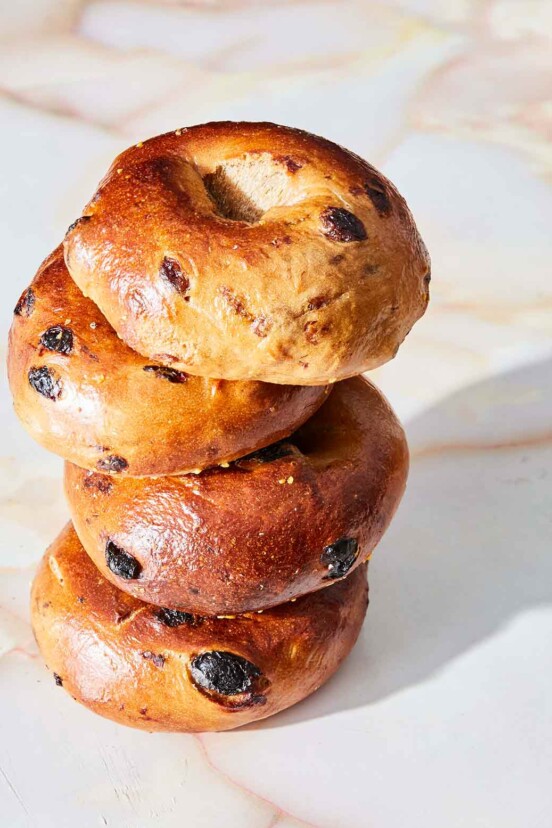
I would also like to mention that this is a great starter for a lot of breads. I have used this in bagels and other breads that don’t call for a starter as they can benefit from a bit of biga if you happen to think ahead and start it a day or two ahead, or if you have some big left over. I have also been known to add a tablespoon of rye or whole wheat flour to this biga, just to change the flavor a bit.
Swell, swell advice, Larry! Thanks!