
TL;DR (Quick-Answer Box)
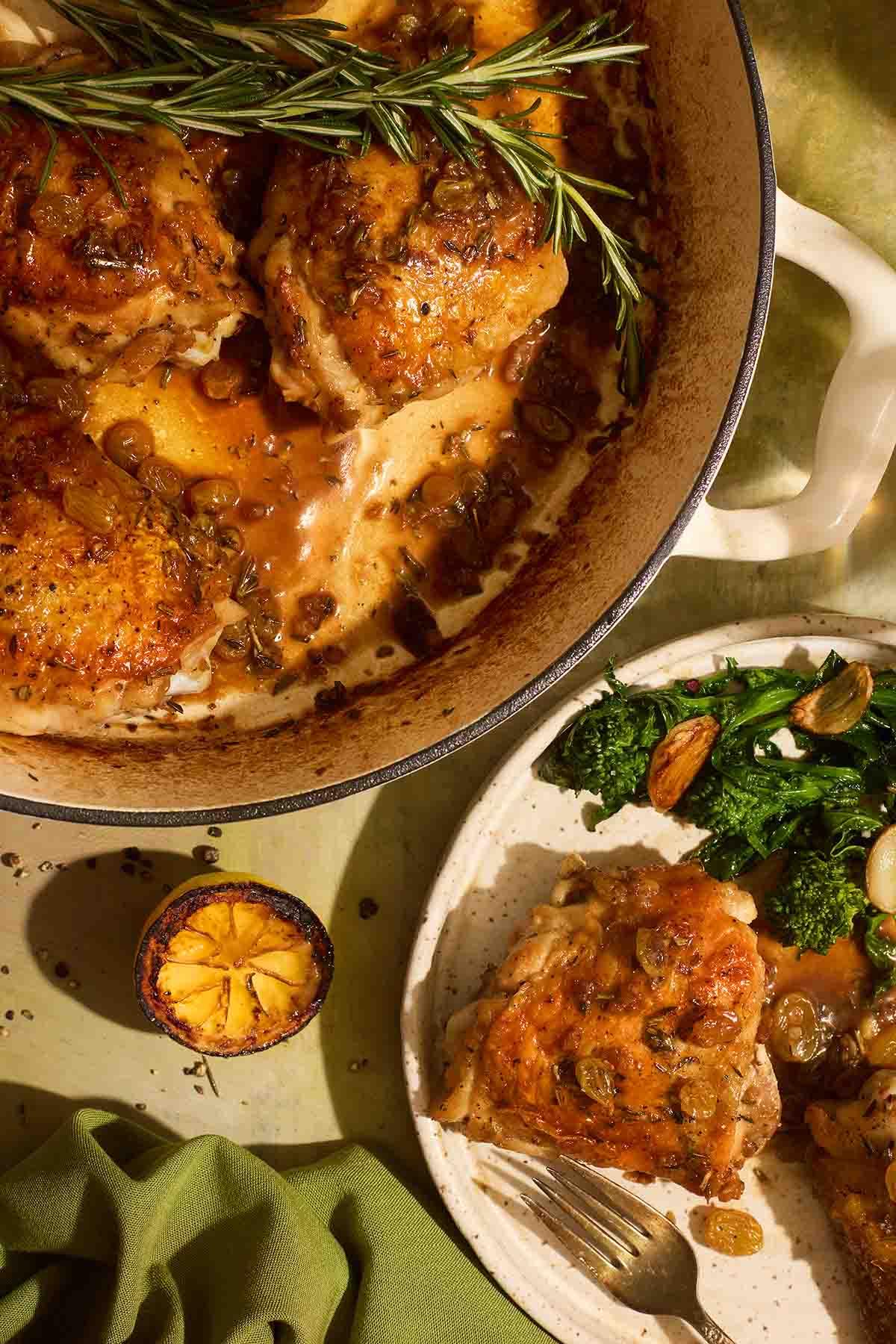
- What it is: Pan-seared chicken thighs finished in a reduced tangy white-wine vinegar sauce sweetened with honey and golden raisins + kicked up with garlic + rosemary.
- Why you’ll love it: Seriously, what’s not to love? The cold-pan method renders the fat and crisps the skin without oil. (Win.) The intensely flavorful sweet-tart sauce—made with pantry staples (Win.)—is guaranteed to have folks mopping it up with crusty bread. (Win.)
- How to make it: Slowly brown the chicken until crisp, deglaze with stock and then reduce the honey-vinegar until saucy. (You may drool now.)

Jump To
- TL;DR (Quick-Answer Box)
- Why this vinegar chicken recipe works
- Notes on ingredients
- Variations & shortcuts
- Your agrodolce chicken questions, answered
- Vinegar chicken pro tips & troubleshooting
- What to serve with vinegar chicken thighs
- Storage & reheating
- More jaw-droppingly good chicken recipes
- Write a review
- Vinegar Chicken Thighs with Agrodolce Sauce Recipe
- Recipe Testers’ Reviews
There are books that sit on the shelf and books that live on the counter. Lucinda Scala Quinn’s Mad Hungry: Feeding Men and Boys has been counter-bound in my kitchen since the day I cracked it open. Not because the recipes are fussy—they’re famously not—but because Lucinda has this rare gift for writing about food the way you actually cook it: practically, lovingly, and without a hint of preciousness.
These pan-seared chicken thighs in an agrodolce sauce are a perfect example. The recipe started life on LC as her vinegar-glossed chicken, which I’ve been making since 2009. I always wanted to DO SOMETHING to it, so I switched vinegars (from red wine to white wine), added honey and golden raisins for more sweetness, and anchovies for a base of umami. Oh, and I swapped out a cut-up chicken for thighs.
The name sounds aggressive as hell, right? Vinegar chicken, like some ornery poultry that attacked you at the country fair. And, at first, it is assertive. When that sharp vinegar hits the hot pan caramelized with stuck-on bits, your guests will clear out. That stuff is pungent! And then, you’ll doubt yourself and curse me. But as that sauce goes from eye-watering to sweetly tart (tartly sweet?), thanks to the honey and golden raisins, just watch the crowd come back and pull out their phones. It’s agrodolce. Italian. Ancient. Completely irresistible.
I serve it over polenta or mashed potatoes (or, when wanting to be virtuous, broccoli rabe), with the sauce spooned extravagantly over everything, and—without fail—someone asks for more.
Chow,

Featured Review
“I made this over the weekend…wow! This is a fabulous recipe, simple and absolutely delicious! I served it with creamy Parmesan polenta. If you haven’t made this yet, do it and don’t be afraid to test it out on company…it presents beautifully and they’ll love it!”
Terri Long

Why this vinegar chicken recipe works
Starting the chicken skin-side down in a cold pan slowly renders the fat before the skin ever hits serious heat, which means maximum crispiness without a drop of added oil. The thighs essentially fry themselves. Resting the agrodolce sauce for 30 minutes before cooking tames the raw garlic growl and lets the rosemary steep into the vinegar, so you get complexity, not a burn. And here’s the kicker: The anchovy fillets mashed into the pan fat build invisible umami bass notes that make the finished sauce taste deeper than the ingredient list suggests.
Notes on ingredients
- White wine vinegar—Since this is the flavor driver for the sauce, use the best you can afford. A good-quality white wine vinegar is fruity and bright and reduces into something kinda elegant. This ain’t the place for that dusty bottle in the cupboard.
- Bone-in, skin-on chicken thighs—They’re fattier than breasts, which means they stay juicy even if you’re scrolling social media, and—critically—provide the fat you need for the cold-pan sear. If you insist on chicken breasts, they’ll work, but watch the internal temp like a hawk. Pull them at 160°F (they’ll continue cooking), or you’ll be eating cotton balls.
- Fresh rosemary—Non-negotiable. Dried rosemary in a warm vinegar sauce’ll taste like you accidentally steeped a pine floor cleaner.
- Honey—A tablespoon or two is all it takes to balance the vinegar’s edge, but taste as you go. Several of my recipe testers found they needed more, depending on how sharp their vinegar was. Trust your tongue over the spoon.
- Anchovy fillets (or anchovy paste)—DON’T YOU DARE SCROLL AWAY! They melt completely into the hot fat and vanish. You won’t taste fish. What you will taste is a whisper of umami that makes people wonder why your pan sauce is way better than theirs. (That alone is worth it.)
- Golden raisins—Golden raisins are milder and more delicate than black raisins and plump up in the sauce into chewy jewels of sweetness. You can go up to 1/2 cup if you want a more pronounced sweet note.
Variations & shortcuts
Make more sauce
More than a few readers and testers have pointed out—correctly, might I add—that the sauce is so good, there’s a genuine risk of family fisticuffs over the last spoonful. If you’re a sauce household (you know who you are), double the agrodolce sauce quantities: 2 cups vinegar, 1/4 cup honey, 8 garlic cloves, 2 tablespoons minced rosemary. This double batch takes longer to reduce, so while it’s boiling down, slide the cooked chicken into a 200°F (93°C) oven to keep warm.
Your agrodolce chicken questions, answered
Starting the chicken in a cold skillet gives the fat time to slowly render out before the skin hits intense heat, which means you get maximum crispiness without the skin tightening up or burning. It also means you need no added oil—the thighs baste themselves.
The process takes longer than a hot-pan sear (20 to 25 minutes, sometimes more depending on your stove), but patience is absolutely rewarded here. Color is your cue. When the skin releases from the pan and is deeply golden-brown, it’s ready to flip. See step 2.
I totally get the skepticism. A cup of vinegar sounds like a threat, not a recipe. But here’s what happens: the sauce reduces by roughly half, concentrating and mellowing as it cooks. The honey pulls against the acid, the golden raisins plump and add sweetness, and the chicken stock rounds everything out. By the time it’s done, what you’re tasting is tangy and sweet and complex—assertively flavored, not vinegar-forward.
If after reducing the sauce still bites back, stir in another tablespoon of honey. Our testers sometimes needed up to three extra tablespoons, depending on the vinegar. Trust the taste, not the clock. See step 9.
You made me clutch my pearls! No, it’s not a marinade! This is one of the biggest points of confusion in the recipe, so let me be clear: For this version, you prep the vinegar sauce in a bowl, let it rest on the counter for 30 minutes (to let the garlic mellow and the rosemary infuse), and then add it to the pan after you’ve seared the chicken and built the base with anchovy and stock. The chicken never steeps in it. Think of it as a make-ahead pan sauce component, not a marinade. See step 1 and step 8.
Keep going. The sauce needs to reduce by roughly half—you’re looking for it to very lightly coat the back of a spoon. Boil the liquid hard for a minute or two more. And keep a close eye once the chicken goes back in. Our tester Joel Jenkins mentioned the sauce can reduce very quickly at that stage.
You can do quite a bit ahead. The agrodolce sauce can be prepped up to 2 hours before cooking. The chicken can be seasoned and rested at room temperature for 30 minutes before searing (helps it cook more evenly). Cover the skillet and slide it into a very low oven (175°F) for up to 30 minutes. Don’t spoon the sauce over the chicken until just before serving.
Vinegar chicken pro tips & troubleshooting
☞ Make space
If your largest skillet won’t fit all the thighs in a single layer, brown them in two batches and combine for the sauce-building step. I find my 12-inch braisier knocks it out of the park.
☞ Open a window before you reduce
Hot vinegar fumes are no joke. The moment you pour the agrodolce sauce into a hot pan, the vapor is sinus-clearing. Consider yourself warned. Open a kitchen window, turn on the exhaust fan, and give yourself a little distance until that first plume of steam clears.
☞ Color is your cue, not the clock
The recipe says 20 to 25 minutes for the initial skin-side-down sear, but stoves vary. One tester needed 27 minutes to get the right color; another tester was done in 20. Watch the skin: when it’s deeply golden-brown, releases from the pan, and is cracklingly crispy, it’s ready.
☞ Watch the sauce when the chicken goes back in
Once you nestle the thighs back into the reduced sauce to warm through, the liquid can tighten up fast. You just want to warm and coat the chicken, not reduce the sauce to a sticky paste. Keep the heat at a gentle simmer and pull it from the stove the moment the chicken is warmed through.
☞ Get under the skin
Tester Nancy G seasoned her chicken on the surface AND under the skin. Smart move. It seasons the meat, not just the exterior, and the skin is crispier for it. Just lift the skin with your fingers and rub salt and pepper directly onto the meat.
What to serve with vinegar chicken thighs
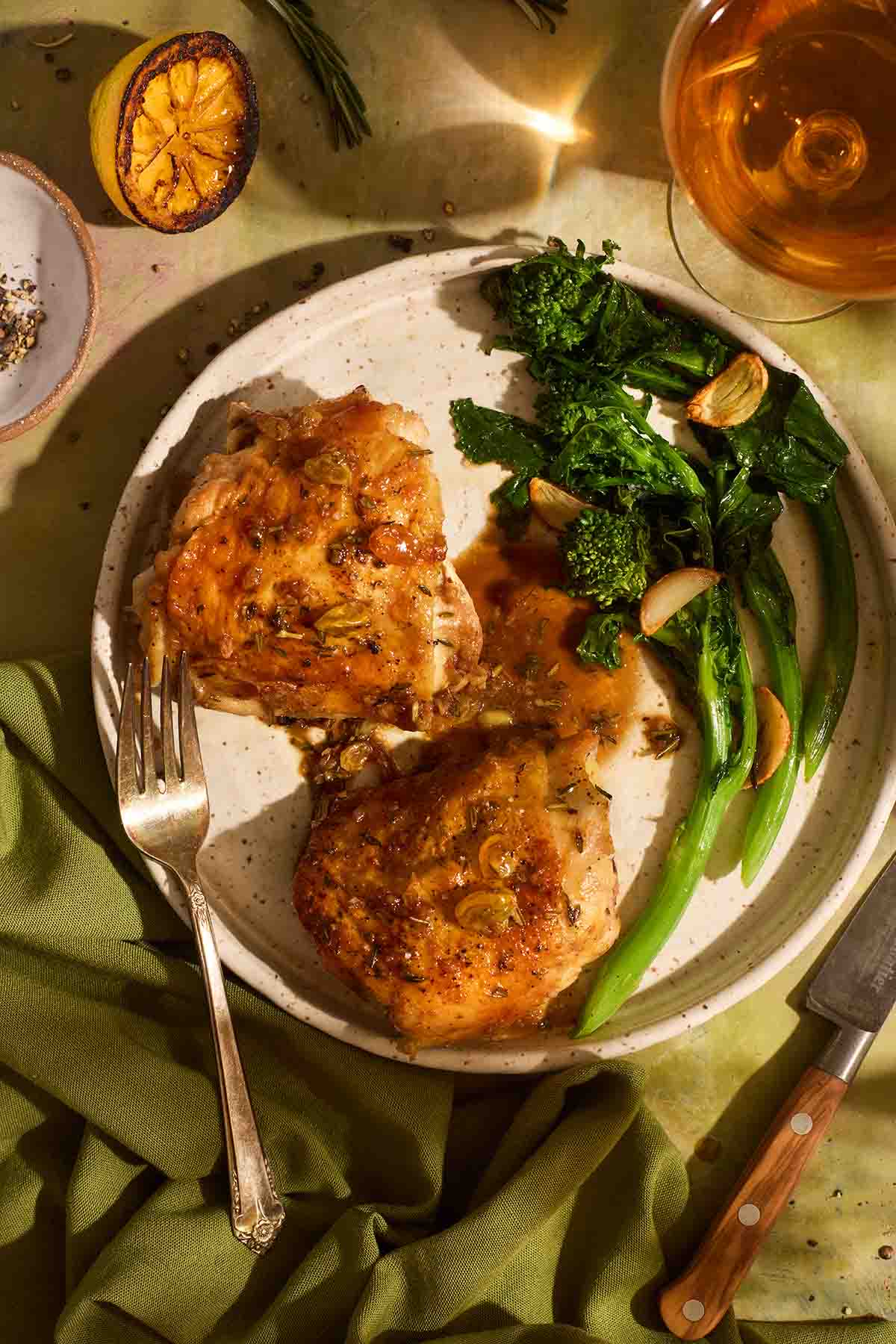
This dish screams for something that can handle the sauce. Creamy polenta is my first choice: it absorbs every drop and the richness plays beautifully against the tangy-sweet agrodolce. Mashed taters come in a close second (several testers and readers went this route and were emphatic about it). Crusty bread for mopping is non-negotiable.
For vegetables, you want something simply prepared so it doesn’t compete. Skillet Charred Broccolini has the right bitterness to cut through the sauce’s brio. Braised Carrots with Orange and Rosemary echo the sweet-savory theme without doubling down on it. Pan-Fried Green Beans keep things simple and bright. And if you want something more substantial alongside, White Beans and Tuscan Kale turns the whole thing into a proper Italian dinner.
Storage & reheating
Fridge: Leftovers keep beautifully in an airtight container for up to 3 days. The sauce tends to thicken as it chills—that’s fine, it’ll loosen right up with a splash of water or stock when you reheat. And yes, the leftover chicken over mashed potatoes the next day is arguably better than the original dinner. Our tester Adrienne reported near-familial conflict over the last thigh.
Freezer: Don’t. The sauce, with its reduction and the raisins, doesn’t love a freeze-thaw cycle. The texture turns slightly grainy and the brightness dulls.
Reheating: Cover the chicken with foil and warm it in a 300°F (150°C) oven for 12 to 15 minutes. The skin won’t re-crisp, alas. The microwave works in a pinch, but use 50% power and go in 60-second bursts. Full power turns chicken thighs into rubbery doorstops.
More jaw-droppingly good chicken recipes
French Roast Chicken ~ Poulet Rôti
1 hr 50 mins
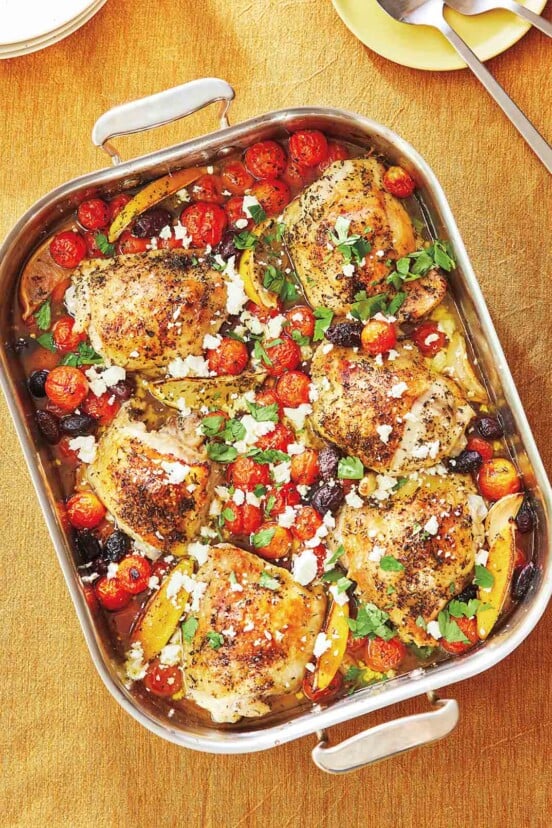
Oven Baked Chicken Thighs with Tomatoes and Feta
1 hr 25 mins
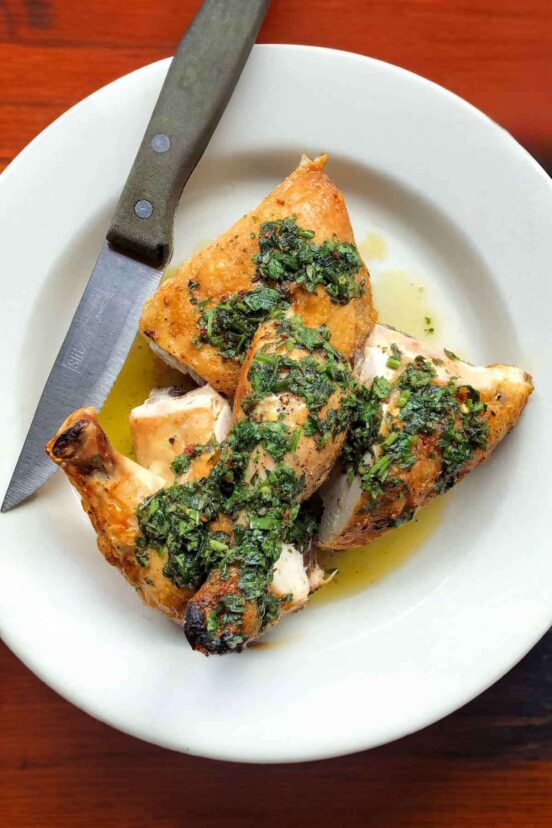
Jonathan Waxman’s Roast Chicken
1 hr 30 mins
Write a review
If you make this vinegar chicken recipe, or any poultry dish on LC, consider leaving a review, a star rating, and your best photo in the comments below. I love hearing from you.–David
Featured Review
This recipe is the definition of a flavor bomb. And to be sure, that’s a goooood thing! Yes, the agrodolce sauce is pungent when you’re cooking it, but letting the flavors of rosemary, garlic, and honey hang out for a while (I did a couple of hours) creates an amazingly tasty sauce with just the right levels of snap, sweet, and savory. I doubled the agrodolce as per David’s suggestion, and boy am I glad I did. That left plenty for the next day when we had a couple of thighs left over. I think it might have been better on Day 2. … My advice? Make. This. Dish.
Greg Crawford
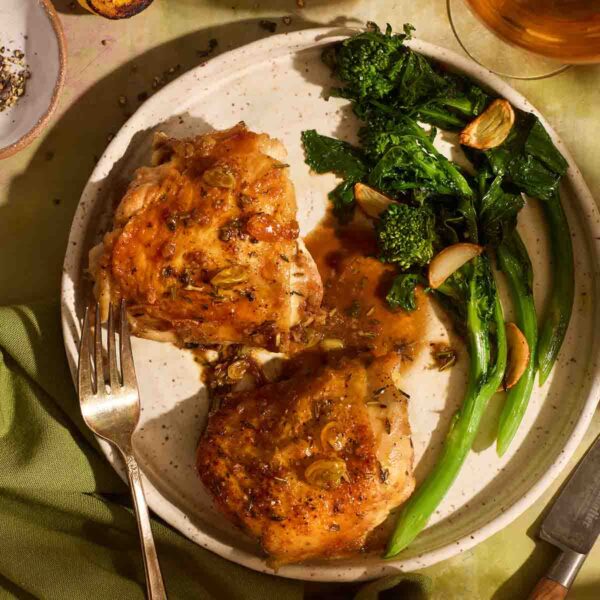
Vinegar Chicken Thighs with Agrodolce Sauce
Ingredients
For the agrodolce sauce
- 1 cup white wine vinegar
- 2 tablespoons honey, plus more as needed in step 6
- 4 garlic cloves, minced
- three 5-inch rosemary sprigs, leaves stripped and finely chopped (about 1 tablespoon)
For the pan-seared chicken thighs
- 3 pounds bone-in, skin-on chicken thighs, (6 to 8 thighs)
- salt and freshly ground black pepper
- 10 to 12 fresh thyme sprigs
- 2 anchovy fillets, or 1 teaspoon anchovy paste
- 1 cup chicken stock, homemade or store-bought low sodium
- 1/3 cup golden raisins, or up to 1/2 cup, if you want more sweetness
Instructions
Prep the agrodolce sauce
- Thirty minutes (and up to 2 hours) before cooking, whisk the 1 cup white wine vinegar, 2 tablespoons honey, 4 garlic cloves, and three 5-inch rosemary sprigs in a small bowl until the honey dissolves completely. Set aside.
Pan sear the chicken thighs
- Season the 3 pounds bone-in, skin-on chicken thighs well with salt and freshly ground black pepper. Place them skin-side down in a single layer in a large (12-inch) cold skillet or two smaller skillets. Turn the heat to medium and let the thighs slowly sizzle, rendering their fat. As the fat begins to render, tuck small bouquets of the 10 to 12 fresh thyme sprigs in between the thighs. Why use a cold pan?
- Now leave them alone. I mean it! If you move them too soon, they’ll stick and you’ll panic. They’ll release on their own when they’re deeply golden-brown and the skin is crispy, 20 to 25 minutes.
Flip and finish searing
- Flip the thighs and cook for 5 minutes more. Transfer to a plate, tent loosely with foil to keep the chicken warm, and set aside.
- Fish out and discard the naked thyme stems from the skillet. Pour off all but 2 tablespoons of the chicken fat.
Build the agrodolce sauce
- Add the 2 anchovy fillets to the hot fat in the pan and mash them with the back of a spoon until they dissolve into a paste. You won’t taste anchovy—just a deep, savory thrum of flavor. Scout’s honor.
- Off the heat, slowly pour in the 1 cup chicken stock and scrape up all those glorious browned bits. Stir in the reserved agrodolce sauce from Step 1, then plop in the 1/3 cup golden raisins.
Reduce the sauce
- Bump the heat to high. Boil, stirring occasionally, until the sauce reduces by about half, 6 to 8 minutes. If you'd like a more glaze-like consistency, reduce it a few minutes more.
☞ TESTER TIP: Hot vinegar fumes are no joke. Open a window before this step and give yourself some distance. Consider yourself warned.
- Taste the sauce. It should be assertively tart with pleasant sweetness. If the acid still snaps at you, stir in 1 more tablespoon of honey and taste. Repeat, if needed.
Finish and serve
- Reduce the heat to a simmer. Nestle the thighs back into the pan skin-side up, cover, and let them warm through and finish cooking, 4 to 6 minutes. Juices should run clear when pierced with a knife.
- Spoon the sauce generously over the chicken and rush it to the table. Act appropriately humble, even though you’re a rock star.

An LC Original
View More Original RecipesNutrition
Nutrition information is automatically calculated, so should only be used as an approximation.
Recipe Testers’ Reviews
Did you know only 68% of the recipes we test make it onto the site? This recipe survived our rigorous blind testing process by multiple home cooks. It earned the Leite’s Culinaria stamp of approval—and the testers’ reviews below prove it.

This recipe results in a crispy pan-fried chicken dish getting an elegant lift from a tangy-sweet vinegar sauce, with golden raisins adding little bursts of sweetness. My better half swooned over this dish.
The recipe really comes together easily, with minimum prep. I used anchovy paste in lieu of fillets, since I always have it on hand. The infusing of herbs with the vinegar is brilliant, and while I felt the rosemary was good, I would have preferred tarragon, or maybe more thyme to suit our palate. I generally start my chicken skin side down in a cold skillet, and IMHO, it’s the best way to create a crispy, crusty skin.
My better half swooned over this dish.
☞ TESTER TIP:
- I highly recommend that you trim any excess fat and skin from the thighs to create neater portions. I then salted and peppered each side, placing them on a rack, inside a paper towel-lined sheet pan, and left them uncovered in the fridge overnight to help get more seasoning into the chicken and dry out the skin for a crispier texture. Let them come to room temperature for about 30 minutes before searing the thighs.
- Use a microplane to mince the garlic cloves. It results in much finer bits to infuse quicker in the vinegar.

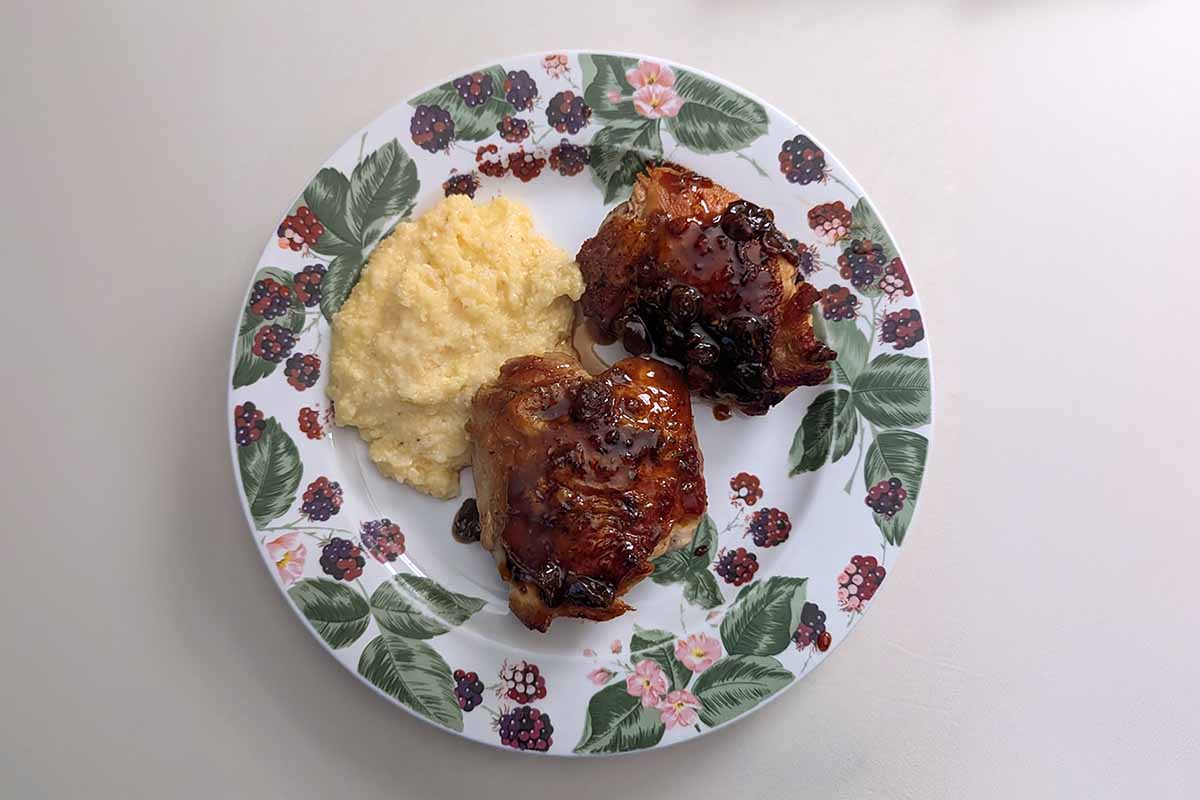
Vinegar chicken isn’t something I would’ve come up with on my own. The name made me pause and take a closer look at the recipe. I am so glad that I did. There really aren’t a lot of ingredients in this recipe, but they make such an interesting and complex flavor combination.
Right now, there’s a single chicken thigh left over, and I fear there may be a bit of a struggle to determine who gets it.
When I was seasoning the chicken, I put salt and pepper under the skin as well as on top of it. The chicken crisps up beautifully—I’ll definitely use the cold pan method for cooking chicken in the future.
I used three extra tablespoons of honey in the sauce before I could taste any coming through. It was a nice balance of tangy acid and a hint of sweetness.
My husband loved this dish. Right now, there’s a single chicken thigh left over, and I fear there may be a bit of a struggle to determine who gets it. The next time I make this, I will double-check to be sure I get an even number of chicken thighs. In fact, next time I make this, I am going to double the recipe so there are plenty of leftovers for another meal.
I served this with Glazed Turnips and Apples, polenta, and a mixed green salad. It was pretty much a perfect meal.

I made the agrodolce sauce about 45 minutes before I started the chicken, which meant it sat for over an hour before I used it. You can taste the difference between when it was first made and when I used it. The vinegar and garlic both mellowed out, and it became almost vinaigrette-like. I used American Vinegar Works Chardonnay Wine Vinegar, blackberry blossom honey, and fresh rosemary (3g). I used four cloves of garlic (15g), and, never one to EVER think there’s too much garlic, once the sauce reduced, it did seem like a lot. It wasn’t too pungent by any means, but visually, it looked like a lot. I think I would use 10g next time and see how that works.
The chicken took a little while to really begin to cook, you have to be patient. Once the fat started to render, the sizzle started, and I added the thyme sprigs. It took me a little bit longer than 20 minutes, 27 minutes, to have nice color on the chicken. That could very well be temperature control too, what’s medium varies from stove to stove. I think color and temperature is more important than time.
The chicken broth will steam up when you add it to the hot oil and anchovy paste. If your pan’s shallow, you may want to remove it from the heat before adding.
About halfway through the reduction, the sauce is very vinegar forward. It’s important (and very obvious) that when the sauce is the right consistency, the taste completely changes to a delicious agrodolce. I didn’t have to adjust the taste with additional honey.
Once I added the chicken back into the sauce, it reduced rather quickly, so watch it closely. I’ll pull it off the heat sooner, so I have more sauce.
It makes a beautiful plate. Served it with creamy polenta as suggested, perfect accompaniment. I used Ploughgate Creamery’s Rosemary Butter in the polenta so the notes of rosemary carried throughout the meal.

All the family loves vinegar-like things. Since my sister and I have been enjoying making family dinners and trying new recipes, this seemed like a good choice.
The flavor of the sauce is really good, not too much vinegar. The sauce is especially good on top of mashed potatoes. Please be aware: The sauce is thin, and there wasn’t a lot. There might be some family fighting over it after people taste it on the potatoes. Other than potatoes, we had salad and little cheese breads.
I used anchovy fillets and smashed them as the recipe specifies, and you genuinely can’t taste them. The raisins add another dimension, too.

If you need something to call your guests to the table, just let them inhale this enticing aroma! They won’t be able to resist. This chicken is flavorful, lovely to look at on the plate, and even better in the mouth. The vinegar infused with some garlic and fresh rosemary would be good on just about anything, and on this chicken it is perfect. There’s just enough zing to bring out the great taste of the cooked chicken that’s still juicy and moist inside while retaining some degree of crispness on the outside.
You won’t be disappointed. It’s an ideal recipe for a dinner party—the smooth, vibrant taste of the dish will elevate the entire evening.
We really liked these pan-seared chicken thighs. It definitely fed men and boys, which is a big plus as far as I’m concerned. It was also delicious, another big plus.
I did kind of wish there was more sauce in the end because the sauce was so, so tasty. But that could easily be remedied by doubling the sauce recipe. (We’re a big sauce family.)
I would actually try this same dish with boneless, skinless chicken breasts when I’m pressed for time, which is just about always. I think it could be equally great that way.










I made this recipe with using 3.5 lbs of boneless and skinless chicken thighs. It was delicious. I served it with a potato. My husband says it was very tender, tasted good, and not too messy. I have to agree with him. I love the glaze it made when it cooked down. I can taste the sweet and sour in the recipe.
I was skeptic about the recipe but seeing that I like recipes with clear directions and few ingredients, I want to take a crack at it. It did not disappoint. Plus, if I did not get rid of the chicken soon it would have gone bad. I hate wasting food and money.
This is a great meal for everyone. The aroma of it being made is good. And the taste of the red wine vinegar is not strong at all. This is a staple recipe in my house. It was the first time using red wine vinegar.
Jr. So glad you enjoyed the dish. It’s wonderful.
I made this over the weekend using just chicken thighs…wow! This is a fabulous recipe, simple and absolutely delicious! I served it with creamy Parmesan polenta. If you haven’t made this yet, do it and don’t be afraid to test it out on company…it presents beautifully and they’ll love it!
Terri, I like the way you think. The polenta sounds great. And using thighs makes so much sense, as they’re so flavorful compared to breast meat.
Years ago I found a recipe called Hunter’s Chicken which was like yours with the addition of tomatoes. I loved to make it because the splash of vinegar changed the profile of the dish. Thanks for the reminder.
The interview was terrific! I grew up in a household of women, and when I encountered “hormones” was mystified by their copious eating, hence our the nickname “Hoovers.” Thank you.