
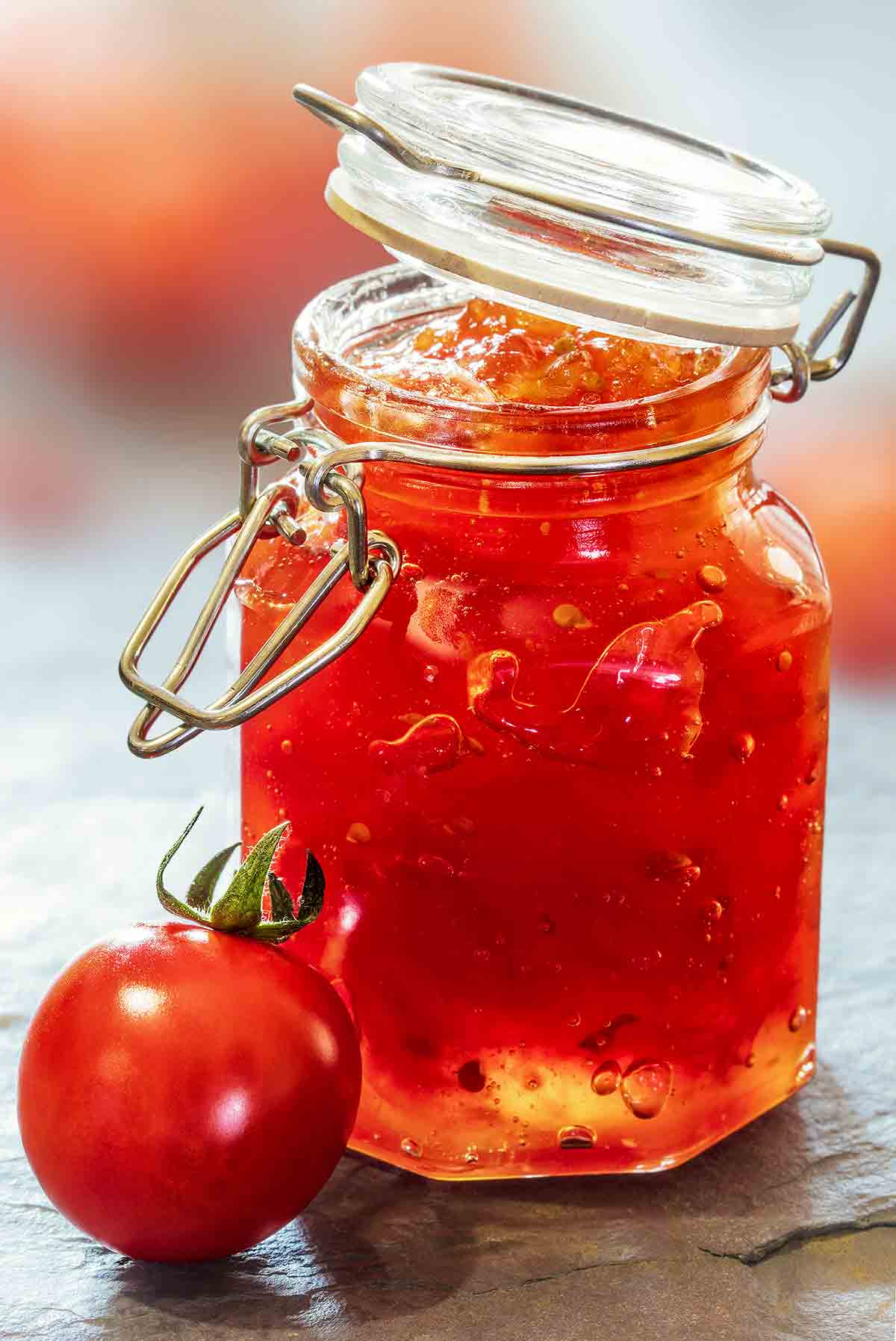
This Portuguese tomato jelly recipe was shared with Amanda Hesser, author and former food writer for The New York Times, by Maria, an expatriate Portuguese cook living in France. I’ve received countless requests for this sweet and simple delight, the centerpiece of many Portuguese childhoods. Thanks to Amanda, here it is. Bon appetite.–David Leite
Tomato Jelly FAQs
If your bounty of tomatoes is more or less than the recipe calls for, simply brush up on your fourth grade math skills and use the proportions in the recipe above to scale the amount of sugar and water according to the amount of tomatoes you have on hand.
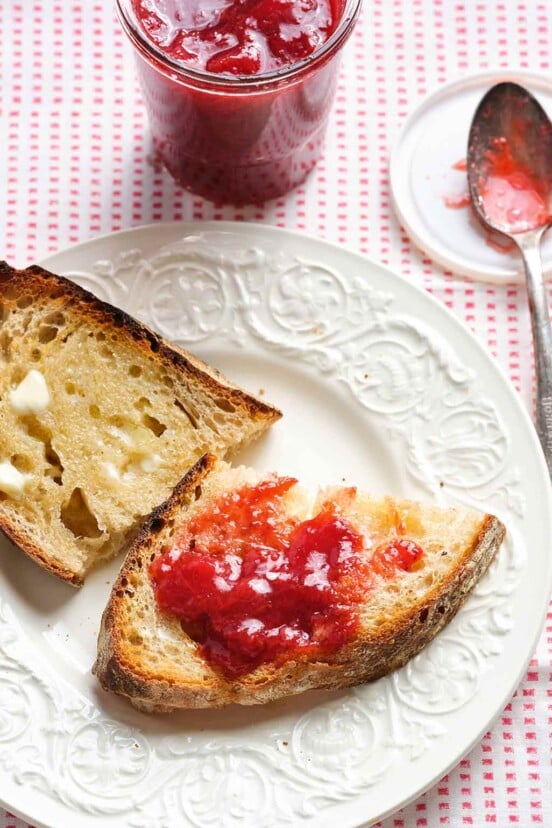
This jelly can be used as you would use any savory jam or chutney. Spread it on toast or artisan bread, dollop it over soft cheeses and spread on crackers, tuck it inside a grilled cheese sandwich, or serve it as part of a charcuterie board.
Once safely canned, store your jelly in a dark spot at cool room temperature for up to 12 months. Refrigerate after opening.
Portuguese Tomato Jelly
Ingredients
- 1 quart tomato juice, (about 6 1/2 pounds [3 kg] tomatoes should yield 1 quart juice—do not use canned)
- 3 cups granulated sugar
- 1 cup water
- 5 tablespoons bottled lemon juice
Instructions
- Purée the tomatoes in a food processor, working in batches if necessary. Pass the pulp through a sieve, pressing with the rounded side of a ladle or spoon to extract as much juice as possible. Measure out 1 quart (4 cups) juice.
- In a large pot, heat the sugar and water, dissolving the sugar to make a syrup, and bring the syrup to a boil. Boil to string stage (240°F/115°C on a jelly thermometer). This could take as long as 30 minutes.
☞ TESTER TIP: You can test this by using a spoon to drop a little syrup in ice water. Dip your fingers in the ice water and take a small bit of syrup off the spoon. Quickly press it between your index finger and thumb, then pull them apart. If a thread or string of sugar forms, the sugar is ready.
- When the sugar reaches 240°F (115°C), take the pot off the heat, pour in the tomato juice and lemon juice, and quickly stir to dissolve the sugar lumps that form.
- Return the pot to the stove and keep stirring with the pot over high heat, until it reaches jell stage (220°F/105°C), 20 to 25 minutes. Pay careful attention because the jelly will rise up in the pot and will need constant stirring with a wooden spoon to reduce the volume. As it cooks, the syrup progresses from a pale peachy color to a russet red. As time passes the color darkens more rapidly, turning this russet red just at jell point. Nearing this crucial point, you will also begin to hear the snap and crackle of air bubbles breaking at the surface and popping against the thick syrup. This means you're almost there. If you wish to test the jell point, pull the pot off the heat and spoon a little jelly onto a plate to see if it sets up in a minute or two. The jelly has a very soft, loose consistency and will not end up completely firm like some jellies.
- When the jelly is ready, pour it into sterilized canning jars. The jelly, curiously, does not set up clear like other jellies but is has a red dotted appearance. Process the jars in a boiling-water bath for 10 minutes.
- Store sealed jars in a cool dark place and use within one year. Once opened, store in the refrigerator and use within 3 weeks.
Nutrition
Nutrition information is automatically calculated, so should only be used as an approximation.
Recipe Testers’ Reviews

Tomato jam is one of my favorite jams. In Portugal, we prepare it in the end of summer, when the tomatoes are ripe and full of flavor, to turn to during winter.
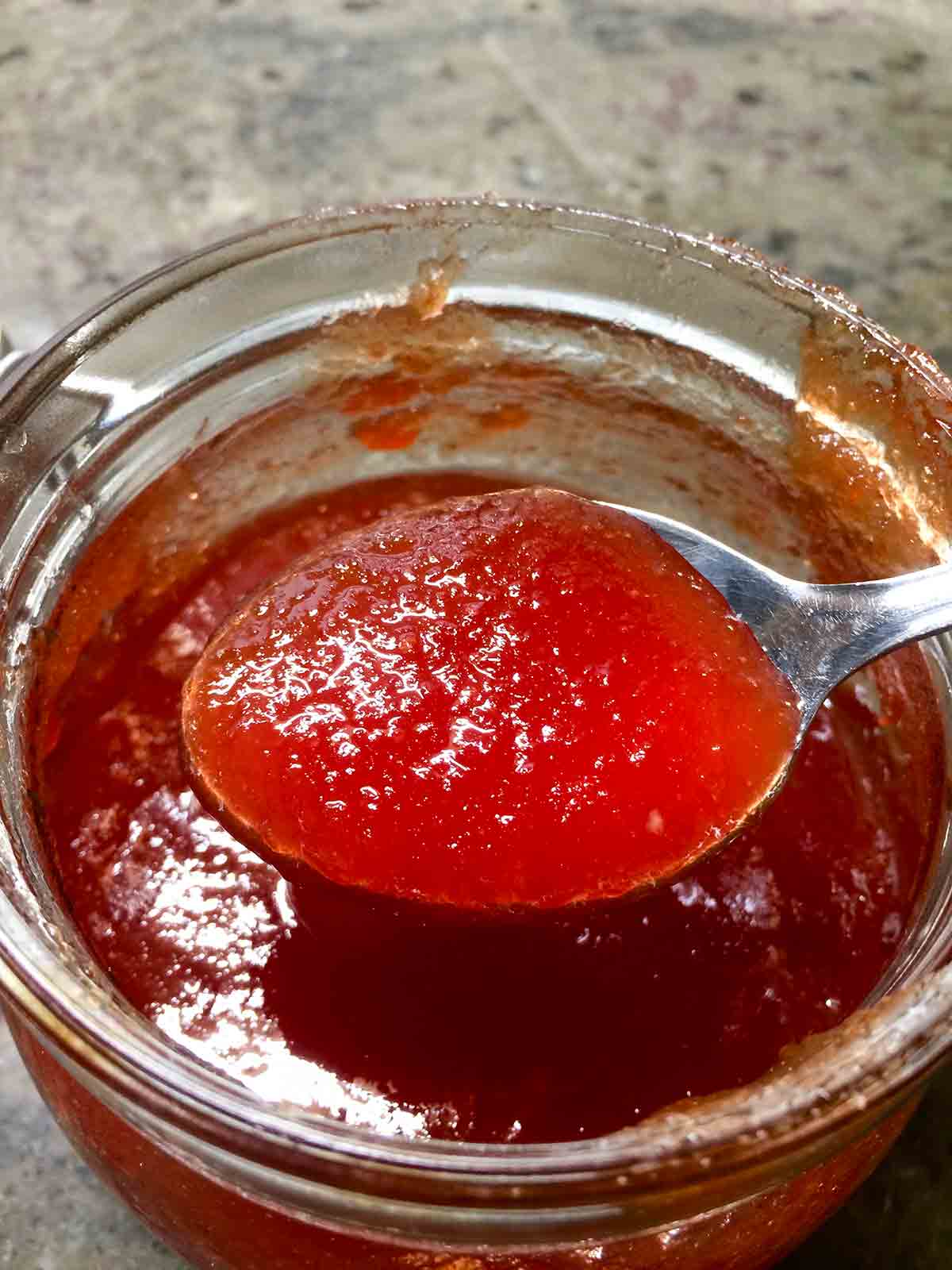
This tomato jelly recipe is easy to prepare and the jelly has a delicious tomato flavor and a good consistency. Perfect to serve with toasted bread and as an accompaniment to cheese.
After adding the tomato purée and the lemon juice, it took 20 minutes over high heat to reach the jelly stage that has a russet red color. Once again, I used the thermometer to monitor it.

This tomato jelly recipe was a delicious and different way to use up some garden tomatoes that will last long past summer! We were big fans of this Portuguese tomato jelly in my house. The jelly has an inherent sweetness but not in a cloying way, and the lemon juice helps to balance it out and lend a level of bright acidity.
This requires a bit of hands-on time, but the effort is fairly minimal and the reward is worth it!
Because we’re big fans of spice, I mixed in some freshly ground black pepper to one of the pint jars and a pinch of crushed red pepper flakes and some dried rosemary to another pint. Next time I’ll add the black pepper to the full recipe as it gave the jelly a bit of zip.
The time to reach jell stage was 28 minutes but it was a humid day and even though I had the air-conditioning on, I think the weather caused it to take longer.
So far, I’ve used the tomato jelly on toast and as part of a cheese plate I served to guests this weekend. I think it would be a great addition to sandwiches or even in a tomato quiche to add another layer of intense flavor.











I made this. The second boil I boiled to about 110 C and still it came out as a thick syrup. Tasty though! I ate drizzled over yogurt with nectarines and some black pepper on top.
Also it made nowhere near the amount promised. I made a batch with 1.5quarts of juice and ended with about 3 pints total.
We’re sorry this didn’t turn out quite as you’d expected, Abby, though we’re glad it’s still very tasty! Your tomatoes may not have had enough pectin (particularly if they were very ripe) to help it fully set and the extra boiling time would have reduced your yield slightly.