

TL;DR (Quick-Answer Box)
- What it is: A semi-boneless Italian roast leg of lamb marinated in a traditional garlic, rosemary, and lemon paste and roasted to a perfect medium-rare.
- Why you’ll love it: A spectacular centerpiece that delivers a punch of Mediterranean flavor with minimal hands-on time, making it a foolproof, elegant centerpiece for Easter or a Christmas dinner.
- How to make it: Pierce the lamb all over, slather with a garlic-rosemary paste, marinate, then roast on high heat before slow-roasting until medium-rare. Top with lemon slices + serve.

Jump To
- TL;DR (Quick-Answer Box)
- Why this Italian leg of lamb recipe works
- Notes on ingredients
- How to roast a leg of lamb: For visual learners
- Your roast leg of lamb questions, answered
- Italian Roast Lamb pro tips & troubleshooting
- Storage & reheating
- What to serve with Italian roast leg of lamb
- More comforting lamb recipes
- Write a review
- Italian Roast Leg of Lamb with Garlic and Rosemary Recipe
- Recipe Testers’ Reviews
Roast leg of lamb scares me. There, I said it. I don’t cook it often, it’s expensive, and, well, it’s honkingly huge. Usually, it’s just The One and me for dinner. But when it came to this recipe—a classic Italian preparation, specifically from Tuscany—I girded my loins.
The only difficult part, if you could call it that, is finding a semi-boneless leg of lamb. I suggest ordering from a butcher; I’ve had little luck and a lot of confused looks when asking the guys at the supermarket meat counter. Once you snagged that, rest is just chopping, mixing, rubbing, and roasting.
And the payoff? Huge. When I came into the dining room with this on a cutting board, everyone gasped. (In a good way.) But the real showstopper was the carving. I know, you think you suck at carving. Not this time. Because the hip bone’s removed, it’s nothing but lamb. If you can slice a loaf of bread, you’re golden.
Chow,

Featured Review
Holy lamb! I made this for Easter and boy was it fantastic. The rosemary lemon paste was just perfection on the lamb. Served with pommes fondant and roasted carrots for a beautiful Easter dinner, yummilicious.
BBQGoddess

Why this Italian leg of lamb recipe works
This Italian roast leg of lamb works because of its massive thwack of flavors and foolproof results. The paste—a classic Mediterranean trifecta of garlic, rosemary, and lemon—penetrates the meat through deep slits, ensuring every slice is infused with bold, bright notes.
To get a perfect texture, starting off with high heat triggers the Maillard reaction, which creates a deep, savory crust. Then by lowering the oven temperature, the lamb cooks evenly to a succulent medium-rare without the risk of drying out. It’s simple to prepare yet elegant to serve, it’s guarantee to drop a few jaws at the dinner table.
Notes on ingredients
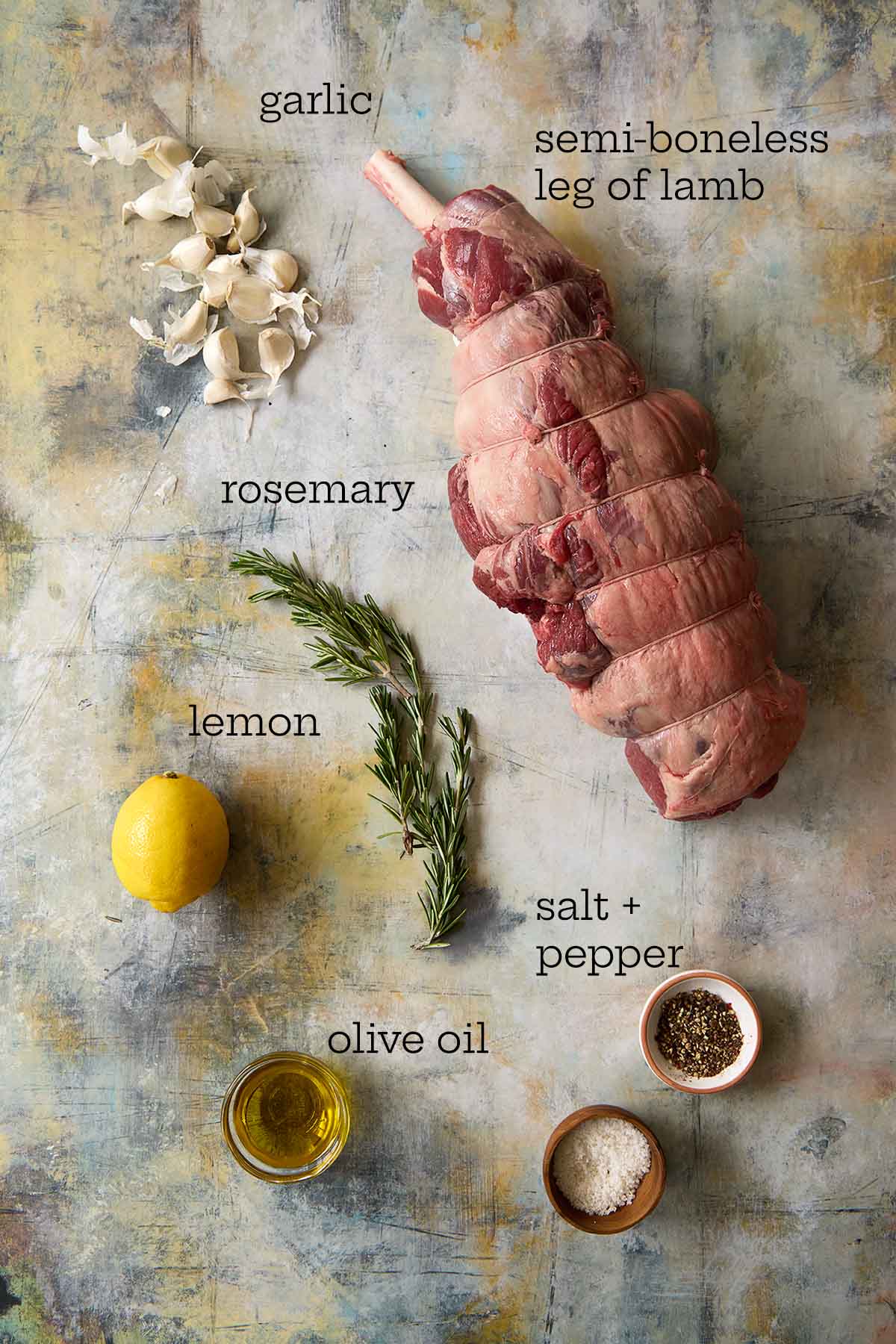
- Semi-boneless leg of lamb—A semi-boneless leg has the hip/aitch bone and shank end removed, leaving the femur in place. This makes for a roast that still looks and eats like bone-in lamb but is much easier to carve; I have my butcher prep it so I won’t mangle it. When buying, look for meat that’s fine-grained with a pinkish-red color and fat that’s creamy-white. Steer clear of anything muddy red or with yellowing fat
- Garlic—Fresh garlic gives brio to the Tuscan rub with a pungent smack that mellows sweetens as the lamb roasts. Opt for heads that are heavy for their size with tight, papery skins. Give the bulb a gentle squeeze; it should feel firm with no soft spots or green sprouts peeking through.
- Rosemary—This woody herb provides a classic Mediterranean piney aroma that penetrates deep into the meat through the slits you’ll make. Look for sprigs with vibrant green needles that are firmly attached to the stem. Nix any yellow, brown, or brittle sprigs.
- Lemon—The juice and zest cut through the richness of the lamb and give a nice lilt. Whenever I use lemon zest in a recipe, I prefer organic lemons. Pick fruit that feels heavy for its size—often a sign it’s packed with juice—and has a bright, thin skin. 🍋 Note: If you can’t find unwaxed lemons, scrub the fruit under hot running water with a brush, and dry well before zesting.
What’s the difference between leg of lamb cuts?
| Feature | Bone-In | Boneless | Semi-Boneless |
|---|---|---|---|
| The Cut | Typically includes hip, shank, and femur bones. | All bones removed; rolled and tied in. | Usually hip and shank removed; femur remains. |
| Carving | Challenging. Requires navigating around the joints. | Easiest. Slices uniformly. | Easy. Slices cleanly until you hit the straight bone. |
| Flavor | Fullest. The bone slows cooking nearby, keeping that meat juicy. | Milder. No bone to buffer heat near the center. | Rich. Retains the succulent bone-side meat without the hassle. |
| Cooking | Variable. The thin shank end cooks faster than the thick thigh. | Uniform. The even shape helps it roast consistently. | Steady. More even shape than a full leg; retains bone-adjacent juiciness. |
| Best For | Dramatic holiday presentation. | Stuffing. | Quick roasting & easy carving. |
How to roast a leg of lamb: For visual learners
- Chop—Coarsely chop garlic cloves. Sprinkle with sea salt and finely chop. Using the flat side of the knife, smear the garlic and salt into a coarse paste.
- Stir—Add rosemary and lemon zest to the garlic paste, chopping until fine. Add to a bowl and stir in olive oil, lemon juice, and black pepper to form a thin paste.
- Pierce—Poke the meat all over with the tip of a small, sharp knife to create slits that will act as small flavor pockets for the herb paste.
- Marinate—Fill the slits with the herb paste, then slather the remaining paste all over the meat. Wrap the lamb tightly in plastic wrap and refrigerate for several hours or overnight to allow the flavors to penetrate.
- Roast—Take the lamb out to remove the chill, then start it in a high-heat oven to develop a savory crust. Lower the temp to finish cooking evenly, topping with lemon slices during the final stage for a bright, citrusy finish.
- Rest and serve—Let the meat rest on a carving board to allow the juices to redistribute. Use the bone as a handle and carve the leg into thin, rosy slices before garnishing with rosemary.
Your roast leg of lamb questions, answered
For a perfect rosy-pink interior, remove the lamb from the oven when your instant-read thermometer hits 130°F (54°C). As the roast rests, the temperature will climb to 135°F (57°C)—the sweet spot for medium-rare. Don’t let it sit too long in the oven, otherwise lamb will go from succulent to tough in no time.
Ah, the eternal question. Cooking times vary depending on your oven’s efficiency, but a general rule is 15 to 20 minutes per pound for medium-rare. That being said, I always always rely on internal temperature, not the clock. Since this is an expensive cut, a thermometer is your best hedge against a muddy red or overcooked center.
Roast it uncovered. You want that high initial heat to hit the meat directly to trigger the Maillard reaction, creating a deep, savory crust. If you find the lemon slices on top are browning too quickly toward the end, loosely tent a piece of foil over the meat to protect them.
“Semi-boneless leg of lamb” is one of those infuriating culinary terms, as it means different things to different chefs. But, generally, a semi-boneless leg is cut that has the awkward hip and shank bones removed, leaving only the straight femur bone intact. This gives you the flavor benefits of a bone-in roast, but it’s infinitely easier to carve—if you can slice a loaf of bread, you got this.
The secret to a tender lamb is the rest. Once the meat comes out of the oven, transfer it to a carving board and leave it alone for at least 15 to 20 minutes. This allows the muscle fibers to relax and the juices to redistribute back into the meat rather than flooding your cutting board.
Italian Roast Lamb pro tips & troubleshooting
☞ Order ahead for the best cut
Don’t gamble on your holiday meal at the supermarket meat counter. Call your butcher a few days early and request a “semi-boneless leg with the hip and shank bones removed” but the femur bone left in for maximum flavor and easy carving. If he or she says, “Huh?” find another butcher!
☞ Trust the thermometer, not the clock
Because a leg of lamb is an expensive proposition, an instant-read thermometer is your BFF. Pull the meat at exactly 130°F (54°C) for a perfect medium-rare; any longer and you risk the lean meat turning from succulent to tough.
☞ The “Long Rest” is mandatory
Resist the urge to carve immediately to avoid losing all the flavorful juices. Let the roast sit for at least 15 to 20 minutes. This allows the muscle fibers to relax, ensuring those juices stay in the meat rather than flooding your cutting board.
☞ Always carve against the grain
The grain refers to the direction the muscle fibers run. To make extra sure every bite is tender, always slice the meat perpendicular to these fibers.

Storage & reheating
Fridge: Cool the lamb completely, then wrap it tightly in plastic wrap or store it in an airtight container in the fridge for up to 3 days.
Freezer: The roast can be frozen for up to 3 months. Wrap the meat (whole or sliced) tightly in plastic wrap followed by a layer of foil to prevent freezer burn. Thaw overnight in the refrigerator before reheating (above).
Reheating: Place thick slices in a baking dish with a splash of chicken stock or water, cover tightly with foil, and warm in a 300°F (150°C) oven until just heated through. Not up for turning on the oven? Let thick slices come to room temp, then quickly heat them in a skillet over low heat to preserve that perfect medium-rare center.
What to serve with Italian roast leg of lamb
Because this roast is rich with garlic and rosemary, you want sides that can either catch the exquisite pan juices or cut the fat. For wine, a Chianti Classico Riserva has the acidity to match the lamb, while a Vino Nobile di Montepulciano offers a deeper, earthier pairing.
- The Potato: Fork-mashed potatoes are rustic and textured, making them the perfect tater for the garlic-lemon pan juices.
- The Vegetable: These braised carrots with orange and rosemary echo the herbs in the lamb while adding a sweet citrus lift.
- The Green: Keep it snappy with pan-fried green beans rather than a heavy casserole.
- The Salad: A crisp apple, Parmesan, and mixed green salad lends a bright, acidic counterpoint to the rich meat.
- The Grand Finale: The One insists on ending the evening with a flourless chocolate cloud cake—it’s intense and moussey without being a “gut bomb” after a big meal.
More comforting lamb recipes
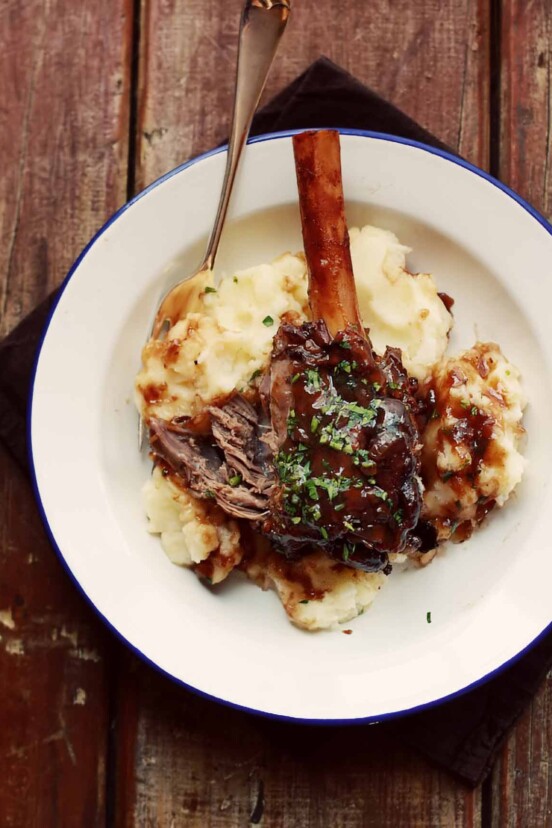
Braised Lamb Shanks in Pinot Noir
3 hrs 40 mins
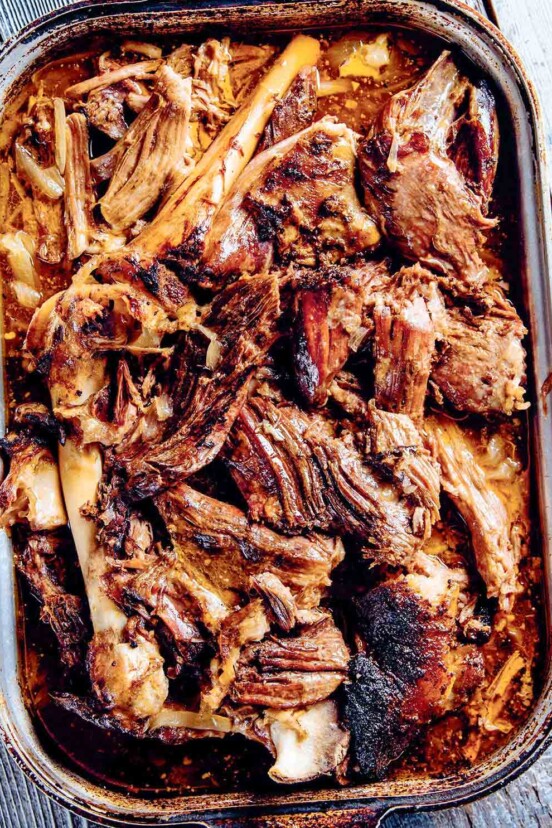
Lamb Barbacoa
10 hrs 15 mins
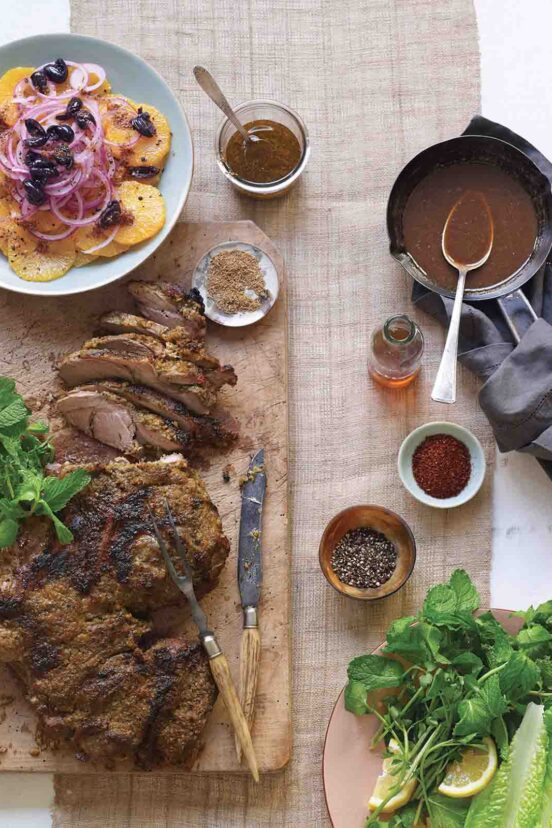

Red Wine Garlic Roasted Leg of Lamb
1 d 2 hrs 30 mins
Write a review
If you make this recipe, or any dish on LC, consider leaving a review, a star rating, and your best photo in the comments below. I love hearing from you.–David
Featured Review
Made this for an Easter dinner for six yesterday, and it was absolutely delicious! … Everyone loved it. My only comment would be that the recipe states it “serves 6.” I bought a slightly-under 7-lb leg of lamb, had it semi boned, and had so much meat leftover!! This could easily have fed 10.
Joanne

Italian Roast Leg of Lamb with Garlic and Rosemary
Ingredients
For the marinade
- 5 garlic cloves, crushed
- 2 teaspoons sea salt
- 1/4 cup coarsely chopped fresh rosemary
- finely grated zest of 1 lemon
- 3 tablespoons extra-virgin olive oil
- 3 tablespoons fresh lemon juice
- 1 1/2 teaspoons freshly ground black pepper
- one 7-pound semi-boneless leg of lamb, with leg bone
For the lamb
- 1 lemon, cut into thin rounds
- Fresh rosemary sprigs, to garnish
Instructions
Make the marinade
- On a cutting board, coarsely chop the crushed 5 garlic cloves. Sprinkle with the 2 teaspoons sea salt and then finely chop and, using the flat side of the knife, smear the garlic and salt into a coarse paste.
- Add the 1/4 cup coarsely chopped fresh rosemary and finely grated zest of 1 lemon and continue chopping and scraping until well combined. Scoop into a small bowl and stir in the 3 tablespoons extra-virgin olive oil, 3 tablespoons fresh lemon juice, and 1 1/2 teaspoons freshly ground black pepper to make a thin paste. (Alternatively, you can purée all of the ingredients in a mini food processor.)
- Place the one 7-pound semi-boneless leg of lamb on a large rimmed baking sheet. Using the tip of a small sharp knife, pierce the lamb about 15 times, making slits about 1 inch (25 mm) wide and deep all over the lamb.
- Using a small spoon and your fingertips, fill each slit with some of the rosemary paste. Slather the remaining rosemary paste all over the lamb. Cover with plastic wrap and refrigerate for at least 4 hours or overnight. Remove from the refrigerator and let stand at room temperature for 1 hour to remove its chill before cooking.
Roast the lamb
- Position a rack in the bottom third of the oven and preheat the oven to 400°F (200°C).
- Place the lamb in a large roasting pan and roast for 15 minutes.
- Reduce the oven temperature to 350°F (177°C). Continue roasting until an instant-read thermometer inserted in the thickest part of the lamb (not touching a bone) reads 130°F (54°C) for medium rare, about 1 1/4 hours. During the last 20 minutes of roasting, arrange the lemon slices on top of the lamb.
- Move the lamb to a carving board and let rest for 15 to 20 minutes. Set the lemon slices aside.
- Using the leg bone as a handle, carve the lamb by slicing vertically along the roast in the boneless area, then parallel to the bone in the shank section.
- Arrange the slices on a platter and pour the carving juices on top. Garnish with the Fresh rosemary sprigs and slices of 1 lemon and serve.
Notes
- Pierce the meat—Making slits in the lamb allows you to rub the paste deeper into the meat for deeper flavor.
- Use a meat thermometer—Shoot for 130°F (54°C) for medium-rare for the ultimate flavor.
- Rest, rest, rest—Even lamb needs to dose a bit. Fifteen to 20 minutes are enough for a moist roast.
Nutrition
Nutrition information is automatically calculated, so should only be used as an approximation.
Recipe Testers’ Reviews
Did you know only 68% of the recipes we test make it onto the site? This recipe survived our rigorous blind testing process by multiple home cooks. It earned the Leite’s Culinaria stamp of approval—and the testers’ reviews below prove it.

Oh my goodness, how good is this Tuscan style roast leg of lamb?! I made the marinade in a mini food processor so it only took a couple minutes. The marinade paste is on the thin side but boy does the aroma of garlic and lemon permeate the kitchen.
I only marinated the lamb for 4 hours before roasting the leg. The results were absolutely phenomenal. The lamb was gently scented with the garlic and lemon and the rosemary was a nice woodsy note in the background. All the flavors played together very nicely. My husband carved the leg vertically so I didn’t get to tell him about cutting on the horizontal at the front. The exterior and middle were done to a delicate blush and closer to the bone it was more rare. Regardless, the lamb was tender, juicy and oh-so-heavenly.
We served this with savory mashed potatoes and classic Greek salad. We have left overs that we are all looking forward to tomorrow. We had 4 very generous servings for dinner and have enough left for 4 pretty generous dinner servings tomorrow. There isn’t a thing I would change on this recipe.

I served this Italian roast leg of lamb on the third day of the Canadian Thanksgiving long weekend, after two days of turkey, and it was a big hit. It’s a pretty basic recipe for roasting a leg of lamb but a very effective one. The lamb was juicy and tender, with so much flavor.
I let it marinate for nearly 8 hours and feel that produced a superior result.
We served it with green beans gremolata, elegant scalloped potatoes and simple roasted carrots. I found the timing to be accurate and the instructions for carving were perfect.










This was so easy and totally delicious. I put all the ingredients in the food processor will be doing this again.
Sandra, I’m delighted it was a hit. And smart move using a processor!