
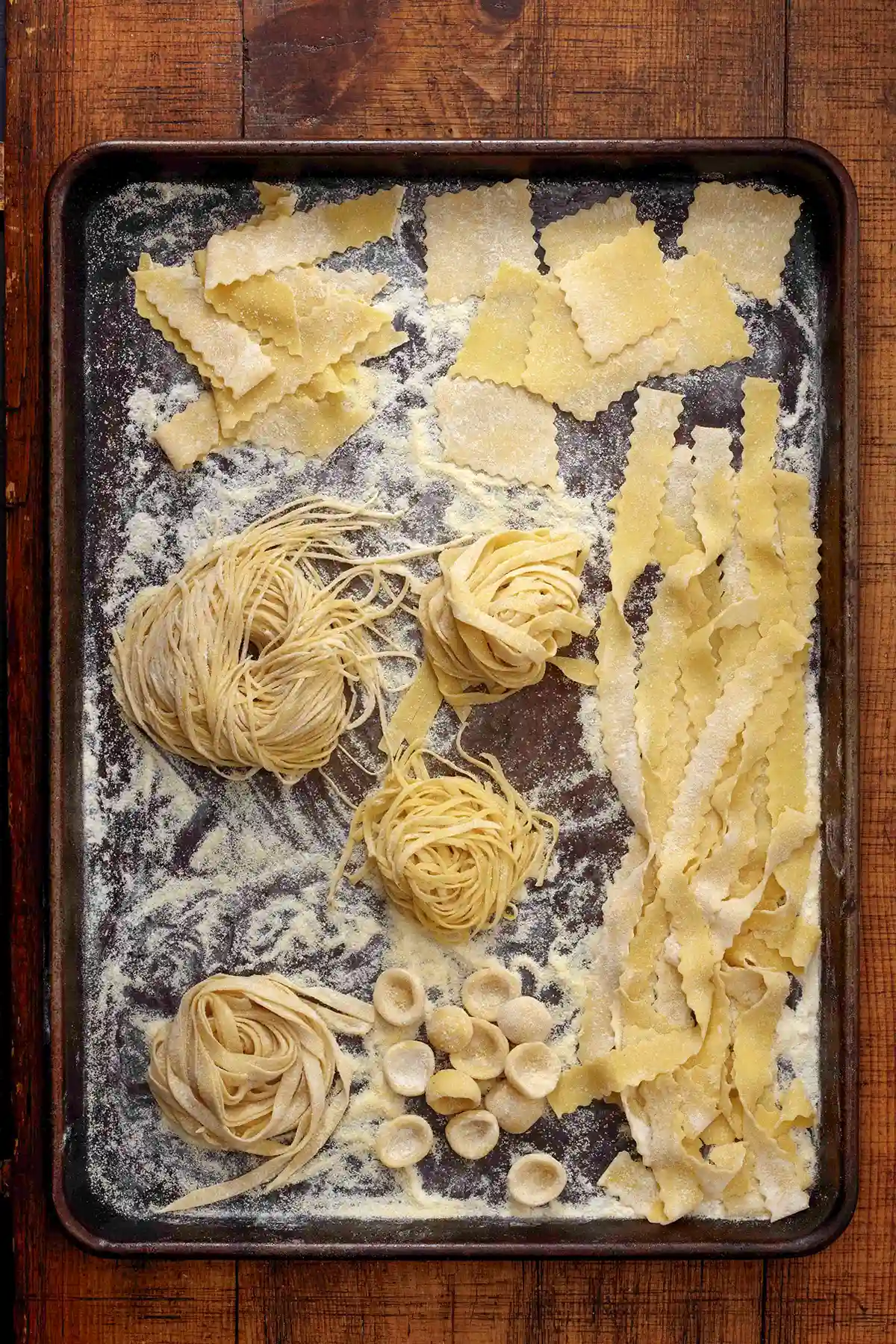
When making fresh homemade egg pasta dough, I almost always use the food processor as it makes quick work of the task. But I feel it’s also worth knowing how to mix pasta dough by hand. For one thing, nothing chases away fear in the kitchen like rolling up your sleeves and getting your hands dirty. For another, making egg pasta is a tactile experience. The more you touch and handle the pasta dough, the more familiar you’ll become with the proper consistency—how firm and how smooth it should be. I’ve included instructions for mixing the egg dough in the food processor and for mixing it by hand.
Can you make homemade pasta ahead of time?
If you plan to cook pasta later rather than sooner, sprinkle a baking sheet with plenty of semolina flour and place the pasta directly on the sheet in several small piles. Slip the baking sheet into the freezer until the pasta is firm. The pasta will keep for a month stacked in a large container with a tight fitting lid or in resealable freezer bags. When you’re ready to use it, just drop the frozen pasta into boiling water. [Editor’s Post: This freezing pasta trick will work for any shape you cut, either filled or unfilled.]
Can you add flavoring to pasta dough?
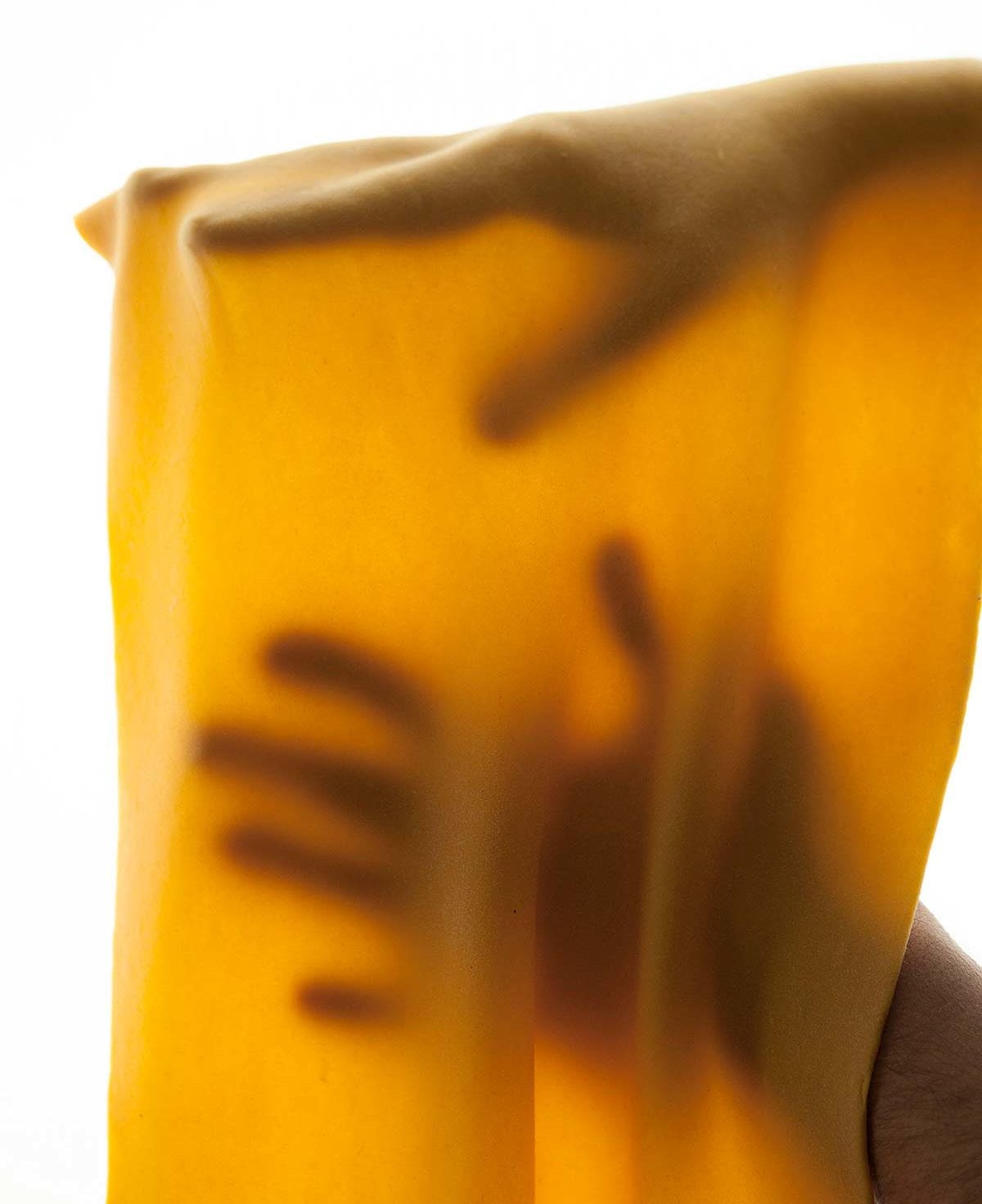
Definitely. We’re particularly smitten with the addition of pumpkin puree to make pumpkin pasta dough (above). which not only gives it a stunning hue, it also adds an earthly flavor.
Homemade pasta pro tips
☞ Pasta thinness depends upon what you’re making
Before you roll and shape the pasta, keep in mind that how thin you roll the pasta will depend on what you’re making, so be sure to carefully read your desired recipe.
- Lasagne and ravioli: Most recipes, including those for ravioli and lasagne, call for stretching the pasta dough very thin—about 1/16 inch. Passing the dough through the second-narrowest roller setting (#6) produces a very thin pasta sheet. We usually don’t go past that setting when making ravioli.
- Long pasta: Use roller setting #5 or even #4 for a more satisfying bite to your pasta.
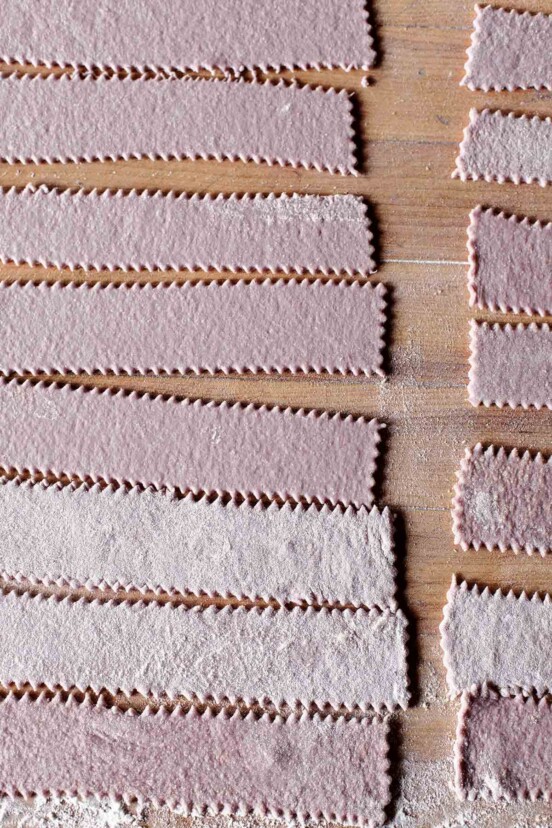
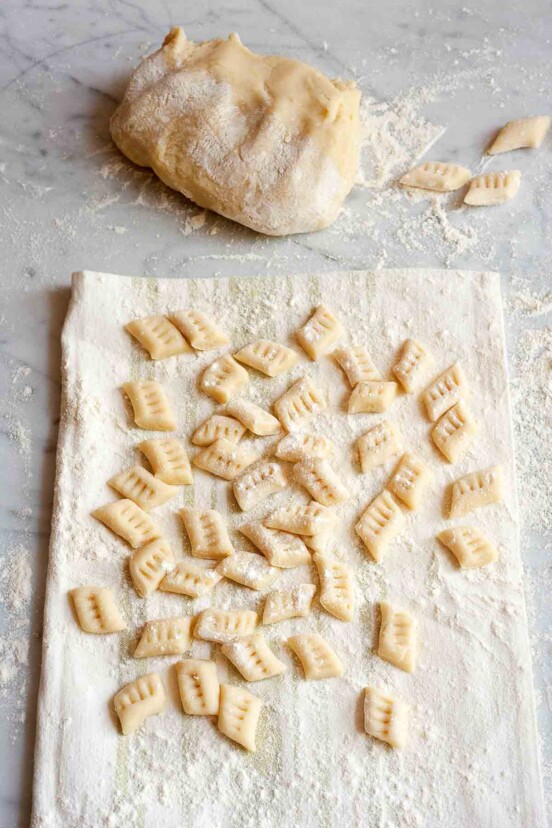
More homemade pasta dough recipes
Write a review
If you make this homemade pasta recipe, or any dish on LC, consider leaving a review, a star rating, and your best photo in the comments below. I love hearing from you.–David
Featured Review
Thanks to the addition of extra large eggs, this homemade pasta dough was such a beautiful shade of yellow! The addition of a pinch of nutmeg added a nice warm depth of flavor as well. I cut my dough with my trusty KitchenAid mixer pasta attachments into fettuccine and served it tossed with homemade pesto and tiny sausage meatballs. The pasta itself when cooked is light and airy; a real dinnertime treat.
Anna Scott
Fresh Homemade Egg Pasta Dough
Ingredients
- 2 cups “00” flour or unbleached all-purpose, (2 1/4 cups when making by hand)
- 1 tablespoon semolina flour, plus more for dusting the work surface and the dough
- 1/2 teaspoon fine sea salt
- pinch freshly grated nutmeg
- 3 extra-large eggs
- 1 tablespoon extra-virgin olive oil, up to 2 tablespoons, if dry
Instructions
Mix the pasta dough in a food processor
- Put 2 cups “00” flour or unbleached all-purpose, the 1 tablespoon semolina flour, 1/2 teaspoon fine sea salt, and pinch freshly grated nutmeg into the work bowl and pulse briefly to combine.
- Break the 3 extra-large eggs into the work bowl, drizzle in 1 tablespoon extra-virgin olive oil, and process the mixture until it forms crumbs the size of small curds. Stop the machine and pinch together a bit of the mixture between your fingertips and roll it around. It should form a soft ball. If the mixture seems dry, drizzle in another tablespoon of oil and pulse briefly. If it seems too wet and sticky, add additional flour, 1 tablespoon at a time, and pulse briefly.
- Turn the mixture out onto a clean work surface sprinkled lightly with semolina flour and press it together with your hands to form a rough ball.
Knead the dough
- Using the palm of your hand, push the egg pasta dough gently but firmly away from you, and then fold it over toward you. Rotate it a quarter turn, and repeat the pushing and folding motion. Continue kneading in this fashion, using a scraper to dislodge any dough stuck to the work surface. It will begin as a shaggy mass but will eventually turn smooth as you knead it over several minutes. You may not use all of the flour on the work surface.
- When the dough is smooth and silky, form it into a ball and wrap it tightly in plastic wrap. Let it rest at room temperature for 30 minutes.
Prep and roll the dough
- Set up your pasta machine with the rollers on the widest setting (#1 on a standard Marcato Atlas machine). Scatter a little semolina flour on the work surface around the machine and have more on hand for sprinkling the dough.
- Divide the pasta dough into 4 equal pieces. Rewrap 3 pieces and set them aside. Knead the fourth piece briefly on the work surface.
- Then, using a rolling pin or patting it with the heel of your hand, form it into an oval 3 to 4 inches long and about 3 inches wide. Feed the dough through the rollers of the pasta machine, then lay the strip on your work surface. Fold the dough into thirds, as if you were folding a letter, sprinkle with a little semolina, and pass it through the rollers again. Repeat the folding and rolling process a few more times, until the strip of dough is smooth.
- Move the roller setting to the next narrower notch and feed the strip of dough through the setting twice, sprinkling it with a little semolina each time to keep it from sticking. Move the notch to the next setting. Continue to pass the pasta dough through the rollers, twice on each setting, until you have stretched it to the appropriate thickness.
- Once you’ve stretched the pasta dough (it will be a fairly long ribbon, depending on how thin you’ve stretched it), lay it out on a semolina-dusted surface (my mother would sprinkle an old tablecloth with semolina, but a clean dish towel works well), and cover it lightly with plastic wrap while you stretch the remaining 3 pieces in the same fashion.
Cut the pasta into shapes
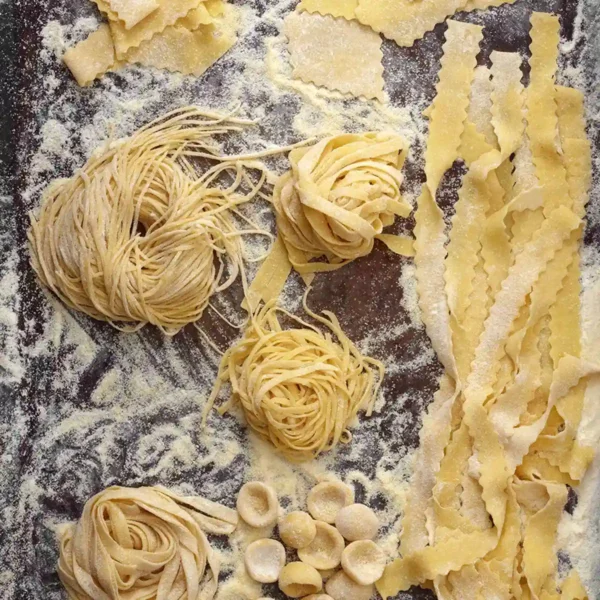
- After rolling the pasta dough cut it into the shape you desire by hand or with a machine.
☞ TESTER TIP: We’ve got some terrific tips on cutting pasta by hand.
If making noodles, such as tagliatelle, linguini, spaghetti, etc., place a wire cooling rack on a rimmed baking sheet. Toss the cut pasta with a considerable amount of semolina flour (don’t worry about using too much flour, as it’ll fall off in the boiling water), and arrange the noodles on top of the rack in small piles. Use the pasta within the hour.
Notes
To make the pasta dough recipe by hand
- Combine 2 1/4 cups “00” flour, the 1 tablespoon semolina flour, sea salt, and freshly grated nutmeg on a clean work surface and pile into a mound.
- Make a well in the center of the mound, and break the eggs into it.
- Drizzle 1 tablespoon of the olive oil into the well.
- With a fork, break the egg yolks and whisk together the eggs and oil. Using the fork, gradually incorporate just enough of the flour from the inside wall of the well into the egg mixture to create a batter-like consistency. Work carefully so that you don’t break the wall of flour, causing the egg mixture to run out and cause a mess. (If it happens, don’t panic. Use your palms to scoop up the egg mixture and work it back into the flour. No harm, no foul.)
- Use your hands to draw the remaining wall of flour over the egg mixture. Gently knead it until it’s incorporated, but here’s the trick: don’t feel like you have to use all that flour. Only work in as much as you need to reach the right consistency. Your hands will tell you when the dough is smooth and firm; any extra flour left on the board can simply be brushed away.
Nutrition
Nutrition information is automatically calculated, so should only be used as an approximation.
Recipe Testers’ Reviews
Did you know only 68% of the recipes we test make it onto the site? This recipe survived our rigorous blind testing process by multiple home cooks. It earned the Leite’s Culinaria stamp of approval—and the testers’ reviews below prove it.

This was my first time making pasta from scratch, and this recipe looked like the perfect foil for my untrained hands. This dough is incredibly forgiving—I didn’t have extra-large eggs or semolina flour and it still came together smoothly. I just added a little extra olive oil. The fact you can make this in a food processor makes it foolproof. I’d recommend this recipe to anyone who has been nervous about making your own pasta. It’s a great way to start and I’ll be using this recipe again and again!

The pasta dough turns out to be very pliable and I will use this easy recipe to make pasta dough in the future. Even at its thinnest, it was relatively easy to handle.










About that semolina flour – is this a fine powder, or the coarser semolina? Here in the Middle East we use the coarse-ground semolina for cakes. Can I use this in the pasta – or must I look for finely ground flour?
Hi Ben, this recipe refers to the more finely ground semolina flour, which adds body but does not affect the silky texture of the pasta dough. Coarsely ground semolina is too rough for egg pasta dough. I hope this helps.
Thanks!
I recently made a delicious homemade pasta using just flour, salt and egg yolks. How does the addition of whole eggs and oil change the dough? Just wondering if there is any science to it?
Thanks
Hi, Lisa. Long time no hear! We’re getting Domenica to loop into this.
Hi Lisa, this is a great question. I know that many Italian cooks use only flour and egg yolks to create an enriched egg dough for delicate pasta, such as ravioli, or classic egg noodles for lasagne alla Bolognese. My standard recipe (above), which includes whole eggs, a drop of oil, and a little semolina flour, makes a slightly sturdier dough, which can be used to make maccheroni alla chitarra (a thicker, square-cut noodle that is a favorite cut of mine) and any number of other shapes. I guess you could say it is slightly less refined than the version you made. Still, I do use it for ravioli and other shapes that require the dough to be stretched very thin, as it seems to work just fine. Hope this helps!
Thank you for the reply which makes good sense to me. I made an angel hair which was quite delicate. Next time I think I will add the semolina flour.
First time on your site. Love it. The pasta is enticing and thanks for the food processor version.
Vinita, welcome! I hope this the first of many visits. If you ever need help, don’t hesitate to write any of us.
Hi Vinita, so glad you like the pasta recipe. I hope you’ll try it. Yes–the food processor is a great shortcut. Even my octogenarian mother, who used to make pasta the “old-fashioned” way, with the mound of flour on the countertop, now uses her food processor.