
TL;DR (Quick-Answer Box)
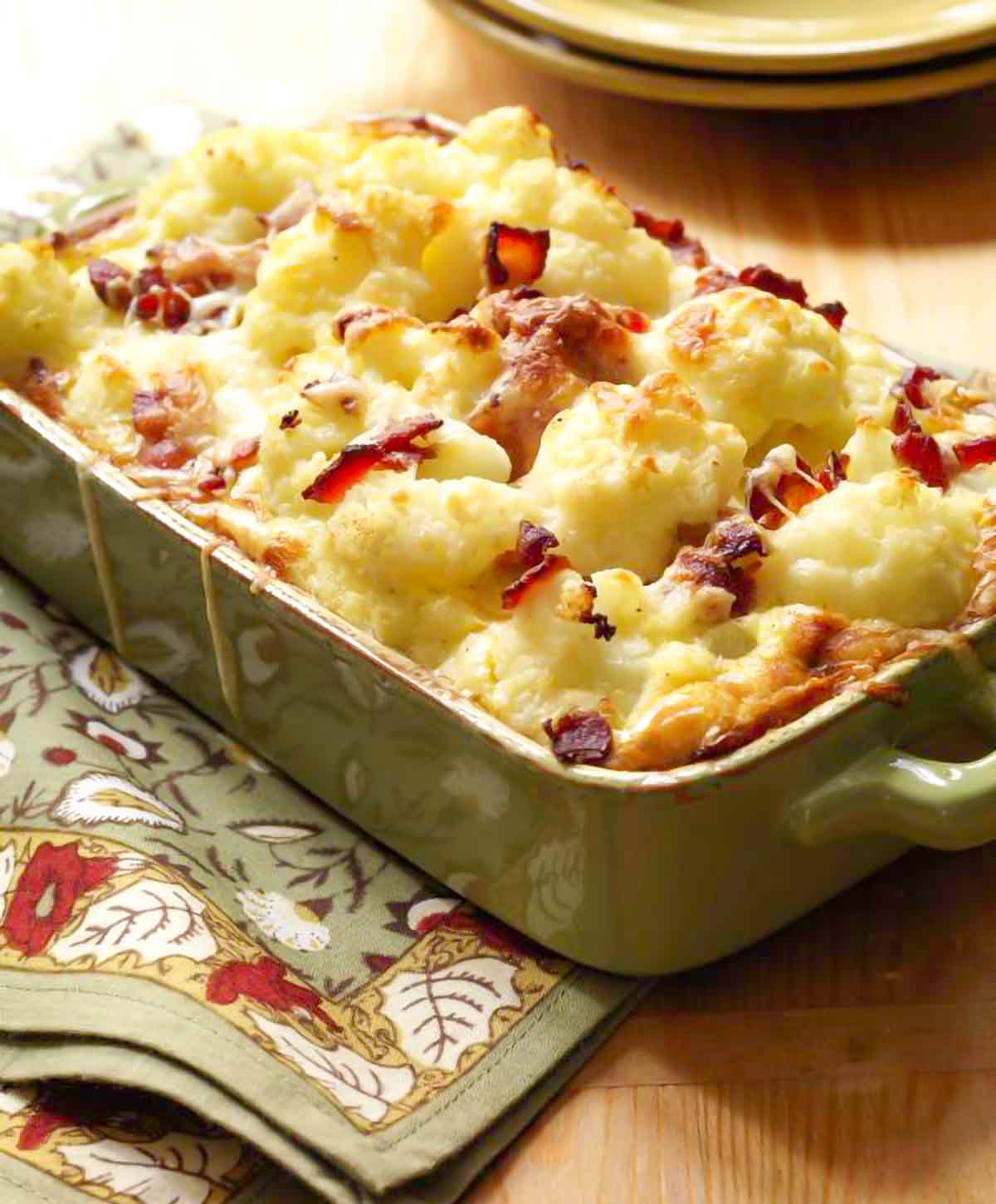
- What it is: A French-style cauliflower gratin layered with bacon, covered in a creamy, nutmeg-spiced custard, and topped with rich Gruyère cheese.
- Why you’ll love it: It is easy, comforting, and elegant enough for a holiday meal, perfect for a Thanksgiving side or a satisfying main dish with a simple green salad.
- How to make it: Boil the cauliflower florets until fork-tender, layer them with cooked bacon in a buttered dish, pour over the seasoned egg-cream-milk-flour mixture, and bake until puffed and golden.

Featured Review
This gratin is such a delicious template that we made it twice within a week (once with cauliflower and then again with broccoli)… Leftovers make a wonderful breakfast… It’s a scrummy dish that’s frankly easier and better than any crustless quiche… Note it’s a great meatless monday-kinda dish, comforting, and a main dish now in our rotation.
irene
Jump To
I’ve always had a thing for cauliflower—not a crush, exactly, but let’s say a deep respect. And when you fold it into this lush, custardy gratin with Gruyère and smoky bacon? I damn near wanted to stand and salute. The fact that this recipe comes from Dorie Greenspan doesn’t exactly hurt things.
I first made this dish years ago when The One thrust Dorie’s cookbook at me. It was rich but not heavy, velvety in that Dorie-French way, with just enough structure to slice cleanly. A gratin, yes, but one that leans ever so slightly into crustless-quiche territory.
What I love most is its range: it’s as comfortable sidled up to a roast as it is starring with a salad and a glass of wine. I’ve served it piping hot, warmish, and, I’ll admit, standing at the fridge cold with a fork. And it never disappoints. If I’m being honest, I sometimes make it just for the leftovers—if they last that long.
Chow,

Your Cauliflower-Bacon Gratin Questions, Answered
Sure, but not too far ahead of time. This lovely little dish can be served at room temperature, like a quiche, so you can make it a few hours earlier. However, you don’t want to make it too far in advance, as it won’t be nearly as good.
Any leftovers that you have can be reheated. It will be a little denser but still be quite good. Just cover with foil and gently reheat in a low-temperature oven.
More Earthy Cauliflower Recipes


Write a Review
If you make this recipe, or any dish on LC, consider leaving a review, a star rating, and your best photo in the comments below. I love hearing from you.–David
Featured Review
We loved this dish so much, I’d definitely make it again, and most certainly for company. While it is a bit hearty with regard to all the eggs, cream, cheese, and such, it could be altered for less guilt, though perhaps a few nights of salad afterwards, and a walk through the park, will be sufficient penance. 😉
Such a beautiful presentation… I used a smaller, round casserole dish—perfect! Next time, I will add bread crumbs on top for just a little extra something.
Again, a great recipe from Leite’s. This one is not only worthy of printing, but even deserves its own protective cover to keep it safe. Love it! Thank you, Leite’s.
Karen Manasco
Cauliflower-Bacon Gratin
Ingredients
- Butter, for the baking dish
- 2 1/2 pounds cauliflower (a medium head)
- 1/4 pound bacon, cut crosswise into slender strips
- 1/3 cup all-purpose flour
- 5 large eggs, lightly beaten
- 1 cup heavy cream
- 2/3 cup whole milk
- Salt and freshly ground pepper
- Freshly grated nutmeg
- 3 ounces Gruyère, (you can use Emmenthal or even Swiss in a pinch), grated
Instructions
- Adjust the oven rack to the center position and preheat the oven to 425° F (232°C). Generously butter a 2 1/2-quart ovenproof dish and place it on a rimmed baking sheet lined with a Silpat or parchment paper. (It’s not elegant and it's a tad too big, but a 9-by-13-inch baking dish works fine.)
- Bring a large pot of salted water to a boil. Cut florets from the cauliflower, leaving about an inch or so of stem. Drop the florets into the boiling water and cook until fork-tender, anywhere from 4 to 10 minutes, depending on the size of the florets. (Alternatively, you can steam the florets over salted water.) Drain and rinse the cauliflower florets under cold running water to cool them and pat them completely dry.
- While the cauliflower is cooking, toss the bacon strips into a heavy skillet, place the skillet over medium heat, and cook just until the bacon is browned but not crisp. Drain and pat dry.
- Spread the cauliflower in the buttered pan and scatter the bacon over the top.
- Place the flour in a bowl and gradually whisk in the eggs until blended. Slowly whisk in the cream and milk. Season the mixture with salt, pepper, and nutmeg and stir in about 2/3 of the cheese. Pour the mixture over the cauliflower and bacon, shaking the pan a little so that the liquid settles between the florets. Scatter the remaining cheese over the top.
- Bake the cauliflower-bacon gratin for about 25 minutes, or until puffed and golden and a knife inserted in the center comes out clean. If the top isn’t as brown as you’d like, run the gratin under the broiler for a couple of minutes.
- The gratin is best just from the oven or warm, although it can be enjoyed at room temperature, just like a quiche. You really should eat the cauliflower-bacon gratin the day it’s made, but if you’ve got leftovers, cover and refrigerate them, then let them come to room temperature or warm briefly and gently in the oven.
Nutrition
Nutrition information is automatically calculated, so should only be used as an approximation.
Recipe Testers’ Reviews
Did you know only 68% of the recipes we test make it onto the site? This recipe survived our rigorous blind testing process by multiple home cooks. It earned the Leite’s Culinaria stamp of approval—and the testers’ reviews below prove it.

With the number of eggs involved, this seemed more like a big, crustless quiche than a gratin. But no matter what you call it, it was delicious. The recipe instructions, measurements, and cooking time were all spot on, and the dish was easy to put together. As rich as it is, I’d serve it as a main dish, with salad greens on the side. It’ll definitely be making a return appearance at my house.

This cauliflower-bacon gratin decadent, delicious, and easy to prepare. I ate it hot out of the oven, at room temperature, and cold, right out of the fridge. The only issue I had was that it took 15 minutes longer in the oven than the recipe stated. If I were to make it again, I’d roast the cauliflower rather than boil it, to give it a little more intense flavor.
This cauliflower-bacon gratin is delicious and easy! And the best part: my vegetable-averse toddler gobbled it up. You can’t go wrong with Dorie.

This cauliflower-bacon gratin is definitely one I’ll make again—but with the amount of heavy cream, whole milk, and eggs, it’s more of an indulgence than an everyday meal. The cauliflower and bacon played off of each other nicely, both enhanced by the cheesy custard.
This is a good alternative to cauliflower in cheese sauce, which tends to be my favorite (and default) preparation for the vegetable. Next time, I might experiment with reducing the fat content and number of whole eggs, so I feel justified in making this more often.
I was partial to this recipe for a few reasons: a) I love Dorie Greenspan, and use her baking book for 90 percent of the desserts I make. b) I love bacon. c) I love cauliflower. d) I love French food. Happily, the dish was indeed very good: warm, homey, and comforting.
One quibble: For a dish like this where it’s impossible to taste as you go, I’d have preferred a set measurement for salt. As it is, I’m a pretty heavy hand with salt, and the dish was still underseasoned.

I served this cauliflower-bacon gratin as a side with roasted pork chops, and it was a big hit. It puffed up beautifully; all golden brown around the edges and cheesy on top. It would make a nice lunch with a salad and some crusty bread, too.

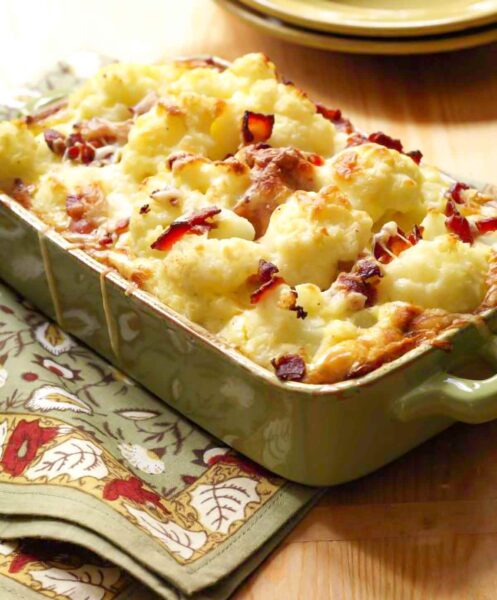
The cauliflower-bacon gratin came out of the oven looking very appetizing—golden brown on top, and bubbly all around. It tastes as good as it looks. I loved the delicate texture of the twice-cooked cauliflower and the hint of smoky bacon. With heavy cream, whole milk, and cheese, it was very hearty and rich, making it a dish that easily could be served as a main dish.
TIP: It’s important that you get rid of as much moisture from the cauliflower before assembling the gratin. Otherwise, you’ll end up with a soupy sauce instead of a creamy sauce that clings to the cauliflower. I also recommend steaming the cauliflower.

This recipe is ideal autumn comfort food, with cheese, bacon, cream, and nutmeg. Initially, when I added the flour and eggs together, the mixture was a little lumpy, but this came out all right when the cream and milk were added.
After 15 minutes of cooking, I turned the oven down slightly and moved the dish down in the oven, as it was already browning. I cooked the dish for the amount of time specified in the recipe and found that although the knife came out clean, there was still a little of the mixture that was runny within the dish—which I liked.
Next time, I might not add the cheese to the egg/cream/milk mix, instead adding some of the sauce to the cauliflower/bacon in the gratin dish, sprinkling the cheese in gradually, as I found it all ended up on the top of the dish anyway.
Cauliflower turned into a mild, but flavorful, platform for cheese, cream, and spices—how could it go wrong? The dish doesn’t take long to make—an hour start to finish or so—and the steps aren’t particularly complex. I’ve made it twice.
My quibble is that there’s no guidance provided for the spices. Nutmeg is a strong flavor and only a little bit is needed. I grated fresh nutmeg into the dish both times, so I don’t have precise measurements, but it was about 1/4 teaspoon. Also, I used more salt and pepper than I would normally think to use because I knew that eggs, cream, and vegetable combo would mask the salt of the bacon and cheese. I used one mounded teaspoon of kosher salt and almost a teaspoon of pepper the first time, and it really could have used more salt. The second time I used about 1 1/2 teaspoons salt and that was perfect. All in all, a delicious side/main dish that I’ll make again.

I made two versions of this cauliflower-bacon gratin: One with bacon and one without (for my non-meat-eating friends). Both versions were wonderful. No one wanted to believe the gratin was made with cauliflower and not potatoes. If you decide to make the gratin without bacon, I’d suggest adding sun-dried tomatoes, olives, or capers to give it a boost.
One note on pan size: I used a larger casserole dish (between 2 1/2 and 3 quarts) and the gratin looked a bit skimpy. Next time, I’ll try a 2-quart dish so it looks more substantial.










Hello there this recipe sounds amazing and I know you can be creative and swap things out and add things in. Can it be made in advance and frozen and is there any certain technique or anything to do if you’re going that route. Like to make it for Thanksgiving in advance.
Hello, Lisa. Full disclosure: We didn’t test freezing the gratin and then reheating it. But I did dome research for you. You’ll need to remove the gratin from the oven about 1/2 to 3/4 of the way through cooking. Let it cool completely, wrap it tightly, and freeze it. Let the gratin defrost in your fridge overnight and finish baking it the day of serving. Now, there will be some textural changes because of freezing. It won’t have that same creaminess, but it will taste the same.
This gratin is such a delicious template that we made it twice within a week (once with cauliflower and then again with broccoli). Not only is it way easier than my usual cauliflower with cheese sauce, it doesn’t mind a substitution (after a power outage I really wanted to use up my crème fraîche and cauiflower, and had no cream on hand). Leftovers make a wonderful breakfast. It is such a satisfying recipe, It is a scrummy dish that is frankly easier and better than any crustless quiche I have made, and a template that has infinite variations possible that will work –note it is a great meatless monday kinda dish, comforting and a main dish now in our rotation.
Love ALL of this, Irene. Thank you!!!