ONE-NIGHT VIRTUAL SEMINAR How to Write the Perfect Recipe with Renee Schettler Tuesday, July 7th from 8:45 p.m. to 11:15 p.m. EDT Fee $85.00 Think back to the last time you shared a recipe. Whether it was your own creation, copied from a cookbook, clipped from a magazine, downloaded from a blog, or hastily scribbled on the back of an envelope, chances are you jotted down a few notes before passing it along. Maybe you offered an ... Read the full story »
On June 11th, I had the pleasure and honor of being on a panel at The New School with some esteemed colleagues—John T. Edge, Anne Mendelson, Betty Fussell, and Molly O’Neill—to talk about one of the 20th century’s most important and controversal food journalists, Craig Claiborne.
Because I’ve been publishing Leite’s Culinaria for more than ten years, I was given the exciting and onerous task of discussing the future of food journalism, a topic about which if you ask 100 people you’ll get 125 responses. I was utterly terrified. To be in such company, who collectively have published enough about food to fill a library, was overwhelming enough. But then to grapple with a topic few people have a viable, concise answer to? (I had visions of suffering the same fate as many Elizabethan actors at the rotten-vegetable-filled hands of a displeased crowd.) After all, if people knew the future of journalism, they’d already be making money from it.
In my research I discovered that technology, with its Internet, mobile communications, computers, etc., is both an asset and liability to food writers. To tackle my topic, I chose to speak to leaders in the writing, publishing, and technology industries…aw, hell, it’d be so much easier, and you’d get so much more out of it, if you just watched the panel instead of listening to me blither on here.
Recently, I was at Sunda, a wildly popular new Pan-Asian restaurant in Chicago, having dinner with Judith Dunbar Hines, our city’s Director of Culinary Arts and Events. (Yes, Chicago thinks so much of food that we have a director.) We were discussing an upcoming project when the Sunda’s Food Buddha, Chef Rodelio Aglibot, approached. After exchanging pleasantries with us, he and Judith chatted about a class he was scheduled to teach, and somewhere in there I heard, “Takashi.” I sat at attention because it was only a week earlier I had chosen recipes from Takashi’s Noodles for the Web site. Takashi Yagihashi, I discovered, was also going to teach a class at Chicago World Kitchen.
When Chef Rodelio left, I turned to Judith with my most pleading puppy-dog expression and asked, “Takashi? Takashi’s Noodles Takashi?” (Hey, he may have been another of the numerous Takashis in Chicago). Without blinking, she invited me to the class.
Takashi Yagihashi, an unassuming but confident man, was named one of Food & Wine’s Top Ten Rising Chefs in 2000 and won the James Beard award for Best Chef: Midwest in 2003. I wanted to attend his class for a lot of reasons, the least of which was to get his assurance that the dishes I had chosen were both accessible and ideal for our readers. Understandably, many of the recipes in his book require ingredients that can only be found in Japanese or Asian markets. But then I figured: that’s what the Internet is for, right? I did a search and quickly found wakame (dried seaweed) on Amazon.com, so I knew I choose well.
The class was as much about food as was about culture. Some of basic tenets of Japanese cuisine, and the ones Yagihashi adheres to, are 1. keep human intervention to a minimum, as evidenced by sashimi, and 2. shun, or the concept of savoring the season. With those in mind, I told him I had picked Chilled Crab and Shrimp Ramen Salad with Chukka-Soba Dressing, which got a nod of approval from Takashi-san. What could better exemplify the Japanese’s kitchen credo than ramen, the noodle of choice for summer months, served with raw veggies.
As Takashi talked about his restaurant’s menu which changes often, I was delighted to hear that his staff wouldn’t let him rotate Braised Pork Belly off the menu, as it’s the most popular dish. Braised pork belly just happened to be the first recipe I chose from his book.
During the class, I learned that an acceptable, even encouraged, behavior of Japanese culture is the slurping of one’s noodles. It demonstrates that you’re enjoying the meal, a compliment to the host. Practice slurping Takashi’s Curry Udon. Be careful, though, he warned: slurp too demurely, and you’ll splatter yourself; slurp with too much gusto, and you may choke. You still have to chew those noodles. Let it be a challenge—slurp, swallow broth, chew noodles.
Finally, avoid one of the biggest biggest faux pas: don’t ever stand up your chopsticks in a bowl of rice (or any other food). It’s an etiquette no-no, as it’s a way the Japanese offer food to the deceased. It also symbolic of incense in the funeral rite. No problem here, though, this book is about slurpy, delicious slippery noodles.
On June 11th, I had the pleasure and honor of being on a panel at The New School with some esteemed colleagues—John T. Edge, Anne Mendelson, Betty Fussell, and Molly O’Neill—to talk about one of …
Recently, I was at Sunda, a wildly popular new Pan-Asian restaurant in Chicago, having dinner with Judith Dunbar Hines, our city’s Director of Culinary Arts and Events. (Yes, Chicago thinks so much of food that …
by Takashi Yagihashi with Harris Salat
from Takashi’s Noodles
(Ten Speed Press, 2009)
Serves 4
When these noodles appear on restaurant menus in Japan, it heralds just one thing: the arrival of summer. This ramen is a classic warm-weather …
by Takashi Yagihashi with Harris Salat
from Takashi’s Noodles
(Ten Speed Press, 2009)
Serves 4
Japanese curry? Actually, curry has been a part of Japanese cuisine for more than a hundred years. The Japanese navy adopted it in the …
by Pamela Sheldon Johns
from Gelato! Italian Ice Creams, Sorbetti & Granite
(Ten Speed Press, 2008)
Makes 1 1/2 quarts; serves 6
Serve this creamy pear gelato with a little glass of delicate but nutty amaretto liqueur.
If you don’t …
by Pamela Sheldon Johns
from Gelato! Italian Ice Creams, Sorbetti & Granite
(Ten Speed Press, 2008)
Makes 2 quarts; serves 8
The best gelato di riso I tasted was from Gelateria Il Fantino in Camp Bisenzio, near Florence. Since …
I don’t know about you, but I’m a gadget freak. And a dyed-in-the-wool Macophile. (Just to show you how easy a Mac is to learn—for the trillions of people still on PCs—I was indoctrinated when …
by Lou Seibert Pappas
from Crème Brûlée
(Chronicle, 2009)
6 servings
Fresh herbs enhance salmon in this pretty dish. Accompany with sliced tomatoes with fresh mozzarella cheese, fresh asparagus, and warm, crusty bread.
convert Ingredients
12 ounces salmon fillet
1/3 cup dry …
by Scott Uehlein and Canyon Ranch
from Canyon Ranch Nourish: Indulgently Healthy Cuisine
(Viking Studio, 2009)
Makes 8 servings
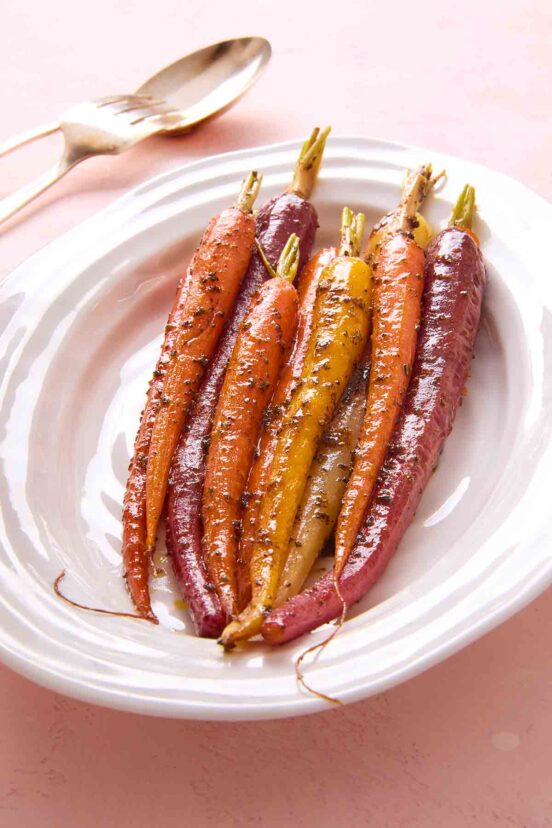
Cooked carrots are actually more nutritious than raw ones—heat helps release beta-carotene, the antioxidant compound that gives them their brilliant …
by Scott Uehlein and Canyon Ranch
from Canyon Ranch Nourish: Indulgently Healthy Cuisine
(Viking Studio, 2009)
Makes ten (1/4-cup) serving
A favorite of Canyon Ranch guests.
convert Ingredients
1 cup pumpkin seeds
1 1/2 teaspoons canola oil
1/2 teaspoon ground cinnamon
1/2 teaspoon ground …
by Nancy Baggett
from Kneadlessly Simple: Fabulous, Fuss-Free, No-Knead Breads
(John Wiley & Sons, Inc, 2009)
Makes 1 large loaf, 12 to 14 slices
The Hispanic influence on American culture over the past decades has been pervasive and shows …
by Scott Uehlein and Canyon Ranch
from Canyon Ranch Nourish: Indulgently Healthy Cuisine
(Viking Studio, 2009)
Makes eight 1/4-cup servings
Look for hearts of palm in exceptionally well-stocked produce sections, or order online.
convert Ingredients
1 pound fresh hearts of palm
2 …