
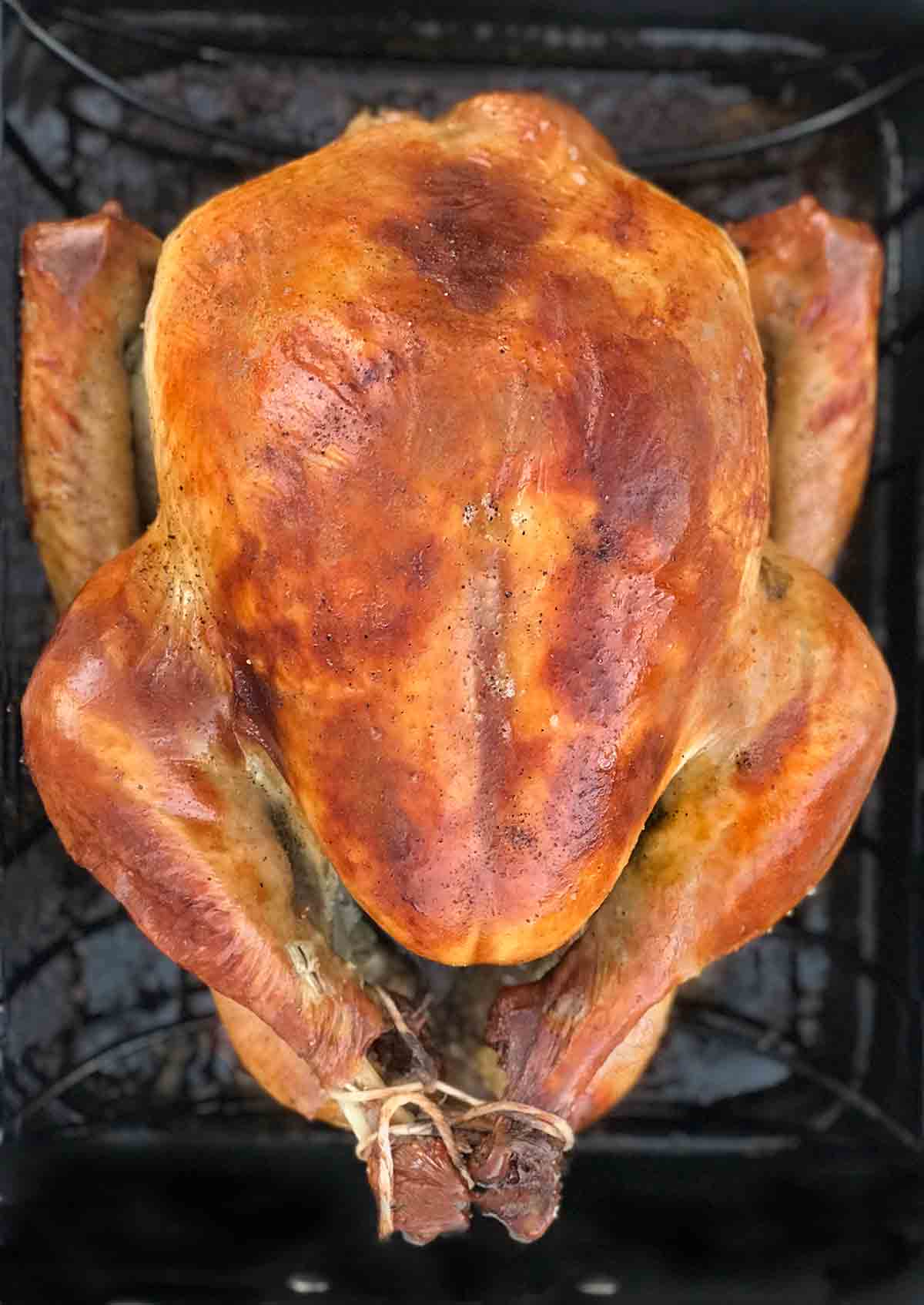
It’s a safe bet that every cook will be called upon to roast a turkey at some point in his or her life. Since it’s usually a once-a-year endeavor, there’s not much room for practice. Rely instead on proven methods and careful planning.–Martha Stewart with Sarah Carey

Why Our Testers Loved This
Tester Sita K. loved that this perfect roast turkey is “moist and tender” and has a “crispy, golden brown” skin. She calls the recipe “foolproof,” even for beginners.
What You’ll Need to Make This
- Kosher salt–Depending on the brand of kosher salt you’re using, you may need to adjust the amount of salt added to your brine. Crystal sizes in kosher salt can vary dramatically.
- If you’re using Diamond Crystal kosher salt, use 1 3/4 cups
- If you’re using Morton kosher salt, use 1 cup.
- If you’re uncertain of the brand, weigh your salt. You should have 7.5 ounces or 215 g.
- Whole turkey–A fresh turkey is ideal here, but you can use frozen. Keep it between 18 and 20 pounds, which is ideal for the amount of stuffing in the recipe.
- White wine–Use a dry wine, like sauvignon blanc or pinot grigio, but avoid sweet white wine.
- Chestnut stuffing–This stuffing has a wonderful flavor, but feel free to substitute your own favorite stuffing here or make a different dressing to bake on the side.
How to Make This Recipe
- Make the brine. Combine 2 quarts of water with the remaining brine ingredients and bring to a boil, stirring until sugar and salt are dissolved. Transfer to the brining pot, add the remaining 4 quarts of water and let it cool completely.
- Brine the turkey. Submerge the turkey into the brine, cover, and stash in the fridge overnight. While the turkey is brining, let your bread cubes dry out.
- Make the stuffing. Score and boil the chestnuts, then peel and quarter them. Sauté the celery and onion in butter, then add 1/2 cup stock and let it reduce. Transfer to a large bowl and stir in the remaining stock, bread, chestnuts, parsley, and seasoning.
- Preheat the oven to 425°F. Drain and dry the turkey and let it rest at room temperature. Combine the wine and melted butter, add the cheesecloth, and let it soak.
- Stuff the turkey. Season the turkey inside and out, then loosely fill it with the stuffing (or fill a baking dish with the stuffing, which makes it technically a dressing).
- Rub the turkey with butter. Drape the soaked cheesecloth over the turkey.
- Roast the turkey for 30 minutes. Reduce oven temperature to 350°F and continue roasting, basting occasionally, until cooked through. Transfer to a serving platter.
- Make the stock. While the turkey is cooking, sauté the vegetables in butter, then add the giblets, neck, and spices and cover with plenty of water. Simmer until reduced and then strain, reserving the giblet, neck meat, and stock.
- Make the gravy. Reserve 3 tablespoons of drippings. Deglaze the roasting pan with wine. Cook the flour in 3 tablespoons of pan drippings, then slowly whisk in the warm stock and the remaining drippings. Add the giblets and neck meat, and season to taste.
- Serve. Carve the turkey and serve with chestnut stuffing and gravy.
Common Questions
Yes, and we’d strongly encourage you to do so. Prepare as much as possible in advance, such as making the stuffing the day before and refrigerating it overnight while the turkey’s brining.
☞ Keep in mind that you can prepare the stuffing in advance, but never stuff a turkey until just before roasting.
Make sure to dry the bread for the stuffing earlier in the week, then transfer it to a resealable plastic bag until it’s needed. This means things will be way easier when the time comes to focus on the task at hand: roasting the perfect turkey.
A delicious gravy begins with flavorful stock. You can do this while the turkey is roasting.
Although roasting a turkey doesn’t require a lot of equipment, for this recipe you’ll need a pot large enough to hold the brining turkey, plus a spot in the refrigerator to place it (alternatively, you can use a cooler.) You’ll also need a heavy roasting pan, cheesecloth for “basting” the bird as it cooks, and an instant-read thermometer.
You’ll want to check the temperature of the thickest part of the thigh as well as the temperature in the center of the stuffing (if it’s inside the bird). Both need to be at least 165°F to be gobbled safely.
This perfect roasted turkey and chestnut stuffing is a classic Thanksgiving dish, so we love them served alongside all of our other Thanksgiving gems. Try our classic green bean casserole, bourbon sweet potato pie, make-ahead mashed potatoes, and caramelized honey pumpkin pie.
Helpful Tips
- Brining the meat ensures that the turkey will be succulent and juicy. The brining solution contains aromatics for more flavor, but you could forgo those and simply use a mixture of salt, sugar, and water.
- When purchasing your turkey, plan on at least 1 pound of turkey per person. If you’d like a decent amount of leftovers, nudge that amount up to 1 1/2 pounds per person.
- To separate the fat from pan drippings when making gravy, pour the turkey drippings into a gravy separator and let stand until the fat has risen to the top, about 10 minutes. Don’t have a fat separator? Simply pour the drippings into a glass measuring cup and discard the fat that rises to the top.
- If your turkey is browning too quickly while roasting, cover it loosely with aluminum foil.
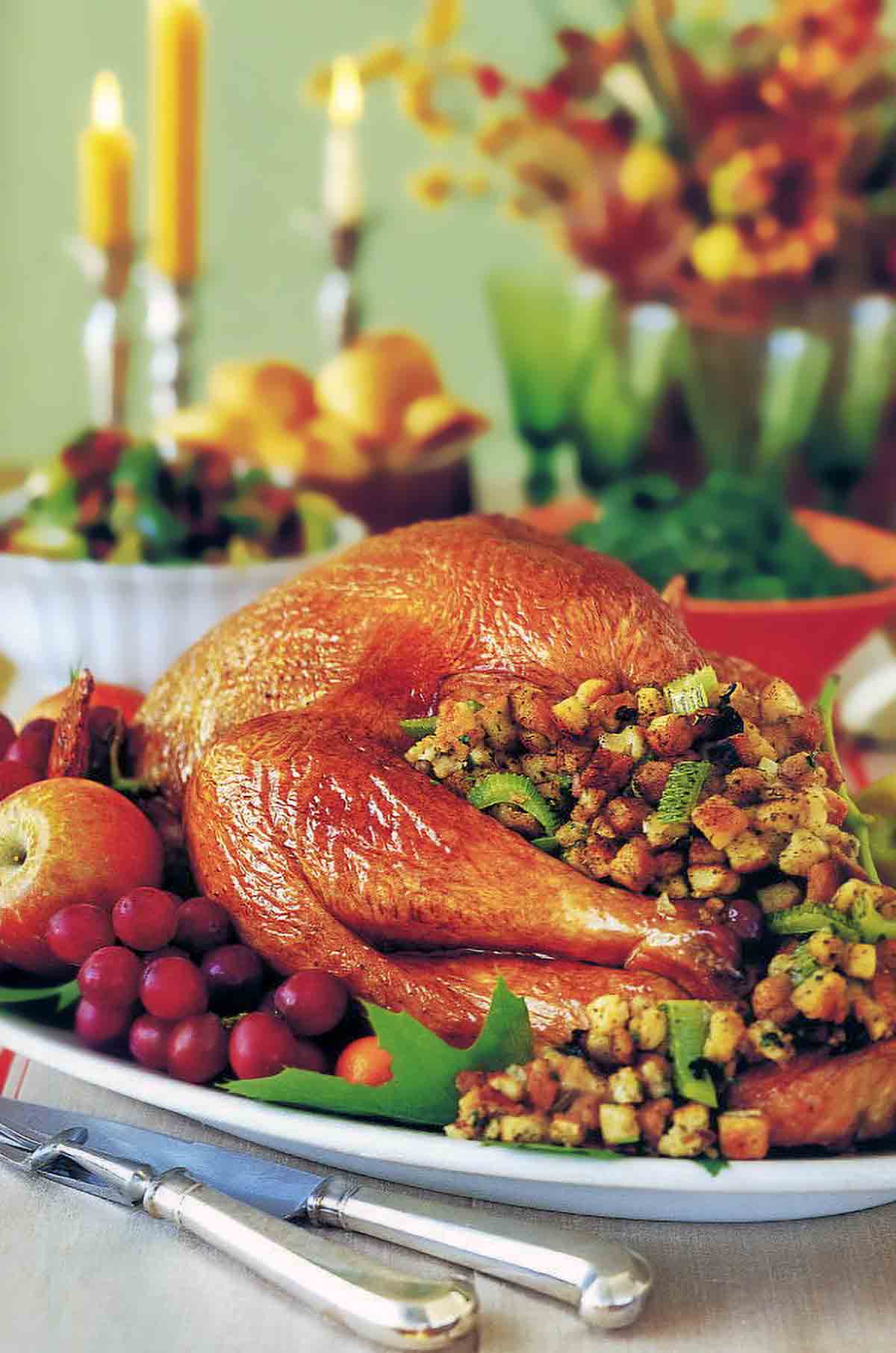
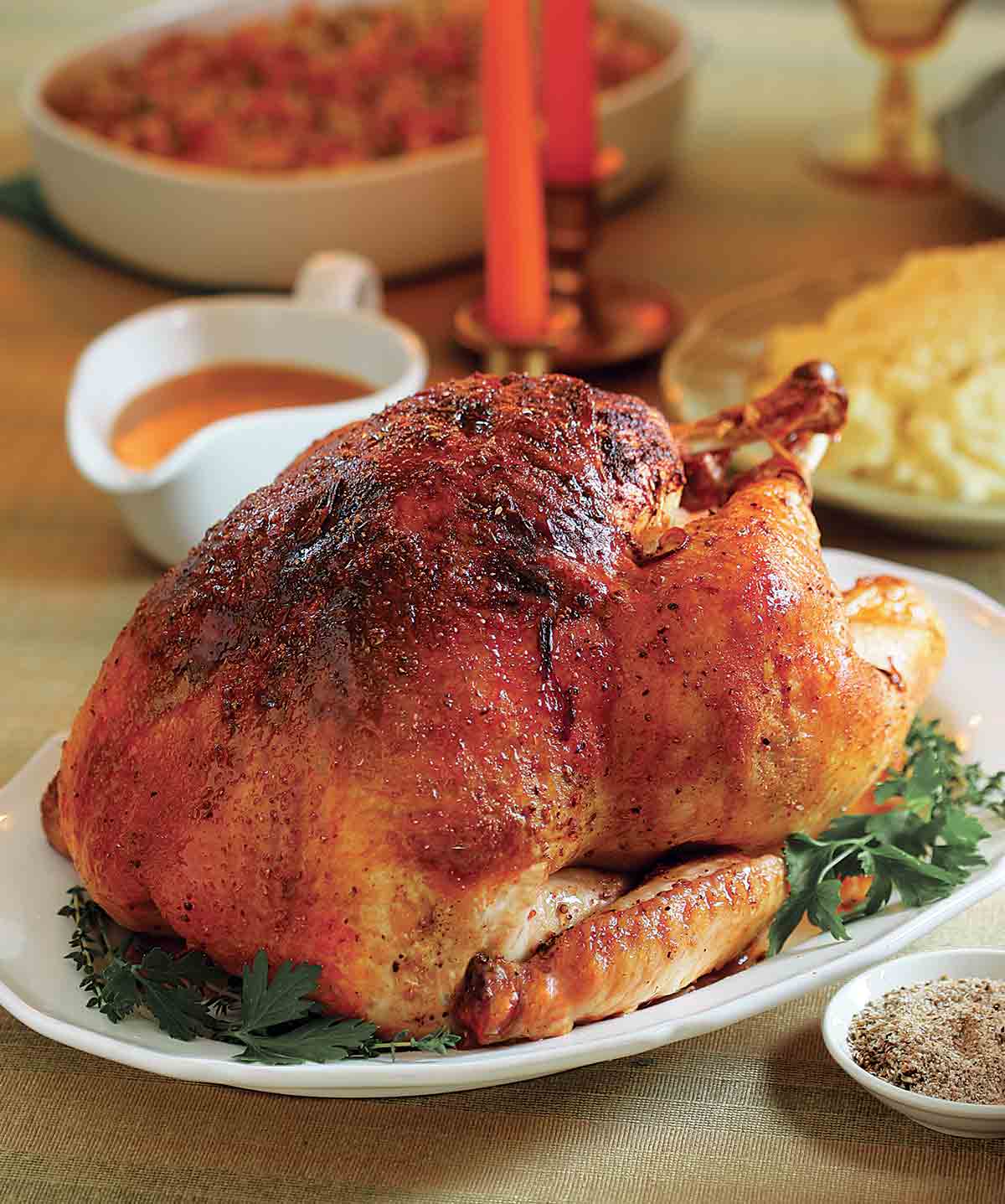
More Great Roast Turkey Recipes
Write a Review
If you make this recipe, or any dish on LC, consider leaving a review, a star rating, and your best photo in the comments below. I love hearing from you.–David
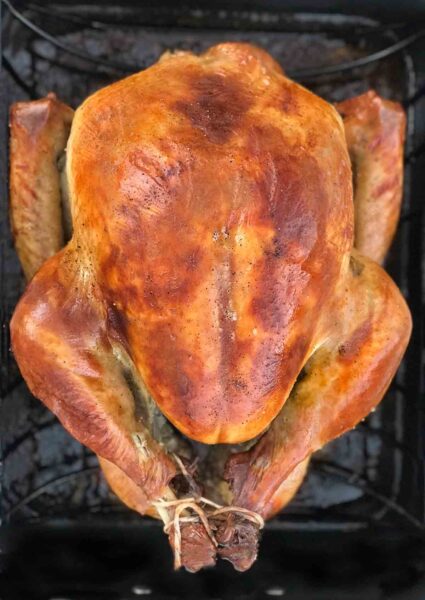
Perfect Roast Turkey
Equipment
- Patience
Ingredients
For the brine
- 6 quarts cold water
- 1 3/4 cups coarse or kosher salt, plus more for seasoning
- 1 cup granulated sugar
- 3 medium onions, peeled and coarsely chopped
- 3 leeks, white and pale green parts only, coarsely chopped and washed well
- 3 carrots, peeled and coarsely chopped
- 3 celery stalks, coarsely chopped
- 3 bay leaves
- 6 sprigs thyme
- 6 sprigs flat-leaf parsley
- 1 tablespoon whole black peppercorns
For the chestnut stuffing
- 2 loaves good-quality white bread, cut into 3/4-inch (18-mm) cubes (about 20 cups)
- 1 1/2 pounds (4 cups) fresh chestnuts
- 12 tablespoons (6 ounces) unsalted butter
- 4 small onions, peeled and cut into 1/4-inch dice (about 4 cubes)
- 1 bunch celery, cut into 1/4-inch dice (about 4 cups)
- 3 tablespoons finely chopped sage leaves
- 5 cups chicken stock
- 3 cups coarsely chopped flat-leaf parsley leaves
- 1 tablespoon coarse salt
- Freshly ground black pepper
For the turkey
- One (18- to 20-pound) fresh whole turkey, rinsed and patted dry, giblets and neck reserved for gravy
- 8 tablespoons (4 ounces) unsalted butter, melted, plus 4 tablespoons more, at room temperature
- 1 1/2 cups dry white wine, such as Sauvignon Blanc
- Coarse salt and freshly ground black pepper
- Chestnut stuffing
For garnish
- Lady apples, (optional)
- Sage leaves, (optional)
- Whole chestnuts, (optional)
For the gravy
- Reserved giblets and neck from turkey
- 3 tablespoons unsalted butter
- 2 celery stalks, coarsely chopped
- 1 medium carrot, coarsely chopped
- 1 leek, white and pale-green parts only, coarsely chopped and well washed
- 1 medium onion, peeled and coarsely chopped
- 3 sprigs thyme
- 3 sprigs flat-leaf parsley
- 1 sprig rosemary
- 1 bay leaf
- 5 whole black peppercorns
- 1 quart water
- 3/4 cup dry white wine
- 3 tablespoons all-purpose flour
- Coarse salt and freshly ground black pepper
Instructions
Make the brine
- Combine 2 quarts of the water with remaining brine ingredients in a medium saucepan and bring to a boil, stirring until the salt and sugar have dissolved completely. Transfer the mixture to a large pot (at least 5-gallon capacity) and add the remaining 4 quarts of water. Let cool completely. It’s essential that you let the brine cool completely before adding the turkey for food safety reasons.
- Lower the turkey, breast first, into the brine. Cover and refrigerate for 24 hours.
- Remove the bird from the brine and pat it dry with paper towels. Let it stand at room temperature for 2 hours. Meanwhile, discard the brine.
- Preheat the oven to 425°F (220°C) with the rack in the lowest position. Prepare the cheesecloth by stirring together the melted butter and wine in a medium bowl. Fold a very large piece of cheesecloth into quarters so that it's large enough to cover breast and halfway down sides of turkey. Immerse the cloth in butter mixture and let it soak.
☞ TESTER TIP: For some added Northeastern flair, sprinkle some Bell's seasoning into your basting mixture.
Make the chestnut stuffing
- Spread the bread cubes in a single layer on several baking sheets. Let the cubes dry uncovered overnight at room temperature. (You could also dry them in a 300° [150°C] oven for 20 to 30 minutes, if necessary.)
- Bring a large saucepan of water to a boil. Score the chestnuts on the bottom with an “X”, then boil them until soft, about 20 minutes. Drain and let cool slightly, then peel and quarter them.
- Melt the butter in a large skillet over medium heat. Add the onions and celery and cook, stirring frequently, until translucent, about 10 minutes. Add the sage and cook for 3 minutes. Stir in 1/2 cup of the stock and cook until reduced by half, about 5 minutes.
- Transfer the onion mixture to a large bowl. Add the remaining 4 1/2 cups of stock, the reserved chestnuts and bread cubes, and the parsley. Season with salt and pepper to taste and toss to combine.
Stuff and roast the turkey
- Place the turkey, breast side up, on a rack set in a large roasting pan. Fold the wing tips underneath the body, as if the turkey was placing its arms behind its head, and season the cavity with 1 teaspoon each of salt and pepper. If you're stuffing the turkey, loosely fill the cavity with the stuffing. Tie the legs together with kitchen twine. Fill the neck cavity loosely with stuffing, and fold the neck flap under, securing it with toothpicks. If you're not stuffing the turkey, transfer the stuffing, or rather, dressing, to a buttered 17-by-12-inch baking dish. Cover it with parchment-lined foil and bake at 350°F (175°C) for 25 minutes, then remove the foil and continue baking until heated through and the top is golden brown, 30 minutes more.
- Pat the turkey dry and rub it all over with softened butter and generously season it with salt and pepper. Remove the cheesecloth from the butter mixture, squeezing it gently over the bowl to remove any excess. Reserve the butter mixture for brushing and place the cheesecloth over the turkey breast. (The legs may be exposed; this is okay.)
- Place the turkey, legs first, in the oven and roast for 30 minutes, then brush the cheesecloth and exposed turkey parts with the butter mixture and reduce the temperature to 350°F (175°C).
- Continue roasting, brushing every 30 minutes, for 1 1/2 hours more. If the bird appears to be browning too quickly, you may need to tent it with foil. Discard the cheesecloth and rotate the pan. Baste the turkey with the pan juices and continue to roast, rotating the pan halfway through, until the skin is golden brown and an instant-read thermometer inserted into the thickest part of the thigh (avoiding bone) registers 165°F (74°C). This will take 1 to 2 hours more, depending on the size and temperature of your bird. It's best to start taking the turkey's temperature after 2 1/2 hours total cooking time.
- To serve, transfer the turkey to a platter and garnish it with the apples, sage, and chestnuts, if desired. Let the turkey stand at room temperature for at least 30 minutes before carving. Set the pan with the drippings aside for making gravy, if desired.
Make the gravy
- Trim the fat and membranes from the giblets. Rinse the giblets and pat them dry.
- Melt the butter in a medium saucepan over medium-high heat. Cook the celery, carrot, leek, and onion, stirring fairly often, until the vegetables begin to brown, 7 to 10 minutes.
- Reduce the heat to medium. Add the giblets, neck, herbs, peppercorns, and the water. Cover and bring to boil, then reduce the heat to medium-low. Cook, uncovered, until reduced to about 3 cups, 50 to 60 minutes.
- Pour the mixture through a fine sieve into a clean medium saucepan and keep it warm over medium-low heat. Roughly chop the giblets and shred the meat from the neck with a fork. Discard any other solids.
- To deglaze the roasting pan, place the reserved roasting pan over two burners. Add the wine and bring it to a boil, stirring with a wooden spoon to loosen any browned bits on bottom of pan. Remove from the heat.
- Heat the reserved 3 tablespoons of pan drippings in a medium saucepan over medium heat. Add the flour, whisking briskly but constantly to combine, then continue to cook, still whisking constantly, until the mixture is fragrant and a deep golden brown, about 9 minutes.
- Whisking vigorously, slowly add the hot stock to the roux and bring to a boil. Still whisking, reduce the heat to a gentle simmer. Stir in the reserved deglazing liquid in the roasting pan, the defatted pan drippings, and the giblets and neck meat. Season with salt to taste.
Notes
- Get-ahead–Dry the bread cubes a couple of days in advance and prepare the uncooked stuffing up to 1 day ahead. Do not stuff the turkey until immediately before cooking.
- Storage–Leftovers can be stored in covered containers in the fridge for up to 4 days.
- Drippings–To separate the fat from pan drippings for making gravy, pour turkey drippings into a gravy separator and let stand until fat has risen to the top, about 10 minutes, or pour into a glass measuring cup and discard the fat that rises to the top.
Nutrition
Nutrition information is automatically calculated, so should only be used as an approximation.
Recipe Testers’ Reviews

I used a 12-pound bird and stuffed it with my own bread stuffing. I followed the directions for using the cheesecloth and it produced a very moist and tender turkey. The skin was a beautiful, crisp golden brown. This is a foolproof recipe for a beginner or an experienced cook alike.











I came here to get this recipe again, which I made last year, and I see I forgot to leave a review. It was AMAZING. The turkey was moist and flavorful, and we’ve never had such a perfectly browned bird. i didn’t make the stuffing–I make my own–but I’m all set to brine tomorrow. Thank you! And Happy Thanksgiving!
Tuck, so happy you enjoy the recipe. I, too, love it. And someday try the dressing–it’s pretty damn amazing!