

Jump To
- Why this pork tamales recipe works
- Notes on ingredients
- How to make red pork tamales: For visual learners
- Your red chile pork tamale questions, answered
- Pro tips & troubleshooting
- Storage & reheating
- More succulent Mexican pork recipes
- Write a review
- Red Chile Pork Tamales Recipe
- Recipe Testers’ Reviews
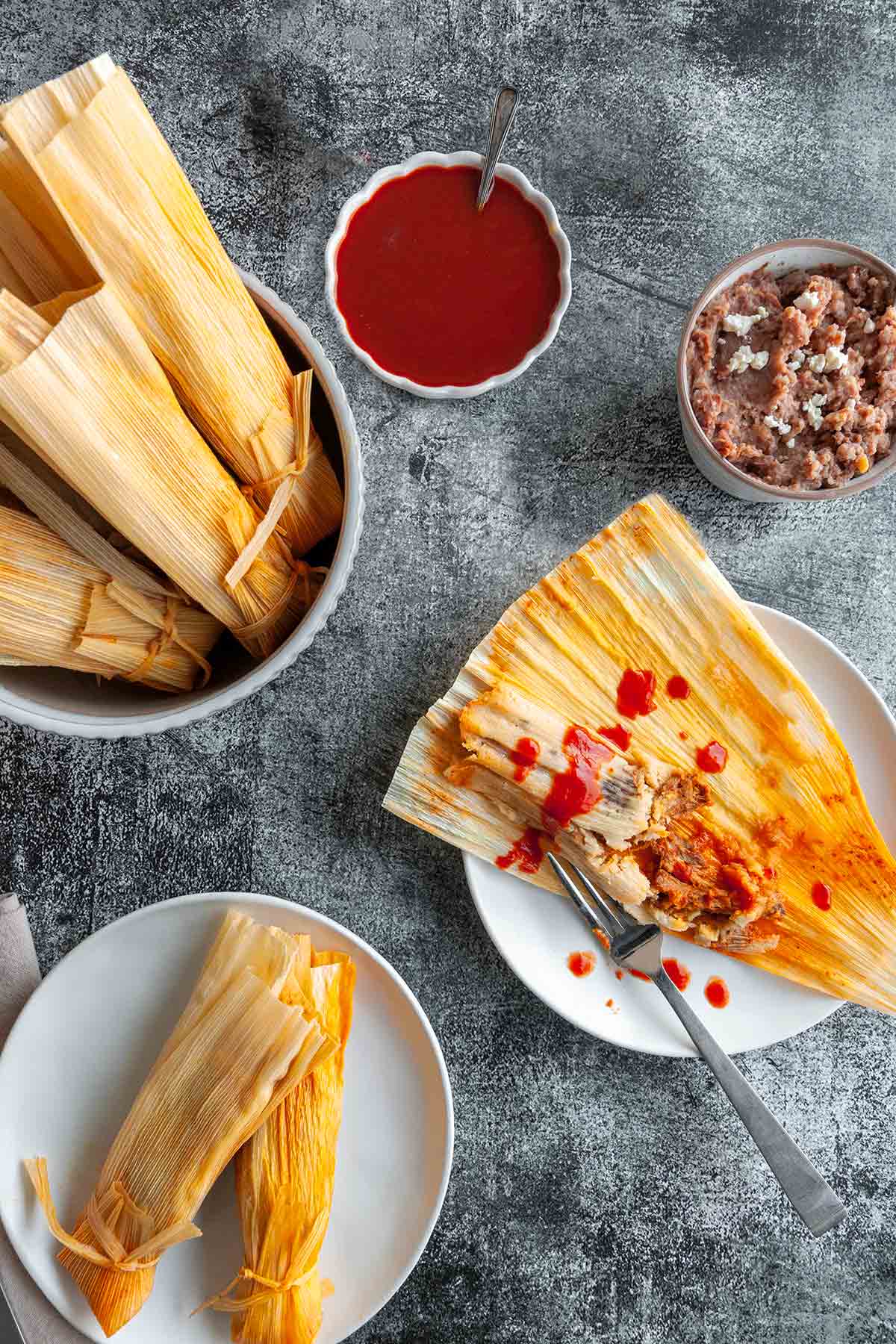
These red tamales are authentic Mexican through and through—sweet corn masa dough envelops a richly spiced, knee-wobblingly tender pork filling. Consider yourself warned, though. You’re going to end up with a holy abundance of red chile pork filling, which is actually a godsend, seeing as you can put it to great use tucked into pork tacos, plopped on rice, or simply inhaled by the forkful.
Featured Review
This is THE BEST tamale recipe. I’ve been using it for a couple of years now and always get compliments that they’re “the best tamales they’ve ever had!” Thank you so much for sharing this recipe!
SHELLY

Why this pork tamales recipe works
This recipe steps back from the usual method of boiling the pork, which often dilutes the flavor. Instead, we season the shoulder with salt and chipotle before roasting it low and slow. This concentrates the meatiness and ensures it shreds beautifully. The sauce gets the same VIP treatment; by toasting the dried guajillos in a skillet before blending, we wake up their essential oils for a filling that’s rich, complex, and never bitter.
The masa isn’t just a vehicle for the pork—it’s got to stand on its own. We swap out some of the water for chicken or vegetable stock to infuse the dough with massive flavor.
But the real secret to that signature fluffy texture is beating the lard (or shortening) until it’s fully aerated. This step is non-negotiable; you want tamales that steam up tender and light rather than dense and heavy.
Notes on ingredients
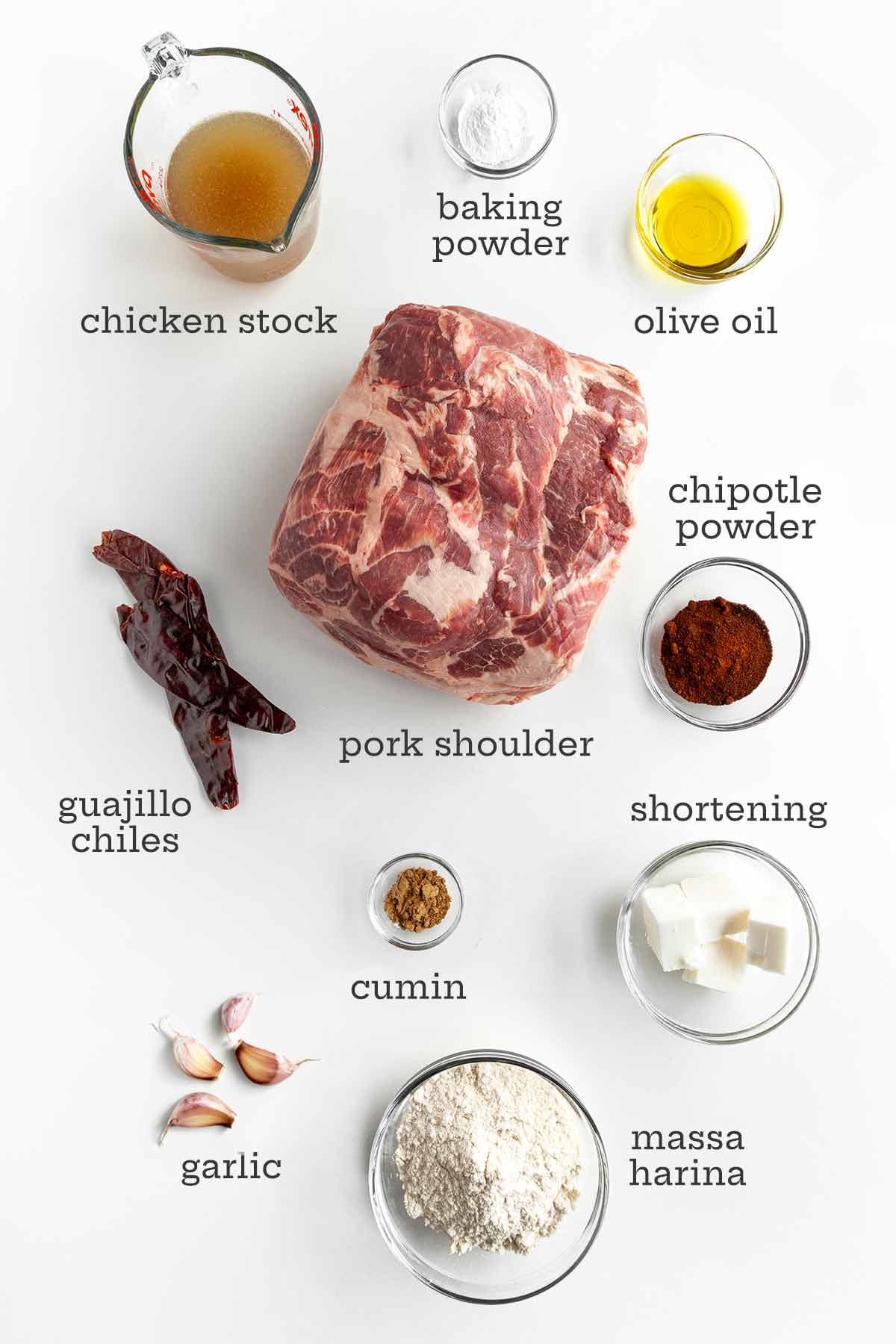
- Pork shoulder—You may see this labeled as Boston Butt at your store. Choose one that is well-marbled, as that will give you the most tender pork.
- Guajillo chiles—These are the dried form of the mirasol pepper and are commonly used in Mexican cooking. They’re available at some supermarkets and specialty grocers. If you can’t find them, dried ancho chiles would be the best substitute.
- Masa—This is flour that comes from ground nixtamalized corn (treated with an alkali) and is available in most major supermarkets. It is commonly used for making corn tortillas for tacos or tortilla soup.
- Corn husks—You’ll need about 32 husks for this recipe. A 1-pound bag contains between 80 and 100 husks.
How to make red pork tamales: For visual learners
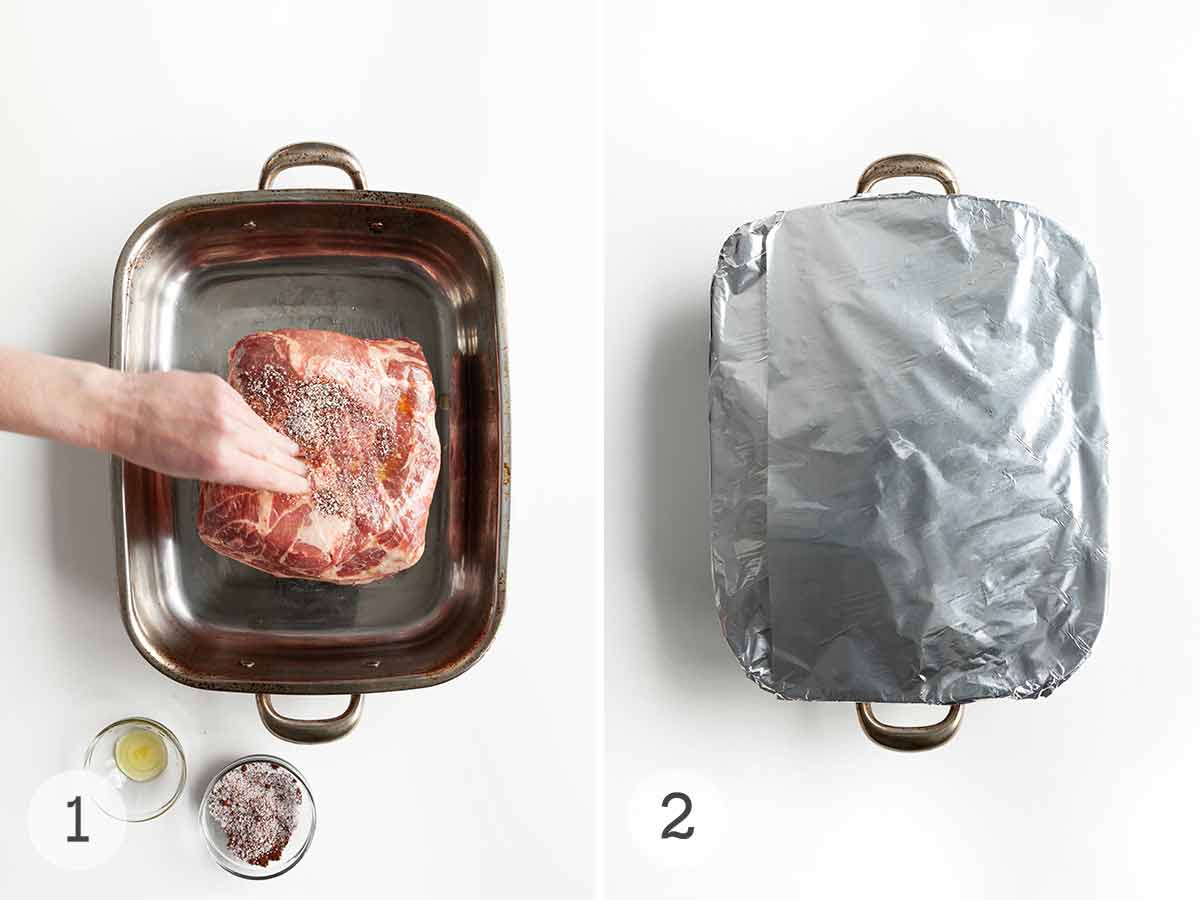
- Pat the pork dry and rub it all over with olive oil. Combine 4 tablespoons of salt with the chipotle pepper and rub all over the shoulder. Let rest at room temperature for 1 hour.
- Heat the oven to 275°F. Place the pork shoulder in a roasting pan, cover with two layers of foil, and roast until tender and falling apart. Let the pork cool for 30 minutes.
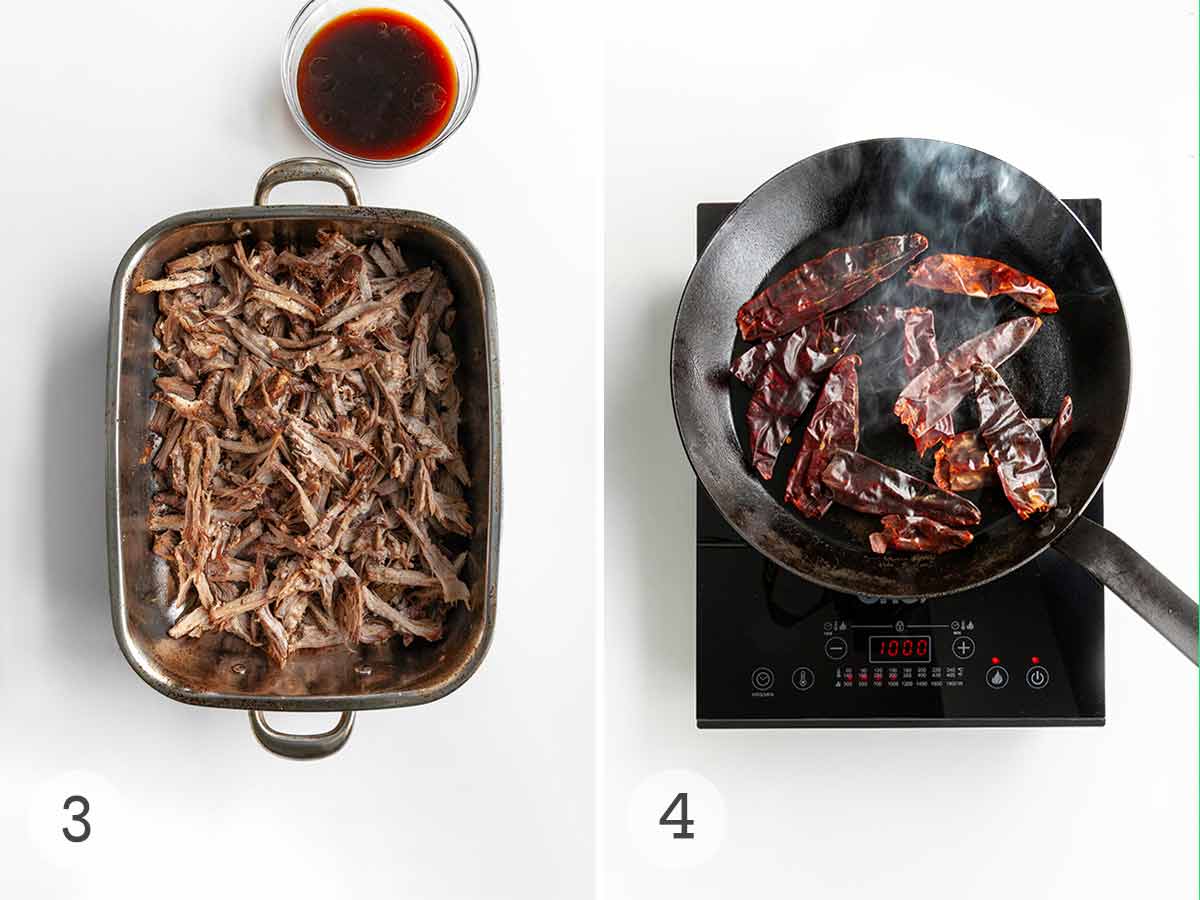
- Shred the pork. Discard any gristle, strain, and reserve the cooking liquid.
- Toast the chiles in a hot skillet for about 30 seconds per side. Place in a bowl, cover with hot water, and let them soak for 30 minutes.
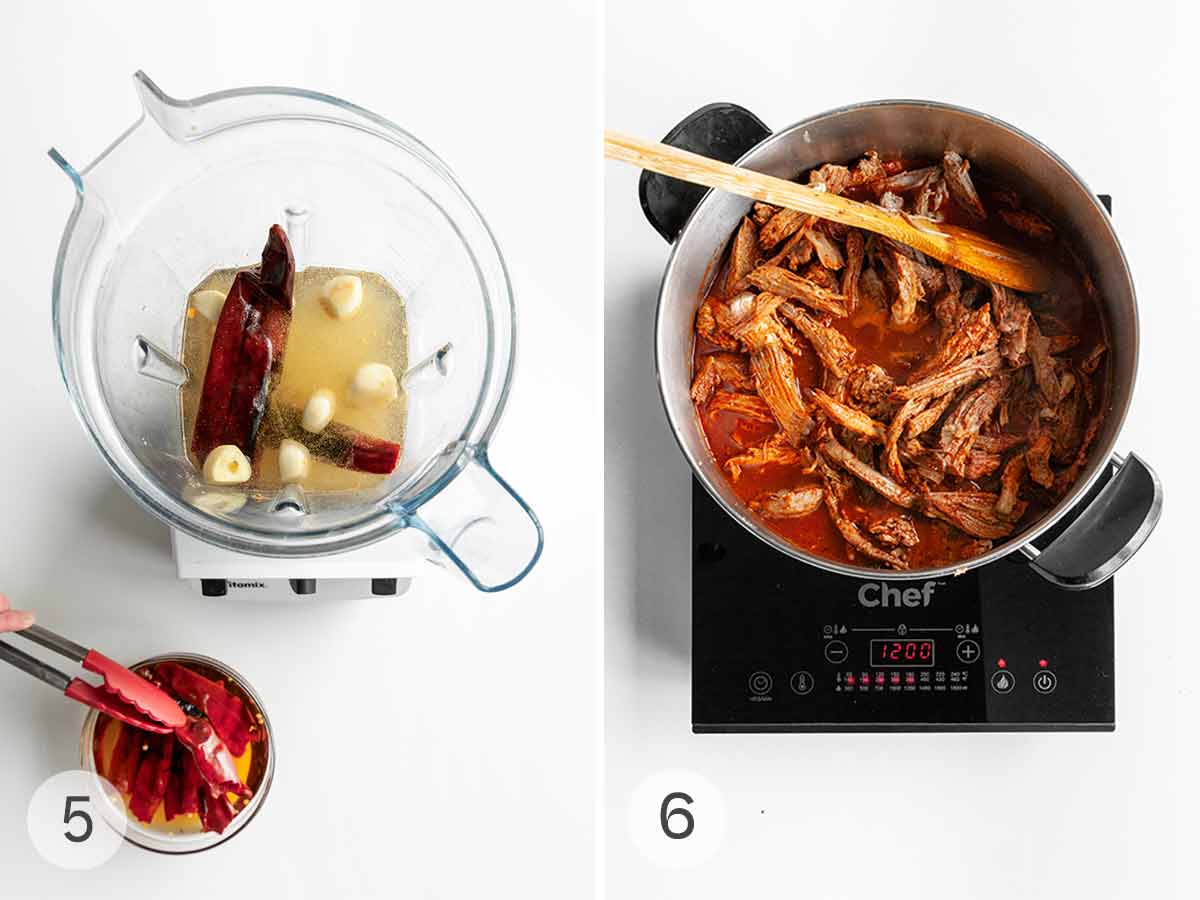
- Blend the soaked chiles, garlic, cumin, 1 teaspoon of salt, and cold water until smooth. Heat 1 tablespoon of oil in a large pot until very hot. Add the chile puree and cook until it darkens.
- Stir the pork and cooking liquid into the pot. Simmer for 15 minutes. Let cool slightly before assembling the tamales.
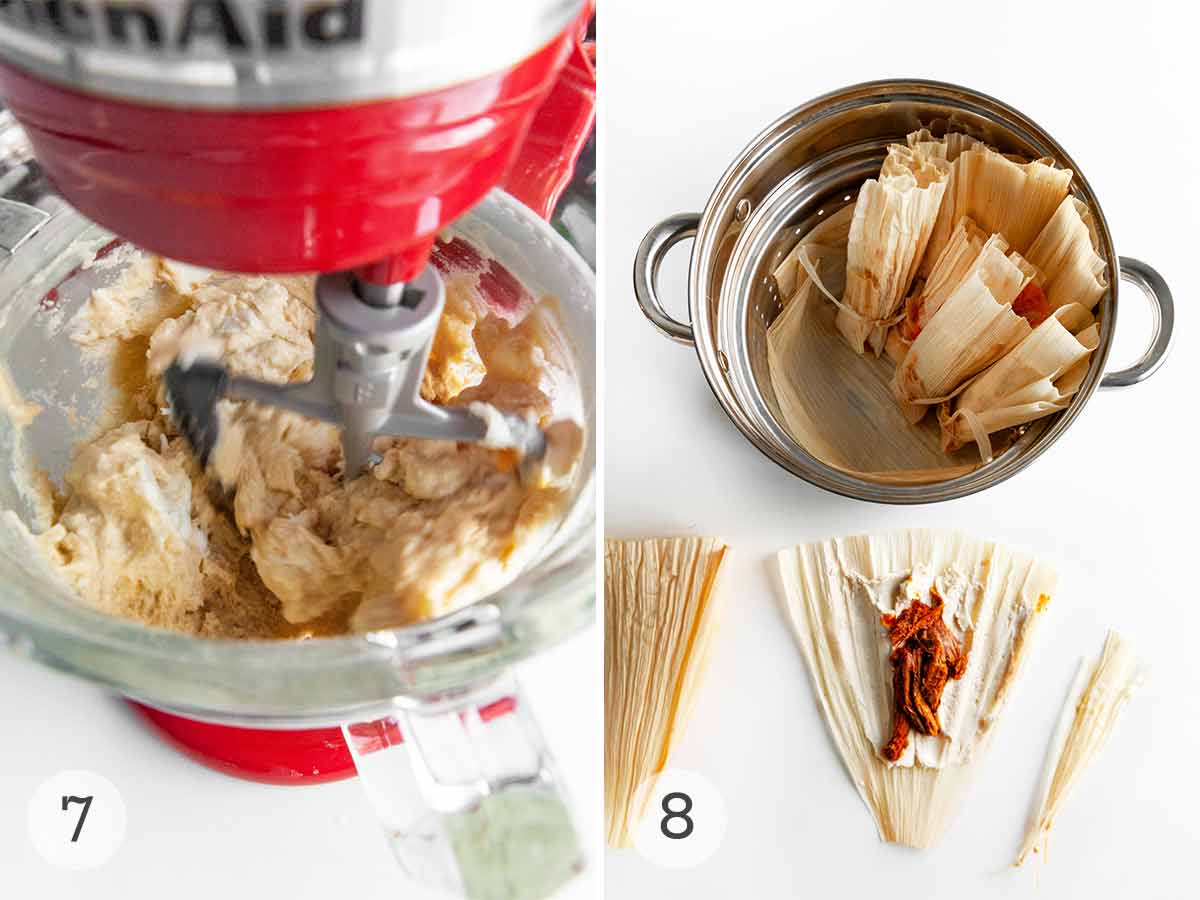
- Make the tamale dough. Whip the lard until it’s white and frosting-like, then beat in the baking powder and salt. Mix in the rehydrated masa and stock until the dough is impossibly light. While the mixer works, soak the husks and prep your ties.
- Fill the tamales. Working with one husk at a time, spread 1/4 cup of the masa dough over the smooth side (inside) of the husk, leaving a 1/2-inch border. Top with 2 tablespoons of the pork, then roll the tamale and secure the bottom with one of the ties, leaving the top open.
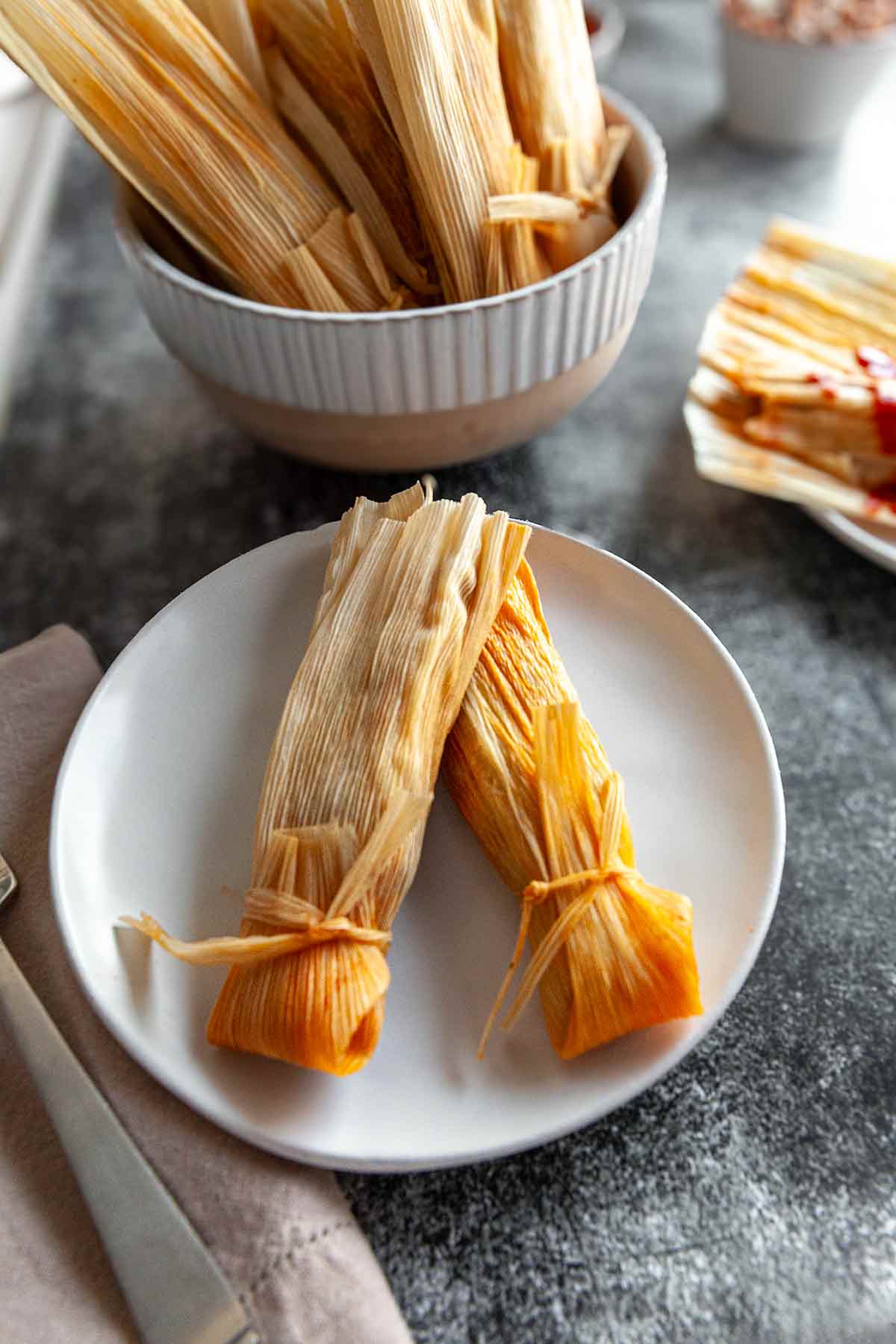
- Prepare a steamer in a large stockpot partially filled with water. Stand the tamales upright in the steamer and cook until the masa pulls away from the husks, adding water as needed. Let the tamales rest in the steamer until they begin to firm up before serving.
Your red chile pork tamale questions, answered
Tamales are a Mexican dish made with tender masa dough and filling steamed inside a corn husk until tender. They’re popular year-round, but particularly during the Christmas holidays, which makes them a great addition to holiday potluck menus. The masa dough can be filled with pork, beef, chicken, and even vegetables, as in these sweet potato tamales.
These Mexican pork tamales can be topped with mole, sour cream, salsa, a squeeze of lime juice, and cotija cheese. If you’re looking for side dishes, try serving them with refried beans, rice, or Mexican corn. Don’t forget biscochitos for dessert.
To eat the tamale, remove the corn husk from around the filling. You can either discard the husk or use it as a plate. Eat the masa filling with your fingers or a fork and knife.
Pro tips & troubleshooting
☞ Take your time
The cooking time for the pork can vary significantly, depending on the thickness and starting temperature of your pork butt. Be patient! The low and slow cooking method ensures tender, shreddable meat.
☞ The float test
Take a pea-sized dollop of your finished masa and drop it into a glass of cold water. If it floats, your tamales will be light and fluffy. If it sinks, keep whipping!
☞ Use the smooth side of the husks
When filling the pork tamales, make sure you spread the filling on the smooth side of the husk. This lets the filling release easily from the corn husk. (Store unused corn husks in a plastic bag in a cool dry place for up to 6 months.)
☞ Save the extra pork filling
Extra pulled pork filling can be used in tacos, sandwiches, enchiladas, or as a topping for a rice bowl. You can freeze it in a sealed container or resealable bag for up to 3 months.
Storage & reheating
Fridge: Cool the tamales completely before placing them in an airtight container or resealable plastic bag. They can be refrigerated for up to 3 days after cooking.
Freezer: The tamales can be frozen for up to 6 months. Let them thaw in the refrigerator before reheating.
Reheating: Line a steamer basket with a few corn husks, then place the tamales in the basket. Set it over a pan of simmering water and let the tamales steam gently until they’re heated through, about 30 minutes.
More succulent Mexican pork recipes
Write a review
If you make this pork tamale recipe, or any Mexican dish on LC, consider leaving a review, a star rating, and your best photo in the comments below. I love hearing from you.–David
Featured Review
I used a combination of this recipe and your braised pork in red chile sauce recipe for the filling—cutting the pork into pieces, simmering it in the sauce in the oven. It came out truly fantastic. I never leave recipe reviews, but wanted to share and say thanks. Seems like a lot of complicated and involved work, but it really didn’t take me too much time at all—mostly just coordinating the steps!

Red Chile Pork Tamales
Equipment
- Tamale steamer or steamer tray for your stockpot
Ingredients
For the red chile pork tamales filling
- 5 pounds pork shoulder
- mild olive oil or vegetable oil, to coat the pork
- 4 tablespoons Diamond kosher salt
- 2 tablespoons chipotle powder
- 14 dried guajillo chiles, seeded and stemmed
- 6 garlic cloves
- 1 teaspoon ground cumin
- 1 teaspoon Diamond kosher salt
- 3 cups cold water
- 1 tablespoon mild olive oil or vegetable oil
For the tamale dough
- 3 1/2 cups masa harina
- 2 1/4 cups warm water
- 10 ounces lard or vegetable shortening
- 1 1/2 teaspoons baking powder
- 2 teaspoons Diamond kosher salt
- 1 1/2 cups chicken stock or vegetable stock
For assembling the tamales
- 32 dried corn husks
Instructions
Make the red chile pork tamales filling
- Pat the 5 pounds pork shoulder completely dry with paper towels. Rub the pork shoulder all over with just enough mild olive oil or vegetable oil to coat it.
- In a small bowl, combine the 4 tablespoons Diamond kosher salt with the 2 tablespoons chipotle powder. Rub the mixture on the pork, completely covering all surfaces. Let the pork rest at room temperature for 1 hour.
- Crank the oven to 275°F (135°C).
- Place the pork in a roasting pan, fatty side down. Cover the pan with a double layer of aluminum foil and roast for 3 1/2 to 4 hours, until the pork falls apart when pressed with the back of a fork and reaches an internal temperature of 195°F (91°C). Remove the pork from the oven and let it rest, without uncovering, for 30 minutes.
- After the pork has cooled for 30 minutes, use 2 forks to pull the pork into long strands. Resist the temptation to chop the pork into chunks! Discard any gristle or chunks of fat. Strain the cooking liquid. You should have anywhere from 2 to 4 cups (473 to 946 ml) of liquid.
- Meanwhile, heat a cast iron skillet or heavy-bottomed skillet over medium-high heat. Once the skillet is hot, toss in the 14 dried guajillo chiles and cook for approximately 30 seconds per side, until they’re slightly toasty. Be careful not to over toast the chiles or let them blacken or the resulting sauce will be bitter.
- Remove the toasted chiles from the pan and place them in a bowl. Add enough hot water to submerge the chiles. Let the chiles soak for 30 minutes.
- After 30 minutes, use a slotted spoon to transfer the soaked chiles to a blender and discard the soaking liquid. Add the 6 garlic cloves, 1 teaspoon ground cumin, 1 teaspoon Diamond kosher salt, and 3 cups cold water to the blender. Puree until the mixture forms a smooth sauce.
- Heat the 1 tablespoon mild olive oil or vegetable oil in a heavy, large stockpot over medium-high heat. When the oil is very hot and begins to shimmer, pour the red chile sauce into the pot and immediately stir. Be careful as the sauce will splatter. Cook the sauce, stirring constantly, for 2 to 3 minutes, until the sauce thickens and begins to darken.
- Add the reserved pork drippings and the pulled pork. Bring the mixture to a simmer and gently cook, uncovered, for 15 minutes.
- Let the red chile pork filling cool slightly before preparing the tamales. (You can cover and refrigerate the pork overnight.)
☞ TESTER TIP: You’ll have a lot of red chile pulled pork, so you’ll need to either make a double batch of tamale dough or be prepared to serve the leftover pork in soft tortillas, over rice, or in any of countless other incarnations.
Make the tamale dough
- In a stand mixer fitted with the whisk attachment, beat the 10 ounces lard or vegetable shortening on medium-high speed until it’s white, fluffy, and resembles frosting, about 3 to 5 minutes.
- Add the 1 1/2 teaspoons baking powder and 2 teaspoons Diamond kosher salt to the whipped lard and beat 1 minute more.
- While the lard is whipping, blend the 3 1/2 cups masa harina with the 2 1/4 cups warm water. Stir the mixture thoroughly to create a solid ball of rehydrated masa.
- Switch to the mixer's paddle attachment. With the mixer on medium-low, gradually add the rehydrated masa in golf-ball size chunks.
- Pour the 1 1/2 cups chicken stock or vegetable stock, bump the speed to medium, and beat for another 5 minutes until the dough is light and smooth. Set aside the dough until ready to assemble the tamales.
Assemble the tamales
- Separate the 32 dried corn husks and place them in a large bowl or your kitchen sink and add enough warm water to completely submerge them. Let the husks soak until they become relatively soft and pliable, at least 30 minutes.
- Remove the husks from the water, separate completely, and pat them dry with a clean towel.
- Prepare the ties for your tamales by tearing several of the husks into strips 1/2 inch (1.3 cm) wide until you have 24 strips. Gently tie a knot at a narrow end of each strip and tear the opposite end to double the strip length to about 12 inches (30.5 cm) long. Repeat with the remaining strips.
- Place a large corn husk on a clean flat surface with the shortest side facing you and the smooth side facing up. Spoon approximately 1/4 cup (60 grams) masa dough on the upper center of the husk and, using a butter knife or the back of the spoon, spread it into a square shape across the width of the husk to approximately 1/4 inch (6 mm) thick. Be sure to leave approximately 1/2 inch (13 mm) on the top and sides of the husks plain to allow for easier rolling.
- Spoon approximately 2 tablespoons (30 grams) pork mixture in an even line along the center of the masa and gently fold the husk over widthwise to completely encase the filling and form a tight tube. Fold the bottom of the husk up toward the center of the tamale and tie with the prepared strip of corn husks. Be sure to leave the top of the husks open. Repeat with the remaining corn husks and masa dough.
- Fill a large stockpot 1/4 full with warm water and bring to a boil over medium-high heat. Line a steamer basket with several unfilled corn husks. Place the prepared tamales upright with the open tops facing towards the top of the steamer basket and top with additional corn husks. It's perfectly fine (and actually necessary) to stack the tamales one atop another.
- Cover the steamer basket with a tight-fitting lid and place on top of the stockpot with the boiling water and steam until the batter pulls away easily from the husks, checking occasionally to see if the pot needs to be replenished with water, about 1 hour total.
☞ TESTER TIP: When heating the water to cook the tamales, drop a clean coin in the pot. As the water boils, the coin will rattle, letting you know that the water has not boiled dry. If the coin stops rattling, you know that it’s time to add more water. Or just set your iPhone timer for every 10 or 15 minutes and check the water level.
- Turn off the heat and let the tamales rest in the basket for at least 30 minutes, until they begin to firm. And then dig in! (It's astounding how quickly tamales disappear in contrast to how long it takes to make them!)
Notes
- Leftover pork—Extra pulled pork filling can be used in tacos, sandwiches, enchiladas, or as a topping for a rice bowl. You can freeze the pork in a resealable bag for up to 3 months.
- Filling tips—When filling your tamales, make sure you spread the filling on the smooth side of the husk. This will allow the filling to release easily from the corn husk.
- Storage—Store leftover tamales in a sealed container or resealable bag in the refrigerator for up to 3 days or in the freezer for up to 6 months. Gently reheat in a steamer.

Nutrition
Nutrition information is automatically calculated, so should only be used as an approximation.
Recipe Testers’ Reviews
Did you know only 68% of the recipes we test make it onto the site? This recipe survived our rigorous blind testing process by multiple home cooks. It earned the Leite’s Culinaria stamp of approval—and the testers’ reviews below prove it.

OH MY GOODNESS!! These red chile pork tamales were delicious! Despite my feeble attempt at wrapping, folding, and tying, these red chile pork tamales looked terrific!! And they tasted absolutely fantastic.
The taste of the corn perfectly balanced the seasoned red chile pork. The mixture of chile powder and salt was the ideal amount. Once the pork was covered with chile salt and had come to room temperature, I popped everything in the oven and roasted it for about 4 1/2 hours. I removed it from the oven and let it rest until cool enough to handle, a little over an hour.
Shredding the pork
Shredding the pork took me about 30 minutes. (It was a large piece of meat and still quite warm.) While the pork was cooling, I seeded the peppers and toasted them in a skillet. Although 14 seemed like a considerable amount, I followed the recipe exactly.
After covering the peppers with hot water and letting them sit for 30 minutes, I threw them in my food processor with garlic, cumin, and salt. The addition of the water helped loosen the mixture and turned it sauce-y. I poured the sauce into the pot and stirred constantly. It didn’t change color or thicken up much.
While the meat was cooling, I weighted the husks in water in the sink for about an hour to soften. I also made the dough at this time. I used shortening instead of lard. The dough came together very nicely, although it was a large amount.
An assembly line is the best for making the tamales
I cleared my counter and lined up the meat, husks, and dough in a row with my steamer pot to the right. Here comes the “fun” part. Since I’ve never made tamales, I followed the directions on spreading and filling the husks. My husks were nicely softened, but when I went to spread the dough, the husks tore.
Adding the meat was pretty easy, but the wrapping part was a fiasco! I did my best to take my time and carefully fill and wrap. I tried wrapping them up with the strips of husk, but after a few, I just stopped trying to tie them. Some of my tamales were fuller than others, and they were in no way uniform, but I kept on filling them.
Cooking the tamales
After stuffing three dozen, my pot was full, and I had plenty of dough and meat left over. I steamed the tamales for 55 minutes until the dough pulled away easily from the husks. I removed the steamer basket from the heat and let the tamales rest while I finished cleaning up.
This is a very time-consuming and fairly labor-intensive dish. I had more dirty pots, pans, and bowls than I could ever remember having for one dish!
Next time, I probably will have to consider cutting the recipe in half and inviting friends and family over to help cook and devour the tamales!










Getting ready to make this for the 1st time. I have the chipotle chilis from a trip to Mexico. Swore I had guagillos as well but sadly I do not. Things like this are not easy to find in Ontario. If I can’t find them, what would make a good substitute? I have arbol and poblanos.
I would use arbol chiles, Tina. They are hotter than a guajillo chile though, so you may want to reduce the number you use to about 10.
Thanks Angie. I’m on my way to a Central/South American specialty shop. Hopefully I can find the correct chilis, a good masa harina, and the corn husks. Fingers crossed!
Good luck, Tina! Please do let us know how they turn out.
This is the best tamale recipe. I get compliments and praise from everyone I give them to whenever I make them. The recipe is perfect 👌
Thanks, Shelly!
I used a combination of this recipe and your Braised Pork in Red Chile Sauce recipe for the filling – cutting the pork into pieces, simmering it in the sauce in the oven. It came out truly fantastic. I never leave recipe reviews but wanted to share and say thanks. Seems like a lot complicated and involved work but it really didn’t take me too much time at all – mostly just coordinating the steps!
Wonderful, Libby! Thank you so much for taking the time to comment. We truly appreciate it, and we’re so pleased that this turned out perfectly for you.